In sheet metal processing, two machines often get confused with each other: coil straighteners and levelers. While both are used to improve sheet flatness, one of these is more capable. Understanding the differences between these two machines is crucial for successful material processing.
Let’s first go over some common terms for issues involving coiled metal.
Issues with coiled metal
Steel and other sheet metals stored in coils experience uneven stress. A coil set is when the metal is uncoiled but the curvature of the coil remains.
Crossbow is a curvature across the width of the strip where the sheet forms a smile or frown due to stress differences through the face or the top and bottom surfaces of the strip.
Edge wave and center buckle are length differences in the strip. When edges are longer than the center of the strip, we call it an edge wave, and a center buckle is when the center is longer than the edges.
Machine differences
While similar, levelers and straighteners address different issues. A straightener is primarily used to remove the coil set or crossbow. The metal strip is fed through rolls that bend it up and down uniformly across the face to reduce or eliminate the internal stress created when the metal was coiled.
Straighteners focus on surface-to-surface stress and cannot fix edge waves or center buckles.
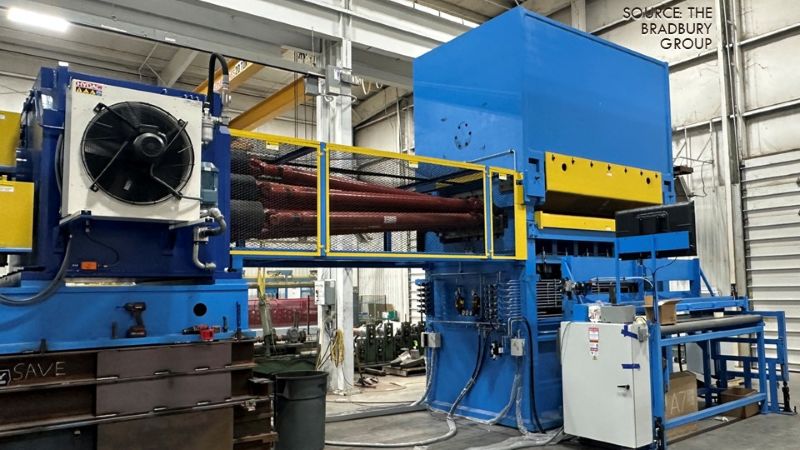
Levelers offer a more advanced form of sheet metal flattening, as not only can they remove coil set or crossbow, but can also correct length differences. They work by employing closely spaced rollers that allow for greater bend angles, which enable the machine to stretch specific areas of metal and equalize the strip length.
A straightener is well-suited for flattening coils or precut blanks before rollforming, press feeding, press brake work, or folding. But when you are producing tighter-tolerance parts—or any parts where flatness affects fit, appearance, or downstream processing—defects such as edge wave and center buckle become more noticeable.
Examples include architectural roofing and wall panels with wide flat areas, as well as sectional door panels, where forming occurs mainly at the edges and the unformed center can reveal defects. In these cases, a leveler is the better investment.
So while properly sized straighteners can remove coil set or crossbow, levelers can do this plus improve the overall flatness of the material by correcting length issues, making them one of the most versatile metal flattening machines available.
Matt Werner is the senior sales and marketing manager with The Bradbury Group—a provider of automated production and systems integration for the metal processing industry.