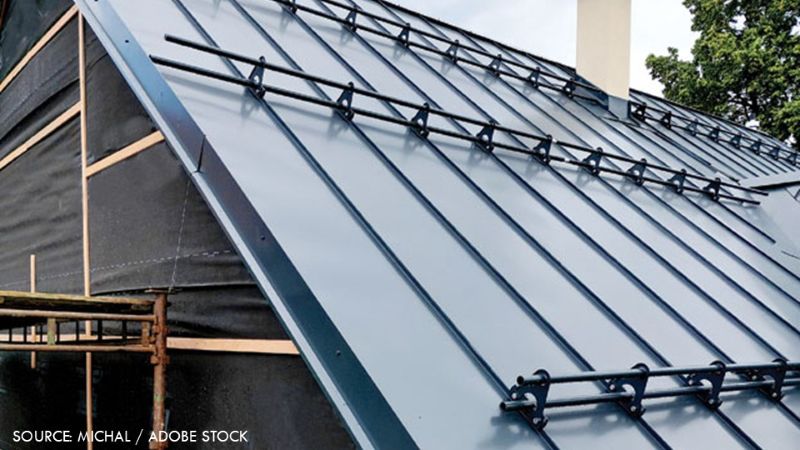
Roof clamps may be among the smallest components on a metal roof, but they are critical to securing rooftop attachments.
Snow retention systems, solar arrays, conduit supports, service walkways, and other accessories all rely on mechanical seam clamps to help transfer loads into the roof system without compromising its integrity.
Proper clamp selection requires more than finding a clamp that simply “fits” the seam, or using some standard spacing “rule of thumb,” like always putting a clamp on every second seam when installing snow guards. Clamp placement should only ever be determined by a proper engineering study that accounts for the installation and its location, never by rule of thumb.
Selection starts with the tested design capacity of the clamp on the specific roof panel, then accounts for the in-service loads the connection will experience.
Start with tested load data
Every clamp should have a tested load-to-failure associated with the specific roof panel or seam profile to which it will be attached. The determined “ultimate” (failure) load should be based on accredited third-party laboratory testing. Contractors and specifiers should also understand the factor of safety used to reduce the ultimate tested load to the published “allowable” load.
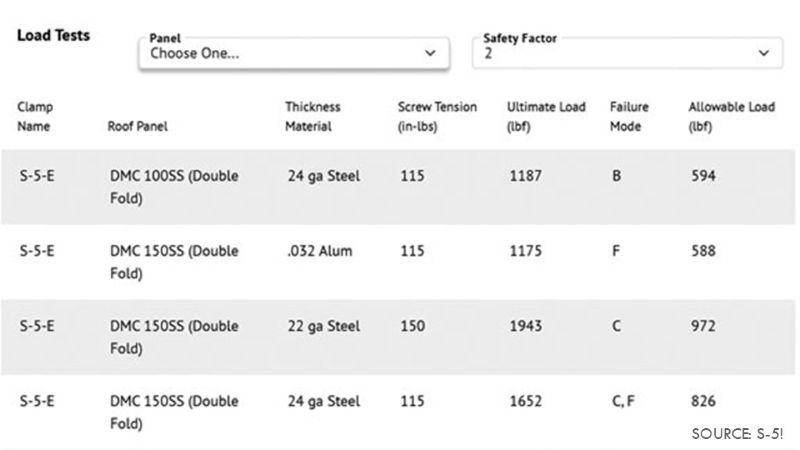
Generally, this factor of safety should be 2.0 or greater. In other words, the allowable load used in design is half the ultimate load as proven by certified testing. Depending upon the importance of the connection, the factor of safety can be reduced or increased, but without this information, an engineered attachment is not possible.
Let project conditions guide the layout
Project conditions also play a major role. Because the application dictates the forces transmitted to the clamp, the intended use should always be included in the layout discussion. The objective is to distribute loads over multiple attachment points without exceeding the allowable holding strength of any single attachment.
Panel material and thickness matter in testing and can render vastly different holding capacities. Copper, aluminum, stainless, and zinc panels require scrutiny with respect to metallurgical compatibility in addition to holding strength. A reputable clamp manufacturer can help determine the proper solution based on these variables.
Rooftop attachments do not all transfer loads in the same manner. Snow retention systems may place significant downslope loads on the attachment, acting parallel to the seam or rib (drag loads). Solar arrays can introduce wind uplift loads that act perpendicular to the seam or rib. Walkways and mechanical equipment supports may create concentrated downward service loads combined with drag loads.
Again, the best clamp is not simply one that appears to fit; it is one that has been tested and approved for the specific roof panel and load condition.
Before contacting any clamp manufacturer, contractors should gather key details, such as:
- type of application being installed
- roof panel profile
- seam-to-seam dimension
- panel material, thickness, and manufacturer
- roof slope
- project location
- applicable design criteria for wind and snow
Providing this information upfront can help the manufacturer recommend a properly engineered clamp layout more efficiently and reduce the risk of changes once work begins.
Install with care
Installation practices are just as important as product selection. Because clamps secure rooftop attachments without penetrating the roof panel, proper torque is critical. A common mistake is over- or under-tightening.
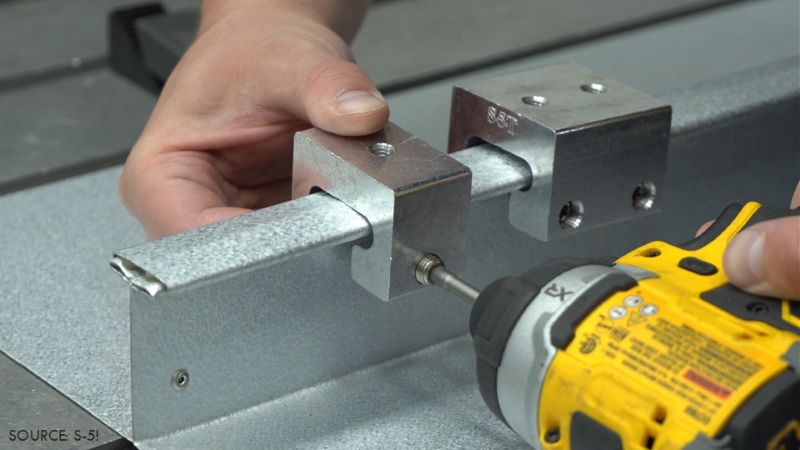
Excessive torque can damage the clamp, roof seam, or panel finish, while insufficient torque may prevent the clamp from performing as tested and intended. Dissimilar metallurgy or damaged coatings can lead to corrosion, which can spread over time. Installers should follow the manufacturer’s torque requirements and calibrate their driver tools accordingly.
Care should also be taken not to damage anti-back-out features found on some clamps. These features are designed to help the clamp resist vibration caused by wind flutter or low-level seismic activity. Using the wrong tool or applying incorrect screw tension can compromise that performance.
Sequence matters for snow retention
For snow retention systems, sequence matters. When multiple rows of snow rails are required to meet snow load conditions, the uppermost row should be installed first, with crews working down the roof from there. If a project is delayed for whatever reason and only a lower row has been installed, an unexpected snowstorm could overload that row and damage the system or roof.
Don’t overlook material compatibility
Contractors must also pay attention to material compatibility. The clamp material should be matched appropriately to the roof panel material to reduce the risk of galvanic corrosion. This is particularly important on specialty metal roofs, where dissimilar metals can create long-term problems.
Before work begins, contractors should confirm that the selected clamp is correct for the seam or rib profile. When there is uncertainty, they should ask the manufacturer for guidance and request a sample before starting installation. Clamps should be installed according to the manufacturer’s written instructions, using the recommended tool and torque setting, then verifying with a torque wrench.
Once your screw gun is calibrated to the correct torque, you do not have to stop to verify every single screw you drive. Instead, check roughly every 200 fasteners to ensure you are still delivering the same verified tension.
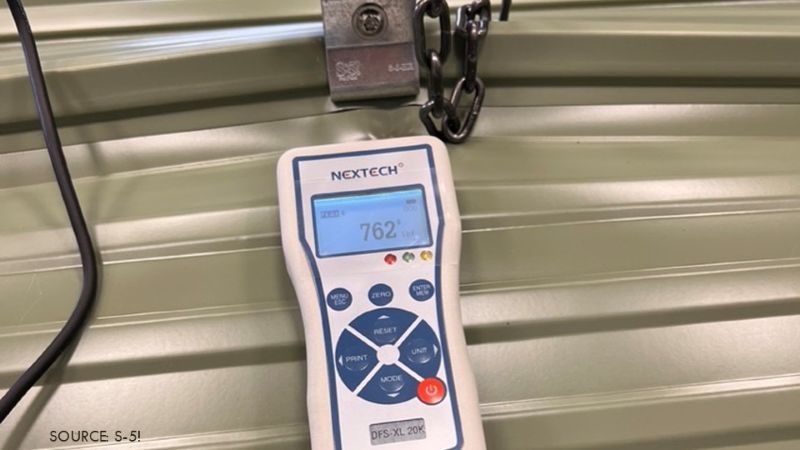
Contractors should also consider warranty requirements before installing rooftop attachments. Using the wrong clamp, damaging the panel, unintentionally penetrating the roof panel, or failing to follow the manufacturer’s instructions may affect roof or attachment-system warranties. When in doubt, confirm requirements with both the roof panel and clamp manufacturer before installation.
Ask before you attach
Quality assurance depends on three interconnected elements: engineered application, certified testing, and consistent manufacturing.
Contractors, designers, and building owners should contact the clamp and roof manufacturer whenever questions arise about product limitations, roof compatibility, installation procedures, or environmental concerns.
Concerns about the environment can be twofold. First, there may be questions about how the product is manufactured and brought to market (i.e. carbon footprint, cradle-to-grave). Second, there are the environmental forces to which the snow retention system will be exposed, such as drag/gravity load and wind uplift forces.
The bottom line is simple: moving from load data to layout demands more than a standard spacing rule. It requires tested performance data, project-specific details, and proper installation for the clamp system to perform as intended over the life of the roof.
Rob Haddock is the CEO and founder of S-5! and the inventor of metal roof attachment solutions. A former contractor turned building-envelope scientist, he has dedicated more than five decades to advancing the metal roofing industry. Haddock is an award-winning roof-forensics expert, author, lecturer, and educator, as well as the director of the Metal Roof Advisory Group Ltd., a consulting firm specializing in metal roof design, installation, and performance.