While solar PV systems have been installed on rooftops for decades, there are nonetheless numerous factors that go into achieving a successful installation. That said, the partnership between Kingspan Insulation North America, Dynamic Energy, and REC Solar makes it look easy.
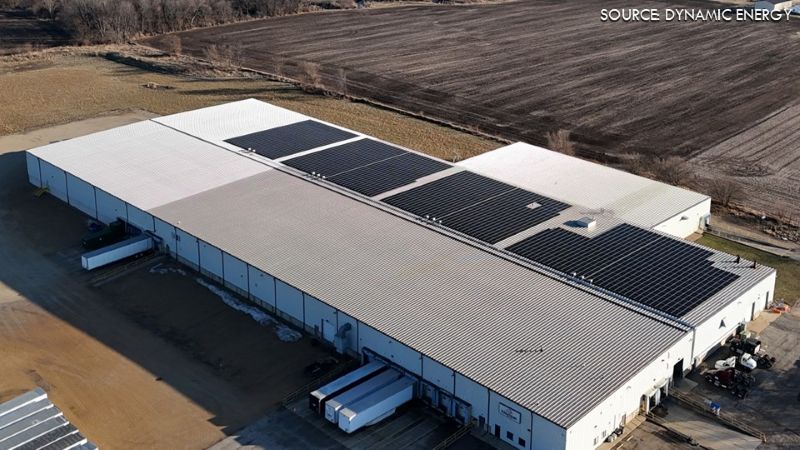
A few months ago, the partners celebrated the completion of a new rooftop solar installation at Kingspan’s Mendota, Ill., manufacturing facility. The 881-kW solar PV system was installed across roughly 50,000 square feet of an existing standing seam metal roof, with racking attached directly to the seam ribs using clamps—no roof penetrations required.
“Installing solar on standing seam metal roofs is one of the most tested practices in the industry. As a result, the process is generally fairly seamless—pun intended—and Dynamic’s experience is invaluable in ensuring the success of the project,” said Jessica Nee, vice president of business development.
Dynamic served as the engineering, procurement and construction (EPC) firm for the Mendota project. The solar PV system itself is owned and operated by REC Solar through a 25-year power purchase agreement.
“From upfront design and engineering, to permitting and working with the utility during the project interconnection, to the construction of the facility and through financing, Dynamic aims to make the installation of solar a smooth process for the facility owner,” Nee added.
The case for solar in Mendota
According to Christopher Davis, Kingspan Insulation’s director of strategic projects and CI, the installation at the Mendota facility was driven by a combination of factors, including advancing the company’s Planet Passionate sustainability goals, improving long-term energy cost management, and increasing operational resilience through greater energy independence. Additional factors included incentives through the State of Illinois and the 2025 federal tax credit.
“Rooftop solar was the right fit for the Mendota facility because it allowed us to leverage existing, unused roof space to generate clean energy onsite, reduce reliance on grid power, and immediately advance our sustainability and cost-management goals without impacting operations or requiring additional land use,” Davis said.
Besides having a suitable roof, the owner also needed reliable partners to ensure success in an active manufacturing environment—partners who could deliver high-quality design, maintain strict safety standards, and coordinate installation with minimal disruption to ongoing operations.
Onsite in Mendota
“Kingspan Insulation had recently completed a project with Dynamic Energy at their facility in Winchester, Va., and as they move forward with their Planet Passionate goals of increasing renewable energy use and reducing Scope 1 and 2 emissions, the facility in Mendota was the perfect candidate to follow Winchester,” said Dynamic’s director of project delivery Neal Brewster.
Mendota has a large, unobstructed roof area in an electric utility zone with favorable renewable energy incentives and regulations, he added.
Dynamic has completed over 100 rooftop projects across the U.S. during its nearly 20-year history, Brewster continued. The Mendota project was a typical rooftop installation as it relates to standing seam roof installs, although it also benefited from being a large single elevation roof that is rectangular-shaped with minimal obstructions.
According to Brewster, these elements truly optimized the site for a solar installation.
For this project, Dynamic used a seam clamp—a pressure-clamped system that bolts to the seam and is torqued to a specific inch-pound value to match the wind uplift requirements of the location.
“This is a tried and true, tested solution to minimize the risk of water leakage during both installation and for the life of the system,” Brewster said.
A structural engineer was engaged early in the project development phase to review the standing seam roof and the facility, with the primary goal of determining whether the roof could handle the load of the PV system. The engineer used test data from the clamps themselves to determine a system design that would meet the site-specific requirements, Brewster said.
“Doing a feasibility assessment with a structural engineer is always an important first step to verify the site is a suitable candidate for solar,” Brewster advised. “It is also important to know the roof installation date. As a solar project typically has a life of 20-25 years, the roof should ideally be less than 10 years old for a solar installation.”
It is also important to verify whether the local grid is able to interconnect the solar project. This is known as the hosting capacity of the site, Brewster explained, adding that Dynamic can easily assess the capacity for a facility owner.
“Once a baseline capacity had been verified, a detailed, site-specific design was produced to account for local conditions, like wind uplift, thermal movement, and seasonal snow loads,” he said.
This confirmation and site-specific design would ensure the integrity and safety of the overall structure, and that the PV system would be successful over the long term.
“With that starting point, the main design criteria were ensuring adherence to codes and requirements of the local authority having jurisdiction,” Brewster said.
The NFPA dictates the maximum dimensions of arrays and walkway requirements to ensure that fire departments can access all areas of the roof, he added. In addition, setbacks are required from any equipment on the roof, and from the perimeter of the facility.
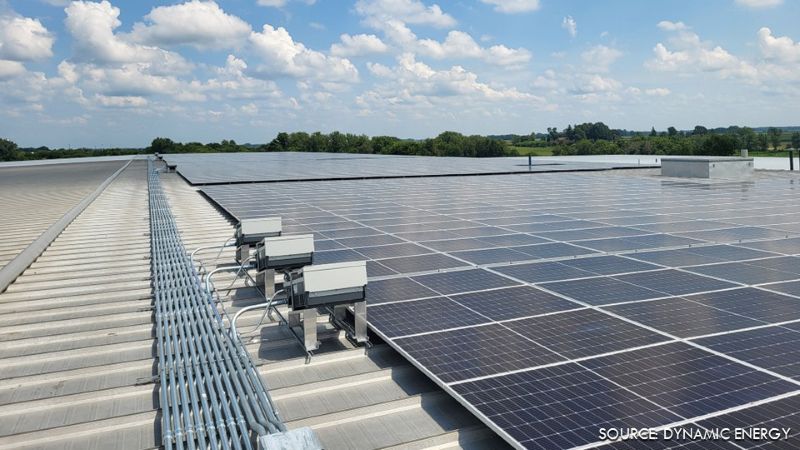
Because the PV system was attached with seam clamps, the risk of water ingress was significantly minimized. Still, this is an existing roof, so did the solar PV system impact any roof warranty?
“Typically, when sites have an active roof warranty, a waiver is filed with the roof warrantor to allow for the installation of the solar PV system,” Brewster explained. “Pre- and post-installation roof inspections are conducted by a certified, independent roofer and, once construction is complete, the roof warranty is re-authenticated.”
Working over an active facility
Given that the majority of the work for the project took place on the roof, Dynamic’s installers were not in the way of the company’s daily operations within the building or on the ground. The biggest obstacles were during materials receiving, Brewster said, which involved pallets of solar modules that would be hoisted onto the roof with a crane or telehandler.
“Once that step is complete, we are largely out of the building owner’s way, and there is minimal impact to daily operations other than coordination and communication of scheduling and progress,” he said. “PV systems do typically require one electrical outage at the building to complete the electrical connection safely, but this usually takes place during off hours, typically on weekends or after business hours.”
The standing seam roof provided a major advantage, as the inter-row spacing between modules is much smaller on a flush-mounted standing seam roof as opposed to a flat, tilt-mounted, membrane roof. Brewster said this can allow for a higher power density (kW/sf), leading to higher solar production. However, all of this is contingent on the roof inspection and structural assessment, so it is important to complete those steps as early in the process as possible.
Brewster also highlighted the extensive safety requirements that were followed because installers were working at height. Plus, solar panel installation also comes with electrical safety considerations.
“Dynamic has a full-time health, safety and quality inspector who continually ensures compliance, and safe and quality working practices, along with robust safety training standards specific to the type of work being performed at a site,” he said.
The independent power producer
“REC Solar worked closely with Dynamic to help ensure the system is set up for long-term success and is well-positioned to deliver reliable performance over its life,” said CEO Robb Jetty.
REC Solar is an independent power producer (IPP) that finances, owns, and operates distributed power systems. Under a power purchase agreement, REC Solar owns and operates the Mendota solar PV system for a 25-year term.
“In this role, we bring the perspective of a long-term owner and operator, with a focus on performance, reliability, and operational efficiency over time,” Jetty said, adding that this ownership model reinforces the importance of consistent energy production and dependable system performance, which helps ensure the project delivers sustained value over the full 25-year term.
Solar PV made seamless
The Mendota installation is Kingspan’s third in North America, following similar installations at its facilities in DeLand, Fla., and Winchester, Va. The company’s sustainability program includes the goal of installing solar PV systems on all wholly owned sites and achieving 60% direct renewable energy use by 2030.
The system in Mendota is expected to generate roughly 1 million kWh of electricity annually, offsetting approximately 700 metric tons of CO2 emissions.
“Across our three North American rooftop solar installations, we’ve learned the importance of working with experienced, reliable partners—Dynamic Energy and REC have been great to work with—and the value of thoughtful planning to integrate solar seamlessly into active manufacturing operations,” said Davis.