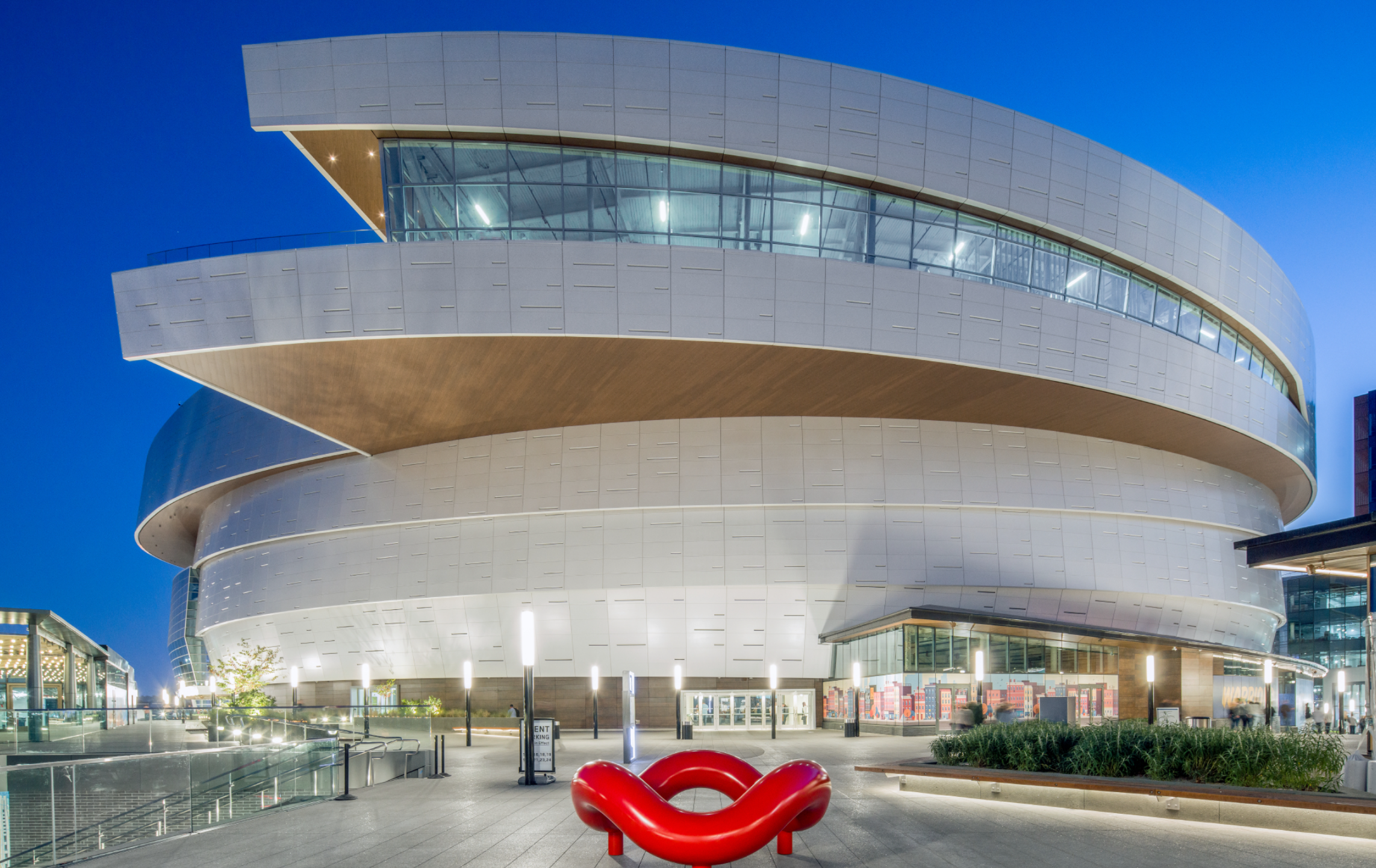
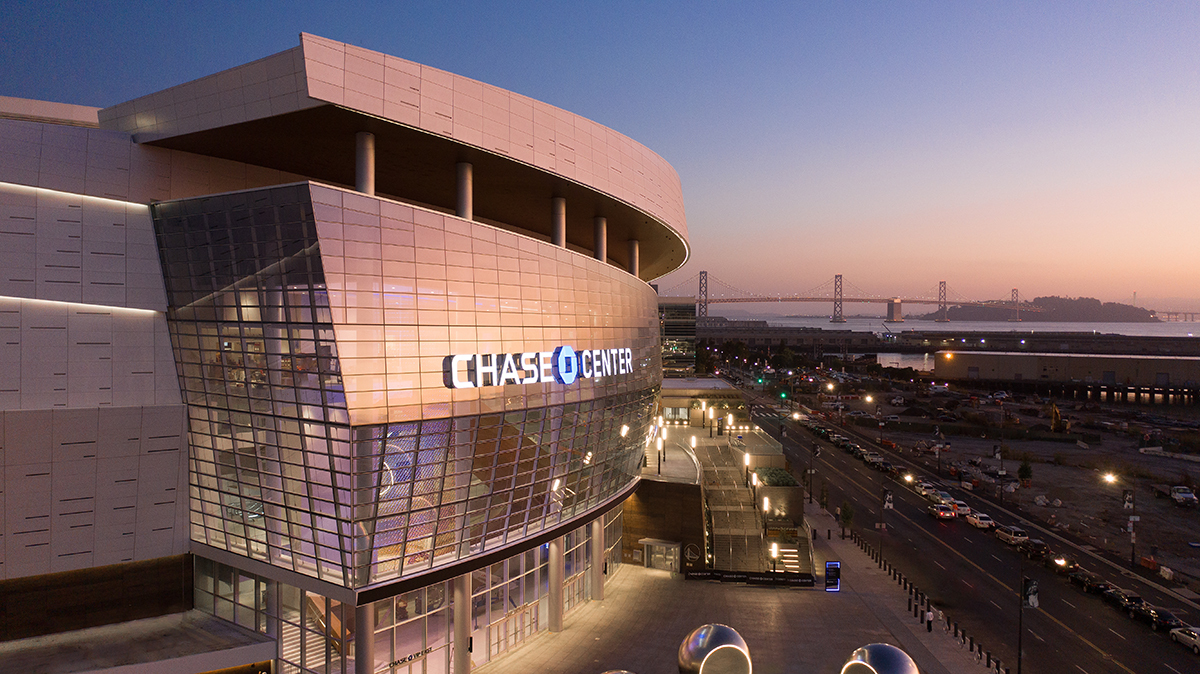
Intricate. That’s the word 2020 Metal Construction News Building and Roofing Awards judge Tim Wybenga, LEED AP, principal at TVA Architects, Portland, Ore., used to describe the exterior metal walls on San Francisco’s new Chase Center Arena, winner in the New Metal Walls category. “The idea that the metal skin on something so huge can actually be quite intricate in a calming nature instead of an excited, exaggerated form, put it on my list.”
San Francisco’s new sports arena’s durable cladding gives it a sleek, modern appearance
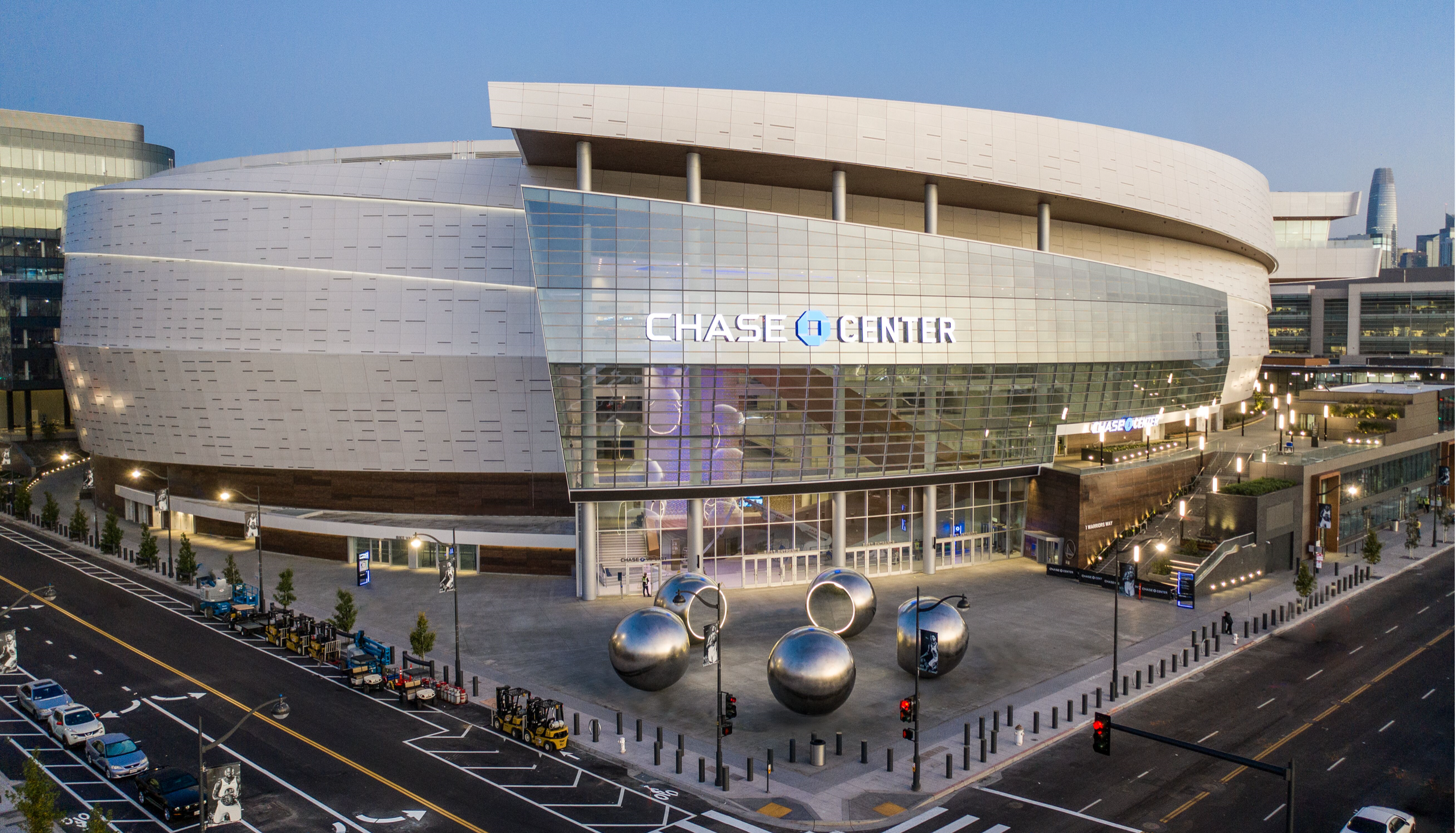
Photos by Jason O’Rear Photography/Chase Center
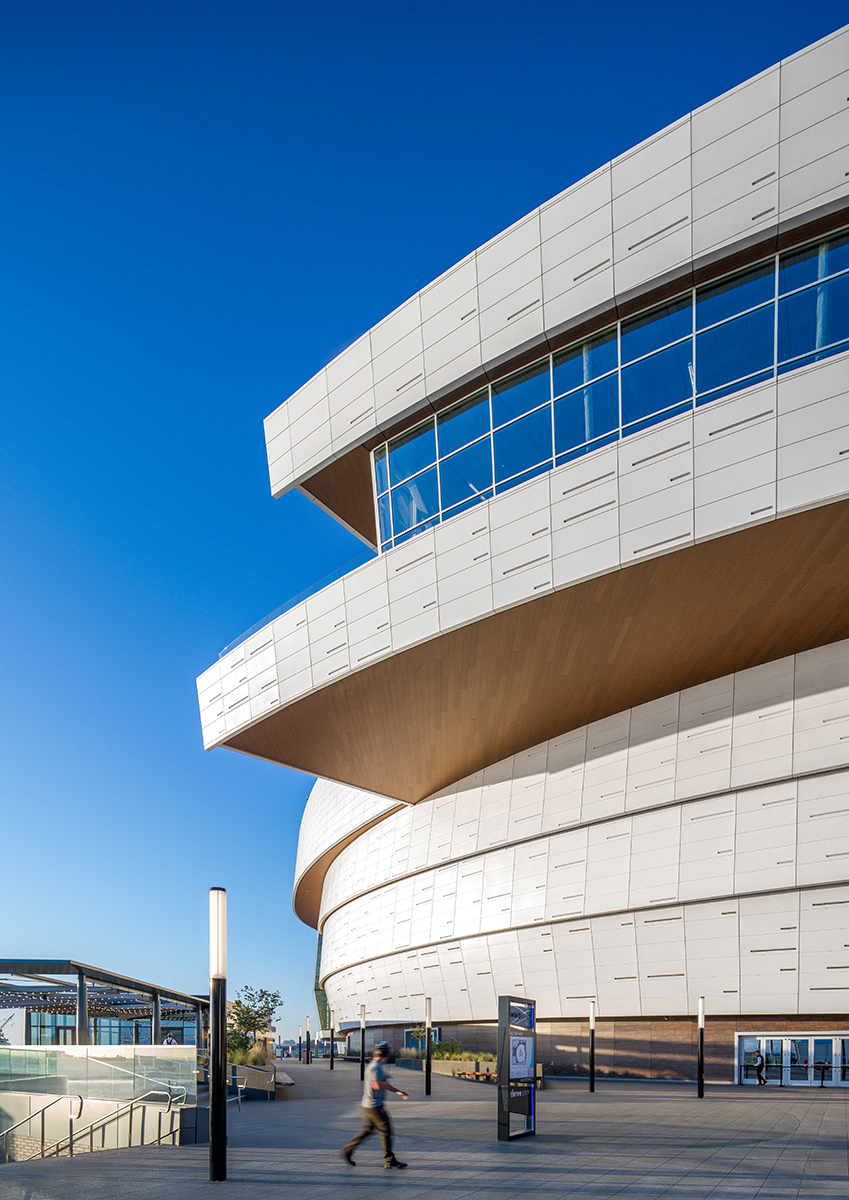
Awards judge Steven Ginn, founding principal at Steven Ginn Architects, Omaha, Neb., says the Chase Center Arena reminds him of the Air Force Cadet Chapel in Colorado Springs, Colo., and that he too likes the innovative use of metal and the craftsmanship. “The architecture is really trying hard, but the metal is not. I appreciate the way the metal skin plays a beautifully supporting role and it has a nice dialogue with the glass as well. Having seen so many not-as-attractive giant buildings, this is such a breath of fresh air to me.”
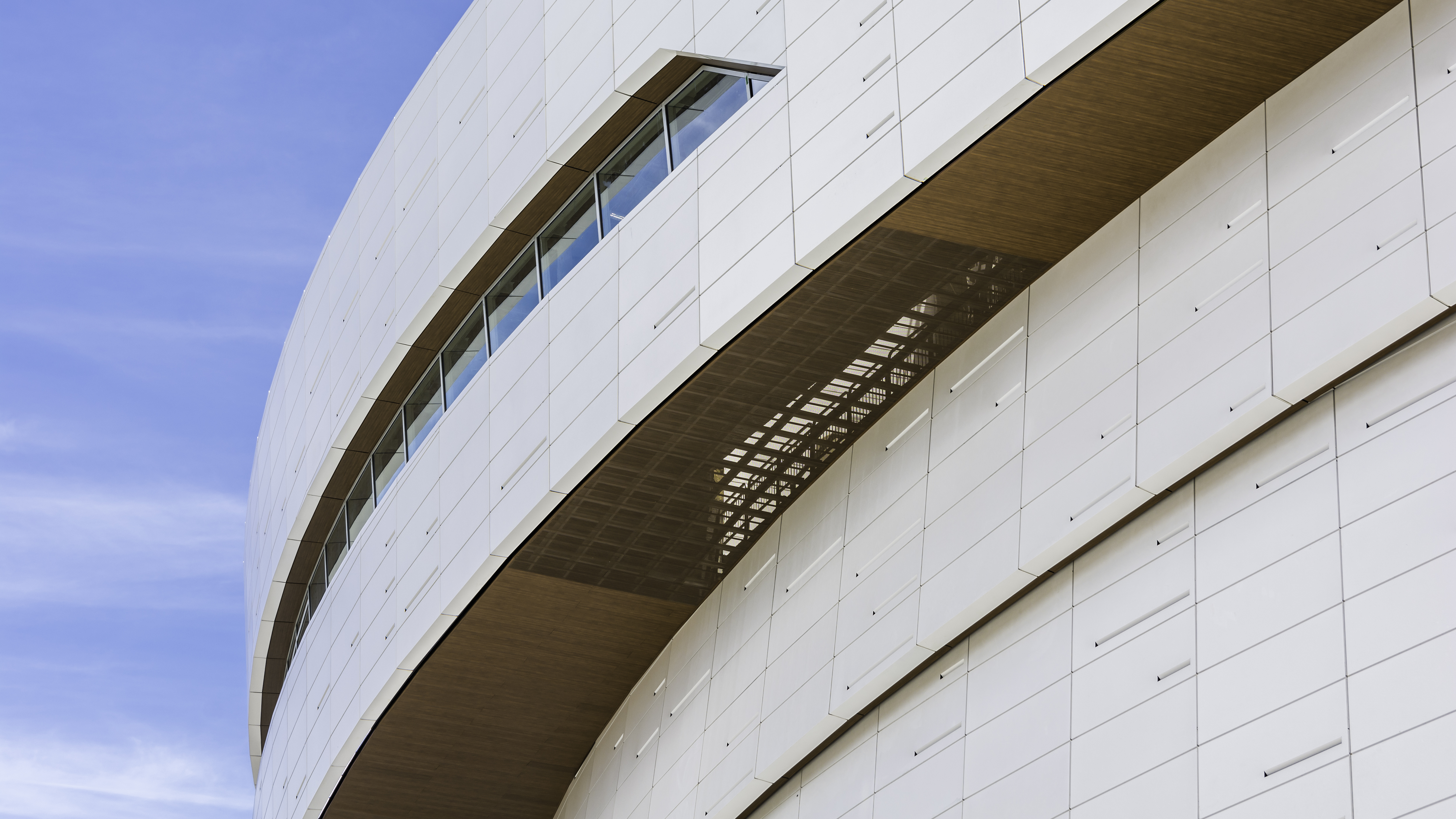
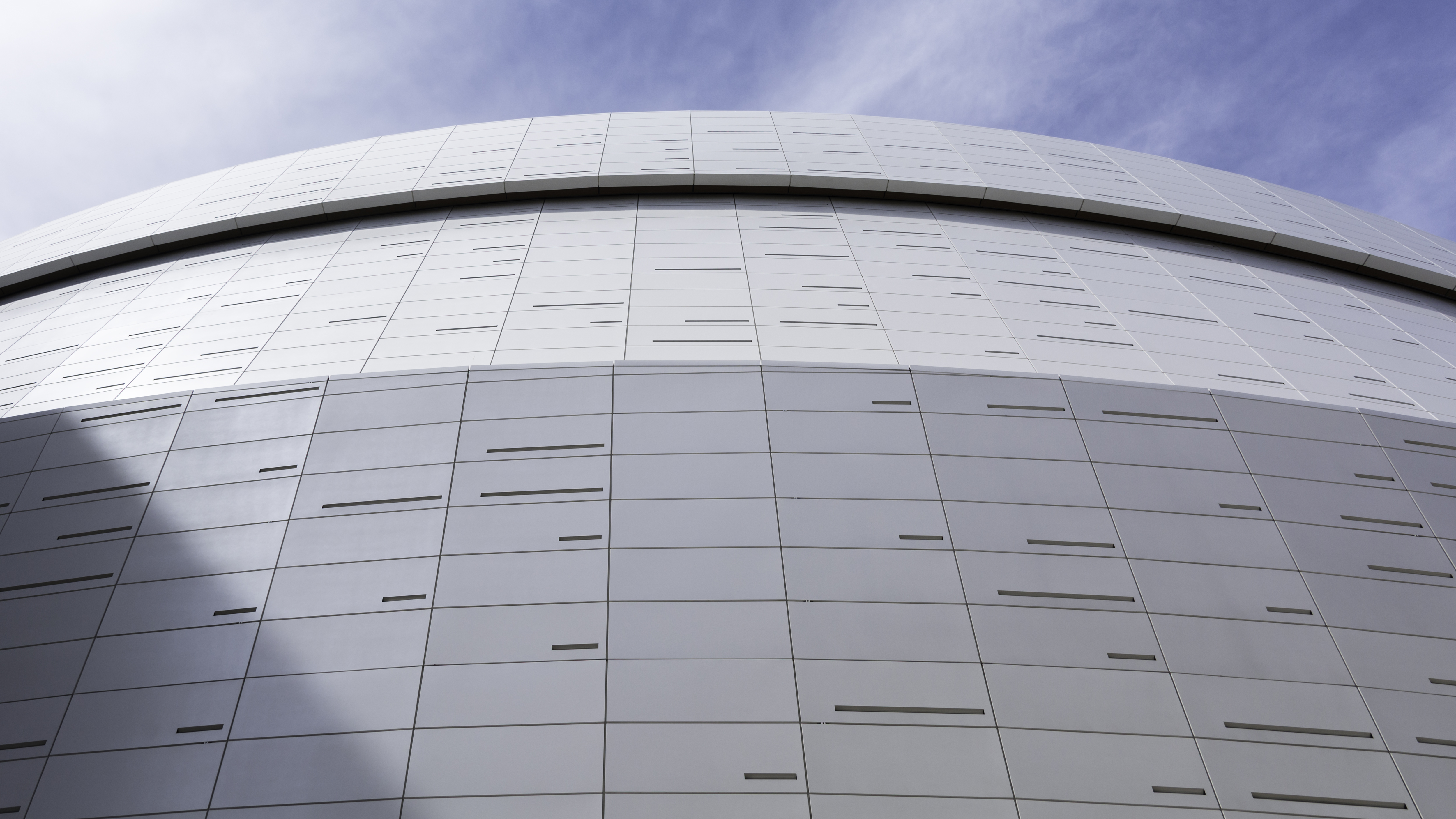
Awards judge George Garcia, AIA, NCARB, RIBA, founder/principal architect at garcia architecture + design, San Luis Obispo, Calif., agrees, saying the exterior cladding “calms down what could have been a much louder piece of architecture. [Also,] the metal cladding gives it some sense of pedestrian scale as your eye moves from the ground level to theconcourse above. [This is] a great application and a great way to change scale throughout the building.”
Thrive City
The centerpiece of the vibrant Chase Center campus, newly-dubbed “Thrive City,” the 18,000-seat arena serves as home court to the six-time NBA Champions Golden State Warriors, and as a hub for nearly 200 events annually. The goal of the Chase Center Arena was to be a luxurious and world-class, yet intimate sports complex. Designers at MANICA Architecture, Kansas City, Kan., created the arena’s exterior design with inspiration of the rich nautical history of the Bay area and the dynamic and flowing forms of the surrounding water.
The joint venture of Clark Construction Group, San Francisco, and Mortenson Construction,Minneapolis, served as the arena’s general contractor, leading a team of more than 260 firms, including engineers, subconsultants, trade contractors and vendors. Mortenson|Clark worked hand-in-hand with the Warriors organization and the project’s design team, which included architects at MANICA, architect of record Kendall Heaton Associates, Houston, and interior architect Gensler, San Francisco.
“To achieve date-certain delivery, Mortenson|Clark harnessed advanced 4-D modeling and developed an innovative construction approach that involved unraveling the arena from other structures on-site and sequencing construction around its four structural cores,” says Kevin Dalager, vice president, operations, Mortenson Construction.
“Under this plan, each quadrant of the arena had its own schedule for concrete and steel, and each level had its own schedule for mechanical, electrical, plumbing and finish work. Chase Center’s aggressive schedule required crews to place as much as $2.3 million of work daily at peak construction.”
Look of Prestige
Metal achieved a look of prestige on the arena because of its custom color options, sleek and seamless configuration, and modern luster. MG McGrath Inc., Maplewood, Minn., fabricated and installed nearly all of the arena’s exterior metal. Approximately 136,600 square feet of 0.125-inch aluminum plate panels were fabricated into a rainscreen panel system and installed on its main façade. Approximately 6,600 square feet of those panels feature slotted perforations to allow for back lighting. All of these panels were installed with a two-coat White Kynar paint finish from Arkema Inc., King of Prussia, Pa., and utilized unitization.
“Specific areas were framed out on the exterior to create 932 uniquely shaped and sized mega-panels with roughly 6 panels per megapanel,” says Jono Semlak, MG McGrath’s director of project management. “MG McGrath worked closely with façade consultant Walter P. Moore, Houston, and façade contractor Enclos Corp., Eagan, Minn., to design the custom megapanels and façade system. There are roughly 7,500 total panels on the project. The mega-panels hang from a secondary steel structure utilizing unique trusses, transoms and custom anchors to the primary structure. MG McGrath also provided and installed 35,000 square feet of Moon Township, Pa.-based CENTRIA’s 20-gauge exposed-fastener, corrugated metal panels with 6,825 square feet of matching integrated louvers. MG McGrath fabricated and installed over 1,000 square feet of its own custom-fabricated column covers made from 0.125-inch aluminum plate panels with a sub-framing system that mounted directly to the concrete columns.”
A Clear Way
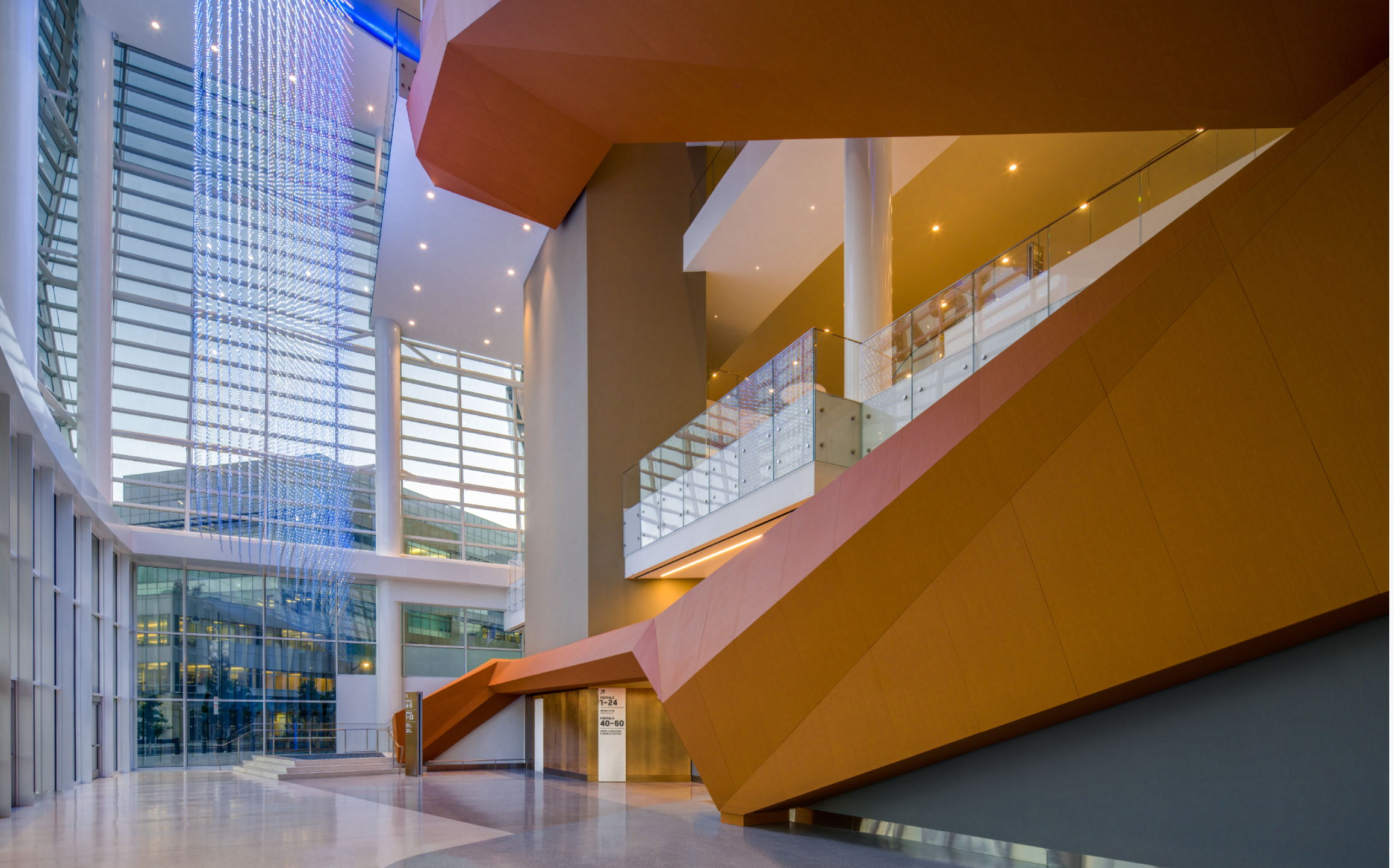
Because of the project’s massive size, the interior space needed a clear way for the masses to navigate the large arena. “The solution was in unifying the interior materials, beginning with the faceted and angular monumental escalator,” says Will Pilkington, president at Pure + FreeForm, St. Paul, Minn. Pure + FreeForm supplied 5,500 square feet of its 3-mm aluminum paneling in its custom wood-look finish Mission Grain that covers approximately 12,000 square feet of the stadium interior and is used on the exterior soffits.
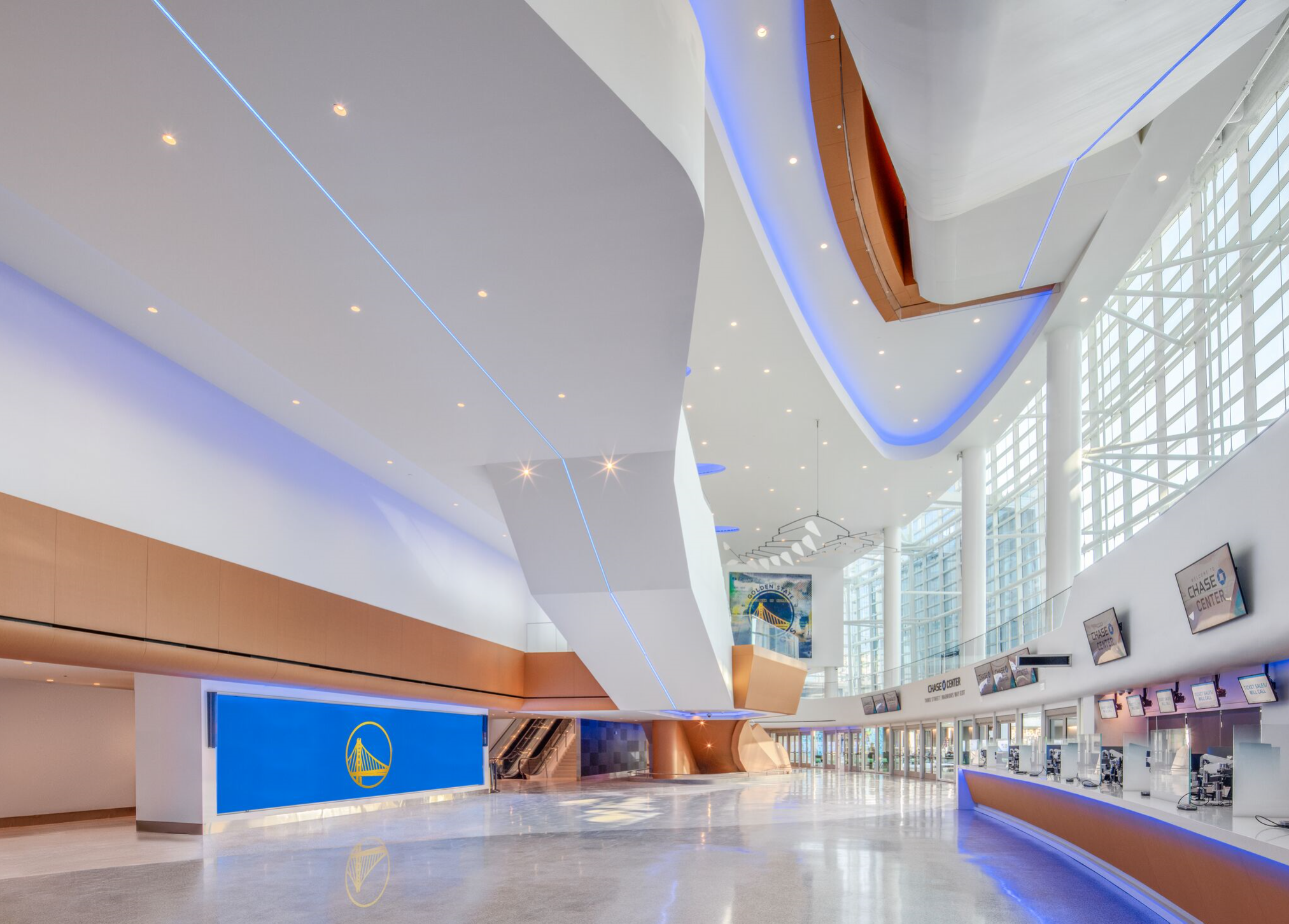
The arena’s façade and soffits are clad in metallic white and wood, respectively. This theme is carried to the interior design where the interior walls are clad in bright white, while the staircase and escalator millwork is clad in a warm woodgrain.
Fabricated and installed by MG McGrath, “The custom woodgrain finish offers a significant contrast and adds a needed warmth in both color and physical touch,” Pilkington says. “Metal can be formed in various shapes and angles, making it an ideal material to capture the modern grandeur of the interior. The interior signifying material is minimally processed, single-skin aluminum finished with organic inks and natural resins. It is made from at least 20% post-consumer recycled content, VOC free, Red List free, and 100% recyclable at the end of its life cycle.”
The Chase Center Arena, San Francisco
- Completed:
- October 2019
- Size:
- 1,740,000 square feet
- Owner:
- GSW Arena LLC
- Architect of record:
- Kendall Heaton Associates, Houston
www.kendall-heaton.com - Design architect:
- MANICA Architecture, Kansas City, Kan.
www.manicaarchitecture.com - Interior architect:
- Gensler, San Francisco
www.gensler.com - General contractors: Joint venture:
- ClarkConstruction Group, San Francisco
www.clarkconstruction.com - :
- Mortenson Construction, Minneapolis
www.mortenson.com - Fabricator, installer and metal supplier :
- MGMcGrath Inc., Maplewood, Minn.
www.mgmcgrath.com - Façade consultant:
- Walter P. Moore, Houston
www.walterpmoore.com - Façade engineer:
- Enclos Corp., Eagan, Minn.
www.enclos.com - Coating:
- Arkema Inc., King of Prussia, Pa.
www.kynar500.com - Metal wall panels:
- CENTRIA, Moon Township, Pa.
www.centria.com - Metal panels/finish:
- Pure + FreeForm, St. Paul, Minn.
www.purefreeform.com