With its impressive use of curves and curved metal wall panels, the entrance renovation of the Northeast Classic Car Museum in Norwich, N.Y., from a plain warehouse into an attention-grabbing destination, won it the 2022 MCN Project Excellence Award in the Metal Wall Retrofit category.
Metal wall panels and curves create a new entry for popular car museum
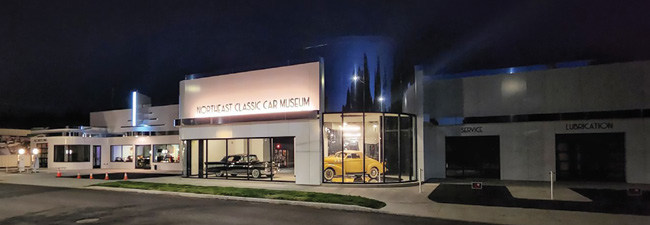
Photo: James Mullen
The Award Judges were impressed with the use of curves and metal, with judge Tania Bortolotto, OAA, ARIDO, FRAIC, LEED AP, WELL AP, calling the project refined. Judge David Sorg, AIA, LEED AP, WELL AP, said the project and its use of metal offers something different, calling its curved corner very compelling. “They’re doing some detailing that does speak to its time that it’s trying to reference,” he adds.
The museum is a not-for-profit educational facility showcasing more than 170 classic and vintage cars and 28 motorcycles in five connected, climate-controlled buildings. Opened in 1997, the permanent exhibit features cars from 1899 through the early 1980s, with collections or pre-war and post-war vehicles, the world’s largest collection of Franklins, and cars made in New York state. The museum also features period-correct clothing, a collection of WWI and WWII airplane engines, and a tribute to Bennett-Ireland, a dedication to all the companies that once operated out of the museum’s building and on State Street.
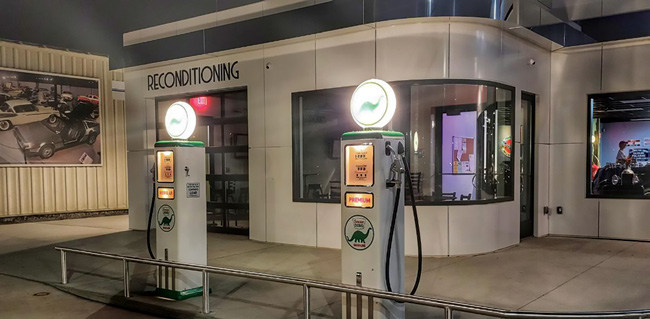
Photo: James Mullen
Throughout the 25 years since the museum opened, there have been three different design firms who were retained to provide concepts of what the exterior could ultimately look like. After seeing what Principle Design + Engineering PLLC in Norwich did with the old 1940s car dealership they renovated to be its office building, the firm became the fourth to create a design concept for the museum.
According to Michael O’Reilly, PE, managing partner at Principle Design + Engineering, his objective with the office building was to create something that honored the building’s heritage, while also providing insight into what the firm does. “The main portion of our office building looks very similar to a 1950s dealership, while from the side, it looks very modern and edgy with wood and gray tone siding, etc. Members of the car museum noticed and loved it.”
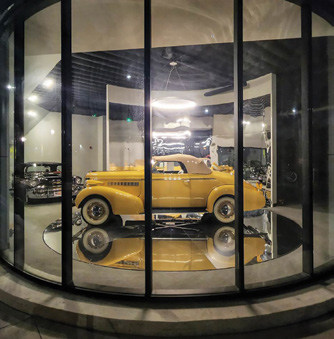
Photo: James Mullen
Reflection of the Times
For the project, the museum was looking for the exterior to reflect the vast collection of cars inside. “They wanted to people to take notice, and really wonder what was inside,” O’Reilly says. “Generate interest and recognition for their vast collection of automobiles.”
When coming up with the design concept, O’Reilly says they considered the experience of visiting a car museum. “To me, an experience is created when someone has an emotional response to something, that emotion triggers a core memory. People visit a car museum for an experience, not realizing that it will unknowingly foster that emotion and those core memories, recalling times of childhood elation, their first-time driving, family and friends, etc. I often tell people the automobile is a true time machine; where else can you be immersed in something that touches all the senses? Everything from the looks (interior/exterior), the feeling of the upholstery, the sound of the radio or door closing, the smell of the engine or interior materials, everything about an automobile triggers emotion. With that, the goal was to help tell the story.”
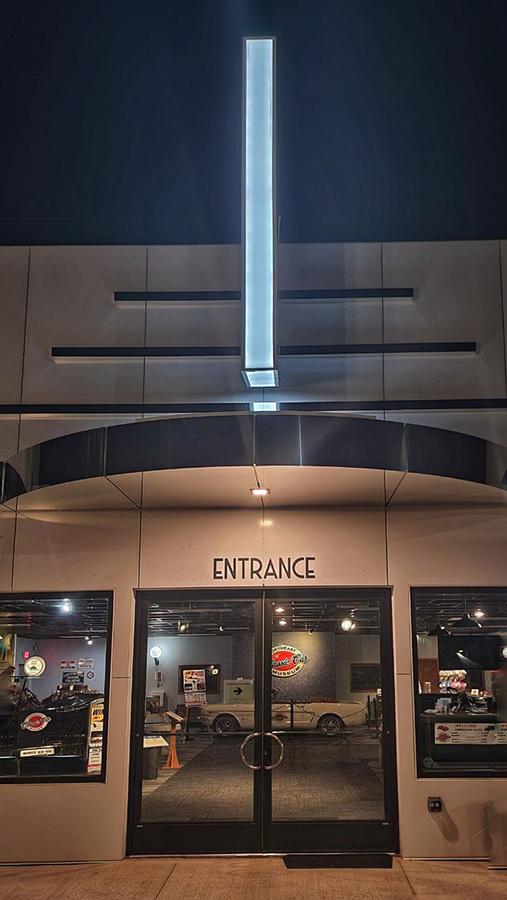
Photo: James Mullen
The American Car Story
O’Reilly says they wanted the museum to represent American car culture, during a time when one in eight automobiles in America were made by General Motors and the 1950s post-WW2 car culture was exploding. By referencing General Motors design manuals from the 1940s and 1950s, the design team knew curved surfaces needed to play a large role in the overall design. “Curves intrinsically tell a story; the messaging is built right in,” O’Reilly notes. “Curves exemplify craft and skill.”
The project consisted of removing the existing warehouse façade and creating two new additions on the front; recreating the showroom, cut-in two new overhead doors, and creating a series of storefronts. “When [visitors] looked across the front, left to right, I wanted it to narrate a story,” he says. “Maybe it actually used to be a car dealership before a museum.” To tell this story, they designed several significant details, such as the small garage door on the left that looks as if they used to clean cars there. The small driveway quickly arrives in front of the fuel pumps and then exits. The main door opens to the office and waiting room. The area in the middle is the showroom, complete with a turntable, while the area at the end represents the service department.
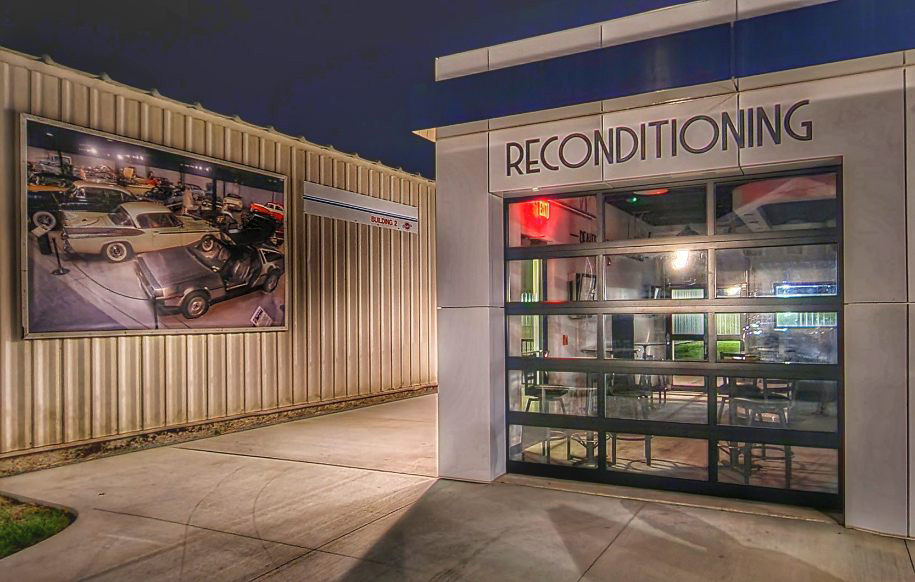
Photo: James Mullen
Light-gauge metal framing was used to create the walls of the new addition as well as the curved sections of the building. “The existing steel building was stripped of its existing exterior finishes and again light-gauge steel used between the existing walls girts to provide a means of attaching new sheathing,” O’Reilly explains. “The exterior is cladded using a fabricated MCM panel to create the different surfaces.”
The project features 5,000 square feet of Alucobond metal composite material wall panels from 3A Composites USA Inc., Davidson, N.C., in HWH Bio White and Reflect Mirror. O’Reilly says the flexibility and finishes MCM offers really lent itself to the project. And, he says, “The reflective mirror material installed on the curves just delivers. It so striking in person.”