 |
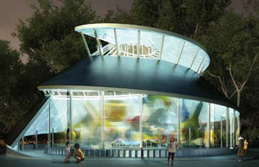
Until its closing in 1941, the New York Aquarium at Castle Clinton, Battery Park, was one of the nation’s earliest public aquariums, welcoming 2.5 million visitors annually. Now, The Battery Conservancy is hoping to bring back some of the history of the N.Y. Aquarium when the SeaGlass Carousel opens up later this year.
In 2006, when The Battery Conservancy was designing the park’s interior to reflect its rich history and to create a light source in the previously darkened landscape, an aquatic carousel was proposed to recall 1896 when the park was the first home of the New York Aquarium.
The idea came from Claire Weisz, AIA, and Mark Yoes, AIA, LEED AP, founding principals of WXY Architecture + Urban Design, New York City, who were part of the team working on the park’s master plan, which involved renovating the original gardens, replacing asphalt with soft surfaces and other park enhancements. The carousel would create a presence is a dark location, as well as lighting, adding a
‘glow’ to the space.
Layng Pew, AIA, the principal at WXY overseeing the construction phase, describes the carousel’s form and design arising from the history of one of the park’s major structures, Castle Clinton. Originally a fort, the building had gone through a variety of uses, including serving as New York’s first aquarium. “This inspired the notion of a carousel of sea creatures, which would refer back to this piece of the history of Castle Clinton and the park,” he explains. “The theme became an underwater carousel, instead of the traditional horse race.”
“We wanted the form of the structure that shelters the carousel to be in keeping with the undersea theme, which led to the nautilus shell-inspired design,” Pew adds. “Rather than just a box that houses the ride, we wanted to build every aspect of the attraction to be a part of the experience.”
The state-of-the-art carousel features 30 bioluminescent figures designed by the George Tsypin Opera Factory, New York City, that will glide through the sights and sounds of a 360-degree aquatic adventure. The figures, made of translucent fiberglass, are molded into 12 unique fish sculptures. In a future phase of work, the plan is to add sixty SmartGlass panels that will transform SeaGlass’ walls from transparent to cobalt clue, simulating a descent to the ocean’s floor. Scenes of undersea life will be projected on the structure, and an audio component, emitting an enchanting oceanic soundtrack, will be located within each figurine to complete the theatrical experience.
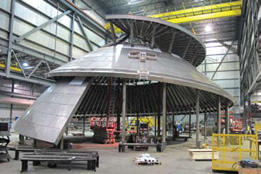 |
Show Canada, Laval, Quebec, Canada, fabricated and installed the entire pavilion, as well as the ride itself. The project features a 46-foot main turntable powered by four motors, and three smaller 17-foot independent turntables. To mimic swimming fish, 18 of the fish sculptures are automated with an up-down movement and a swinging motion. The pavilion was build indoors at Show Canada’s shop, completely fitting out the frame, plywood sheathing and metal panels. It was then disassembled, shipped and rebuilt on-site. “The custom-fabricated interlocking shingles resemble a conventional metal shingle detail applied to a non-traditional shape, though the associated challenges are similar to those of a traditional dome,” Pew notes.
Stéphane Lemay, project manager at Show Canada, explains that the stainless panels are made from standard stainless sheets. “We tried different ways to do them and since each panel is unique, we ended up cutting the basic shapes on a CNC. Then all panels were adjusted one by one in the shop.”
The pavilion’s frame is made up of 23 bent arches connected to a central structural ring that becomes the frame for the oculus skylight above the center of the carousel. “The bent frame pieces have been constructed from straight segments of steel, engineered so that when they are connected horizontally and clad they form the nautilus shape,” Pew explains. “Because the finish materials would be covering an essentially warped surface, we had to consider the cladding design very carefully. The material needed to last as long as possible (40+ years), since it is a public project, and the only options that made sense in this context were metals. We chose stainless, with a non-directional orbital finish, not only because it is beautiful, but because the minimally reflective slightly satin sheen resists patina, unlike zinc or copper. Over time, if panel repair or replacement is needed, they can be finished to blend with the older adjacent panels relatively easily. Also, it just felt right to use a white metal: A light and reflective building was in keeping with the original goal of bringing light and activity to this section of the Battery.”
SeaGlass Carousel, New York City
Owner: The City of New York, Department of Parks and Recreation with The Battery Park Conservancy
General contractor: Pavarini McGovern, New York City
Architect: WXY Architecture + Urban Design, New York City
Design of ride and fish figure carriages: George Tsypin Opera Factory, New York City
Structural, mechanical, electrical and plumbing engineers: Buro Happold, New York City
Civil and ride engineers: McLaren Engineering Group, West Nyack, N.Y.
Media design: Local Projects, New York City
SmartGlass panels: TBD in future phase
Ride and pavilion fabricator/installer: Show Canada, Laval, Quebec, Canada, www.show-canada.com