Reviewing appearance, sustainability and corrosion resistance
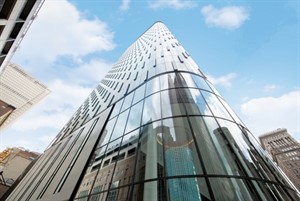 In recent years, powder fluoropolymer coatings have gained market share for aluminum architectural components in North America, a trend driven by increased demand for more environmentally friendly coatings as well as technical advances that have made custom-color production and small batching of powder coatings more economical.
This article reviews the general appearance, environmental and performance attributes of powder fluoropolymer coatings and compares them to liquid coatings with the goal of helping architects and specifiers choose the best technology for their projects.
Appearance Considerations
Architectural coatings are available in solid, mica and metallic formulas. Metallics have been the preferred choice of architects for years because of their brightness and sparkle. When matching liquid and powder coatings for a specific project, solid colors are relatively easy to harmonize. The same task for mica and metallic powder coatings is more difficult.
There are four main reasons for this:
• The inability of powder and liquid coatings to accommodate the same volumes of mica and metallic flake.
• The need to apply clear coat over the color coat to protect metal flake from UV exposure and color change. (Metallics are not common in powder, as the need for a clear coat makes matching a liquid metallic in a powder mica formula difficult.)
• The differences in film thickness between liquid and powder coatings, which prevents achieving the same proportions of mica and metallic flake in each.
• The orange peel effect associated with powder coatings.
Environmental Factors
Comparing liquid and powder coatings for sustainability involves a wide array of factors. Volitile organic compound (VOC) content is one area that favors powder coatings, which emit virtually no VOCs because they are made without solvents.
While most liquid extrusion coatings applicators overcome this challenge by incinerating emitted VOCs as fuel, that process still requires consumption of natural gas and, therefore, the emission of carbon.
Powder coatings also incorporate material recovery systems for recycling, have better production efficiency, and require less energy for transport because of their lower volume and lighter weight. For these reasons, powder coatings are generally perceived to be more environmentally friendly than liquid coatings. For most architectural applications, however, the answer is not quite so definitive. The following performance and durability information describes why.
 UV Durability
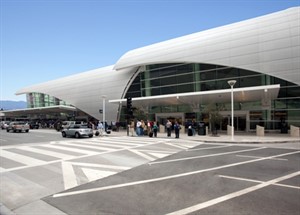
Architects and specifiers face little risk when specifying 70 percent polyvinylidene fluoride (PVDF) liquid coatings to the AAMA 2605 standard because most companies formulate products with a proven, finite set of durable pigments that meet it. PVDF powder coatings are based on the same resin technology as PVDF liquid coatings, which have a 50-year track record of durability and performance in harsh, UV-intense climates.
Powder coatings formulated with fluoroethylene vinyl ether
(FEVE) resin (fluoropolymer based) are increasingly popular as one-coat finish options because they adhere better to aluminum than 70 percent PVDF powder coatings yet offer the same exceptional levels of chalk resistance and color retention. While FEVE-based powder coatings do not have the same historical south Florida exposure data as 70 percent PVDF liquid coatings, current test results for durability and weathering are comparable.
Seacoast Performance
As people migrate toward coastal areas, the need to combat the corrosive effects of salt on aluminum curtainwalls, panels, roofs and other components is increasingly urgent. Unfortunately, chrome pretreatment and chrome primers⎯are at odds with competing demands for more ecologically friendly pretreatment and coatings systems.
Although significant advances have been made in FEVE-based, one-coat powder formulations, two-layer systems with chrome in both the pretreatment stage and primer still provide the most robust protection against corrosion.
Hardness
Powder coatings have a well-deserved reputation for hardness and durability. They are widely preferred for coatings that will be in direct public contact, such as door frames and railings. In addition, contractors historically report lower scratch-related rejection rates for powder-coated parts than for those finished with liquid PVDF coatings.
Cost
Cost considerations are central to any material selection decision. In the end, actual installed costs are a function of customer requirements, such as job size, geographic location and the dynamics of an ever-changing bid environment. Market conditions and pricing throughout the coating supply value chain is difficult to predict with accuracy.The best way to balance cost competitiveness and corrosion-related liability risk is to work with a manufacturer that produces liquid and powder coatings, and that has an established certification program for applicators. To compare true installed costs between liquid and powder coatings, solicit competitive bids for each project from several manufacturer-certified applicators.
With their expanding color range and small-batch capabilities, powder coatings have become a popular comple ment to liquid coatings. Both technologies have value, but each must be evaluated according to the individual building projects and environments for which they are being specified.
Scott Moffatt is market manager, of coil and building product coatings at PPG Industries Inc., Pittsburgh. To learn more, visit
www.ppgideascapes.com