The unlimited reflectivity, texture and structure of crimped metal mesh
The metal construction industry already knows that wire mesh serves an amazing array of functions-from railing infill and cladding, to signage and car grilles. The details in the ornamental ironwork of a historic inn and the utility of a water screen immediately reveal wire mesh’s beauty and functionality across a wide range of industries. However, the process behind its versatility is less obvious.
In theory, the crimping process is simple. Warp and fill wires are shaped to fit together to form a solid intersection. But the details will make or break quality mesh in terms of aesthetics and performance. When manufactured to exacting standards, the eight crimping styles of mesh-plain, lock, intercrimp, flat top, triple shoot, faux cable, helix and twill-are the basis for the material’s incredible versatility, fostering endless aesthetic and performance possibilities.
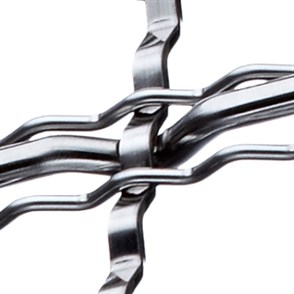
The following fundamental crimp styles are building blocks. They can be scaled, customized or brought together to create texture, reflectivity and a variety of structure. The engineering flexibility of metal mesh opens up the possibilities for endless patterns and applications, and these crimping processes provide the foundation for all of them.
Plain
Plain crimp is a simple zig-zag style of crimping, in which wires intersect at every available pocket. The smooth woven construction of plain crimp produces a subtle pattern, most common when Mesh to Diameter (MD) ratios are 4:1 or less. Used in installations as small as park benches and as large as parking garage panels, plain crimp is suitable for an extensive array of architectural and industrial applications.
Intercrimp
Intercrimp is simply a plain crimp with one small difference: wire intersections occur only at odd numbered frequencies. The visible depressions between intersections give this crimp the appearance of being in constant zig-zag motion. This widespread crimp style is most commonly used with MD ratios of 6:1 or greater.
Lock crimp
Lock crimp is a more versatile crimp pattern, working well at practically any MD ratio of 4:1 or greater. It is characterized by straight sections of wire connected by a well-defined “bump” at their intersections. Distinct intersections give this crimp a clean aesthetic, which is appropriate for many types of applications: including residential and commercial railings and signage. Its dimensional stability and strength also make it useful for security and safety applications.
Flat top
Flat top is similar to the lock crimp, but all of its crimping is offset to one side of the material. This creates a smooth top surface, with no high points, as all wires are woven on a single plane. Its bottom side, however, has crimp bumps approximately twice the height of lock crimp bumps. The smooth shape of flat top lends itself to a wide variety of architectural applications because of its unique characteristics and reflectivity.
Triple shoot
Triple shoot is a specialty crimp style that creates maximum open area. It consists of relatively long sections of straight wire, connected by groupings of three plain crimp pockets. The resulting material has rectangular openings with a very high aspect ratio. Because of this high aspect ratio, the directionality of the pattern is highly noticeable, and can be used for more expressive designs.
Faux cable
Faux cable is a variant of the triple shoot crimp style. In this crimp style, long sections of straight wire are connected by two, three or four wires spaced very tightly together, instead of separated by a small space as in the triple shoot. While some manufacturers produce this style of material simply by pressing groups of wires together, Banker Wire places special crimps in the surface of the wire. This technique assures absolute repeatability in the mesh spacing, which is crucial when attempting to align multiple panels.
Twill
Traditionally, the twill style weave allows for a tighter mesh-to-diameter ratio, which reduces the need to form the wire beyond its physical limitations. This ratio also creates a unique aesthetic. During the weaving process, four independent heddle frames on the loom allow for complex wire positioning that creates parallel diagonal pattern configurations. Pre-crimping a twill style mesh allows for complete control of the visual details, and the densely spaced wires create low percent open area suitable for all sorts of interior design applications.
Helix
The helix is a new crimp style with enormous design potential. For years, the wire mesh industry had been limited to making squares, rectangles and diamonds until Mukwonago, Wis.-based Banker Wire introduced its Circle Mesh. Naturally flowing circular shaped openings are created by the intersection of helical wires, providing a soft and tranquil aesthetic. The helix can be combined with any other fundamental crimp style, creating a truly unique woven wire mesh pattern. Although the helix is the first-ever circular crimp style, it is simply the latest innovation in crimping from Banker Wire. A commitment to exploration and invention in the crimping process-and the possibility for combination and modification of existing crimp styles-allows metal mesh to serve an everexpanding range of both architectural and industrial purposes, limited only by one’s imagination.
Harrison Horan is vice president of sales and marketing at Banker Wire, Mukwonago, Wis. For more information, visit www.bankerwire.com.