Metal-based addition is a critical component to an essential institution
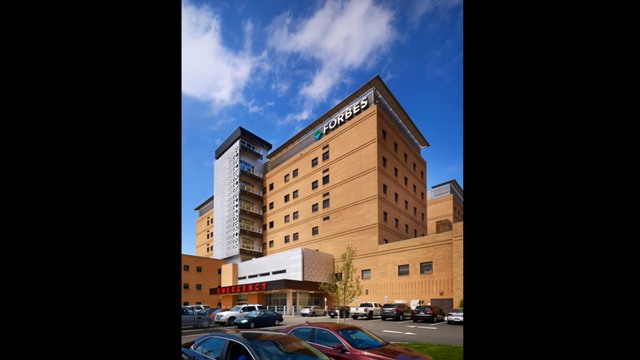 Because of a new acute-care hospital in its town of Monroeville, Pa., Forbes Hospital sought a visible indicator that its facility reflected the state-of-the art medical expertise that was available within. The opportunity arose with its new elevator project. The hospital challenged architectural firm IKM Inc., Pittsburgh, to design an elevator tower that would provide access from the surgical department to every floor in the hospital and a renovation to the emergency department intake and waiting areas. “We understood that the exterior design expression needed to reflect the hospital’s commitment to increasing and improving medical expertise in new services and employing the latest technologies to assist in achieving this mission,” says Roger Hartung, AIA, NCARB, IKM’s principal in charge of the project. “We were challenged to translate that idea into a physical form.”
Vertical Transportation
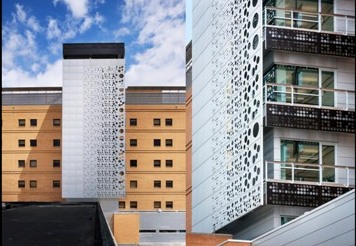
The primary goal was to simplify vertical transportation and access from the Emergency Department to the upper stories of the hospital. Perforated metal panels supplied and installed by Dri-Design, Holland, Mich., offered numerous design opportunities for taking an otherwise mundane, but necessary function and dramatically improving its visual appeal. The addition’s location offered good possibilities for daylight and views. The eight-story addition looks out over the rolling hills east of Pittsburgh.
The tower has two ways of defining the building. First as a marker for the entire hospital that can be seen from the highway as one approaches, and revealing the complete tower and the entrance upon arriving at the emergency department at the tower’s base. The use of metal as an element on the building’s façade separates it from the traditional buff brick that comprises the majority of the existing hospital’s surface area. The contrast of the metal draws attention. At night, the illuminated tower acts as a lantern.
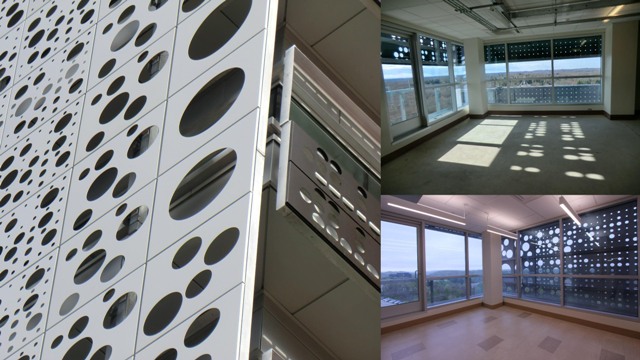
IKM architects were drawn to a metal panel solution for its contemporary, forward-looking expression,⎯something the hospital was also seeking by way of rebutting the competition. Design options included perforated openings in the metal panels. One option offered a unique, but somewhat permanent, branding opportunity to include images created on the panels by the design of the openings. The second option offered more a random or specified pattern, no images. The hospital chose to move forward with the second solution.
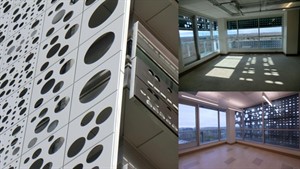 Perforated metal panels increase daylight into spaces without the need for privacy curtains or blinds along the exterior wall. The screens also control the afternoon light to reduce solar heat gain, while still allowing daylight into each floor plate. “The solid and perforated metal panels serve as the perfect screen providing appropriate levels of shade and visually interesting open areas,” says Joe Obritz, AIA, NCARB, IKM project designer. “The patterns create a dramatic interplay of light and shadow, screening natural light in the day and revealing artificial lighting at night.”
Dri-Design installed 15,211 square feet of its rainscreen aluminum wall panel system, which included tension-leveled, 0.08-inch perforated aluminum plate panels with dark bronze anodized and clear anodized aluminum finishes, and tensionleveled, 0.08-inch aluminum smooth plate wall panels with dark bronze anodized and clear anodized aluminum finishes. The 13,400-square-foot project was completed in March 2016.
____________________________________________________________________________________
Sidebar: Forbes Hospital Elevator Tower and Emergency Department Renovation, Monroeville, Pa.
Owner: Allegheny Health Network, Pittsburgh
Architect: IKM Inc., Pittsburgh
General contractor: MBM Contracting Inc., Pittsburgh
Distributor: A.L. Harding and Co. LLC, Bridgeville, Pa.
Metal wall panels/installer: Dri-Design, Holland, Mich.