Inside the Cade Museum for Creativity and Invention, plasticity of the brain, or how brains change, is one of the concepts integral to the floor plan. Similarities between the layout and the way neurons branch out and connect, and how experiences affect brain development, are embedded in the building.
A museum in the round celebrates creativity, community and natural forms

Photo: hortonphotoinc.com
Outside the museum, the building’s forms and massing were derived, in part, from the Fibonacci sequence of numbers. In nature, the spiral-shaped Nautilus shell is one of numerous examples of how the Fibonacci number sequence is seen. In the sequence, each number is the sum of the previous two numbers. For the museum, its footprint with concentric circles, and many lengths, heights and other measurements were calculated specifically to match the Fibonacci number sequence.
The museum’s floor plan and appearance were developed to support its use as a modern museum with community events, and pass-through building between a main roadway and public park. Its location in downtown Gainesville, Fla., at the northwest corner of a new park, Depot Park, lent itself to a facility that would accommodate dual entrances and high foot traffic.
Brain Activity in a Building
Since creativity and invention are the focus of the museum, and its mission is to “transform communities by inspiring and equipping future inventors, entrepreneurs and visionaries,” Baltimore-based GWWO Architects was inspired by how creativity and inventive thoughts manifest in brain activity, says Alan Reed, FAIA, LEED AP, design principal at GWWO Architects.
The architecture firm organized the museum around a central rotunda. Wedge-shaped spaces for entrances, exhibits and other uses flow out from that main circulation space. Relative to brain activity and the intersection of creativity and invention, Reed says circulation in the rotunda can be likened to activity in the nuclei of brain cells, or neurons. Each wedge-shaped space can be compared to an individual experience that affects connections among neurons, he says. “Creativity leads to invention, and diversity of experience leads to creativity. If you think of the center hall as the nucleus of the neuron, then you could think of each of those galleries that spiral out as like dendrites that go out and make the synapse connections with other neurons, and it all gets synthesized in the nucleus. So the idea was that each of these galleries is a new experience, and then you continually pass back and forth through the neuron as you experience the whole museum. It’s more about how the brain works, and not necessarily the brain itself.”
Another way the design facilitates connections that can lead to creative thinking is with views of the park and other landscape around the building through glazing at the outer walls of the wedge-shaped spaces.
“[The design is] all about making connections,” Reed says. “Views out of the galleries establish connections to the site, similar to the way neurons reach out to make new connections.”
For curtainwalls and storefront systems on the wedge-shaped spaces, Gainesville-based Shea’s Glass Co. supplied and installed Norcross, Ga.-based Kawneer Co. Inc.’s 1600 Wall System 1 curtainwalls and Trifab 451T storefront systems.
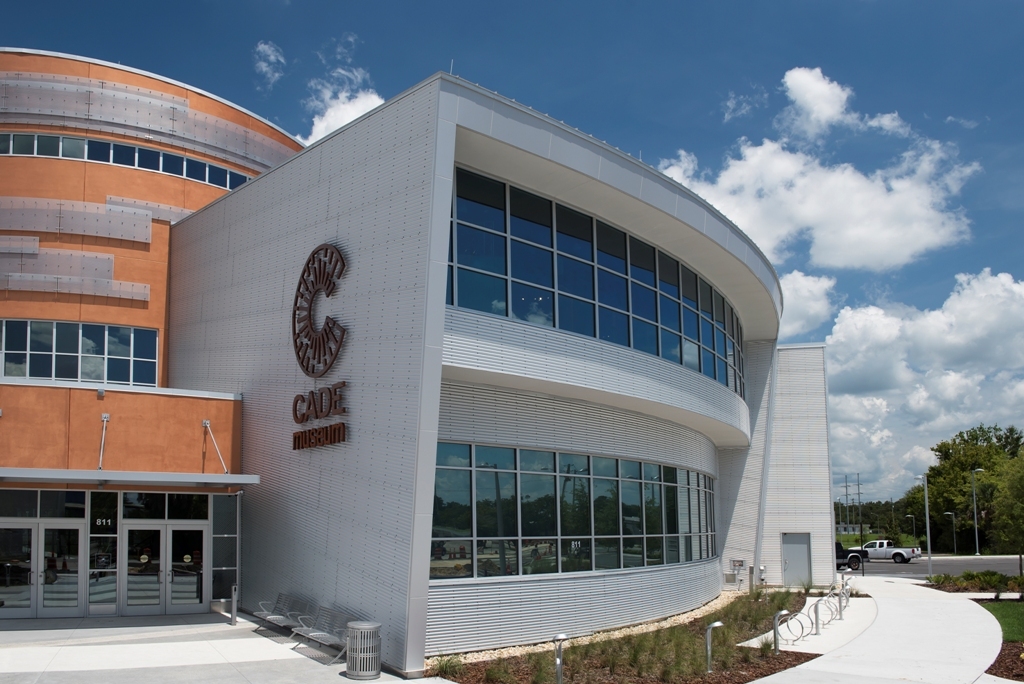
Photo: hortonphotoinc.com
Exterior Expression
The significance of the central rotunda, and activity therein, is expressed on the exterior. Contrasting materials differentiate the main circulation space and wedge-shaped spaces, and, on the rotunda’s exterior, clusters of perforated metal panels evoke a sense of movement.
GWWO Architects contrasted the spaces with smooth, copper-colored EIFS that draw attention to the central rotunda and, on the wedge-shaped spaces, Galvalume-finished corrugated metal panels and Galvalume-finished standing seam roofs. In addition to contrasting colors and textures with the copper-colored panels, the corrugated metal panels were chosen for their economical and industrial qualities, ability to be curved, and to allude to industry once prevalent in the area.
To reference activity inside the rotunda, overlapping clusters of perforated, clear anodized aluminum panels were attached. “As we were designing, we talked about that main hall as sort of a vortex of energy,” Reed says. “And so the perforated panels were meant to express movement, that all of the activity kind of happens in that center space. Even before you enter the building, you have a sense of how special that space is, and that there’s activity going on inside there.”
To create the appearance of movement with perforated metal panels, GWWO Architects varied sizes, lengths and widths. In all, 21 sizes of overlapping panels were used to create depth. “We tried to really emulate movement with overlapping [the panels] and spreading them out so you get the sense that there’s movement going on on the façade,” Reed says. “[The panels have] different densities where two or three of them overlap; it’s a little bit denser and more solid versus where there is only one panel, and you get a sense of the copper color coming through.”
On flat exterior walls, Orlando, Fla.-based Architectural Sheet Metal installed 11,400 square feet of Elk Grove Village, Ill.-based Petersen Aluminum Corp.’s 22-gauge PAC-CLAD corrugated metal wall panels in a Galvalume Plus finish. On curved exterior walls, Architectural Sheet Metal installed 6,000 square feet of the same panels.
For the perforated metal panels on the rotunda, Tampa, Fla.-based Metalcraft Services of Tampa Inc. installed 1/8-inch-thick, clear anodized aluminum perforated panels.
For roofs on the wedge-shaped spaces, Architectural Sheet Metal installed 14,080 square feet of San Antonio-based Berridge Manufacturing Co.’s Double-Lock Zee-Lock standing seam roof system with a Galvalume finish.
For soffit fascias and wing walls, Austell, Ga.-based Abrams Architectural Products Inc. fabricated, and Architectural Sheet Metal installed, Eastman, Ga.-based Arconic Architectural Products Inc.’s Reynobond metal composite material in Anodic Clear mica finish.
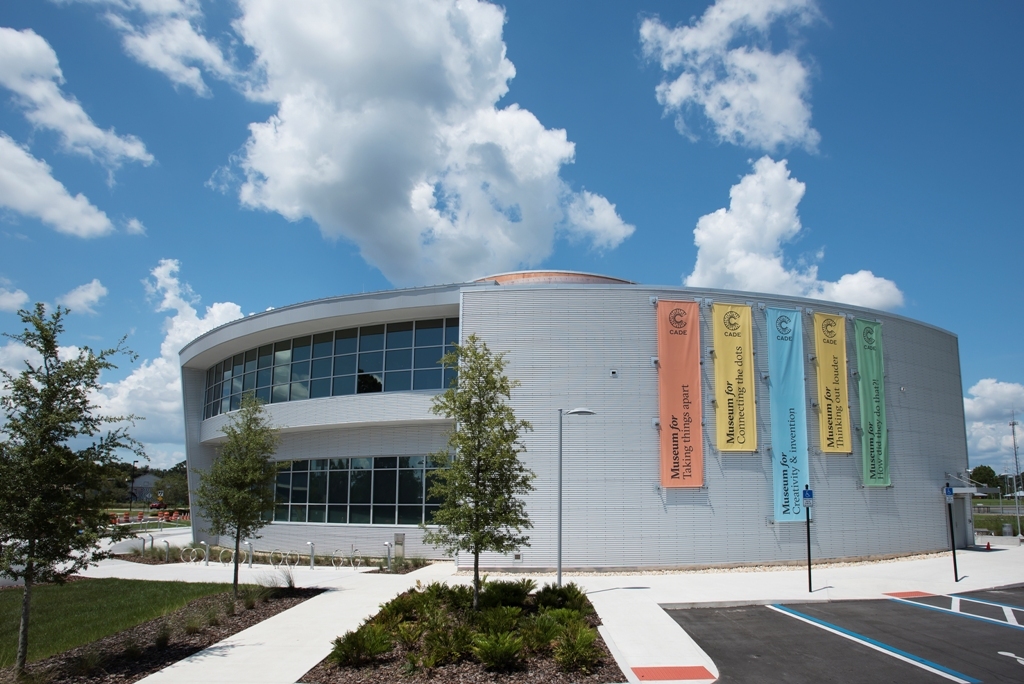
Photo: hortonphotoinc.com
Round Construction
Building the circular rotunda and connecting wedge-shaped spaces along concentric circles, six in total, presented measurement and alignment challenges that do not occur in conventional, rectangular buildings. Ethan Newport, senior superintendent at Jonesville, Fla.-based Oelrich Construction Inc., general contractor for the project, says, “A round building of this type has no control, meaning no straight line or constant from which to measure from. To remedy this, we placed a station in the very center of the site and used this point to measure to every foundation, column and concrete slab edge. The structural steel rotunda was constructed of 10 vertical columns and several horizontal radius beams that connected to the columns with zero slot in the connections, meaning there was no room for error. We had to start erecting at one column and connect horizontally, 360 degrees, back to it. We used Egyptian-era string lines to manually lay out the entire foundation schedule and all column bases. The building was erected in a clockwise direction.”
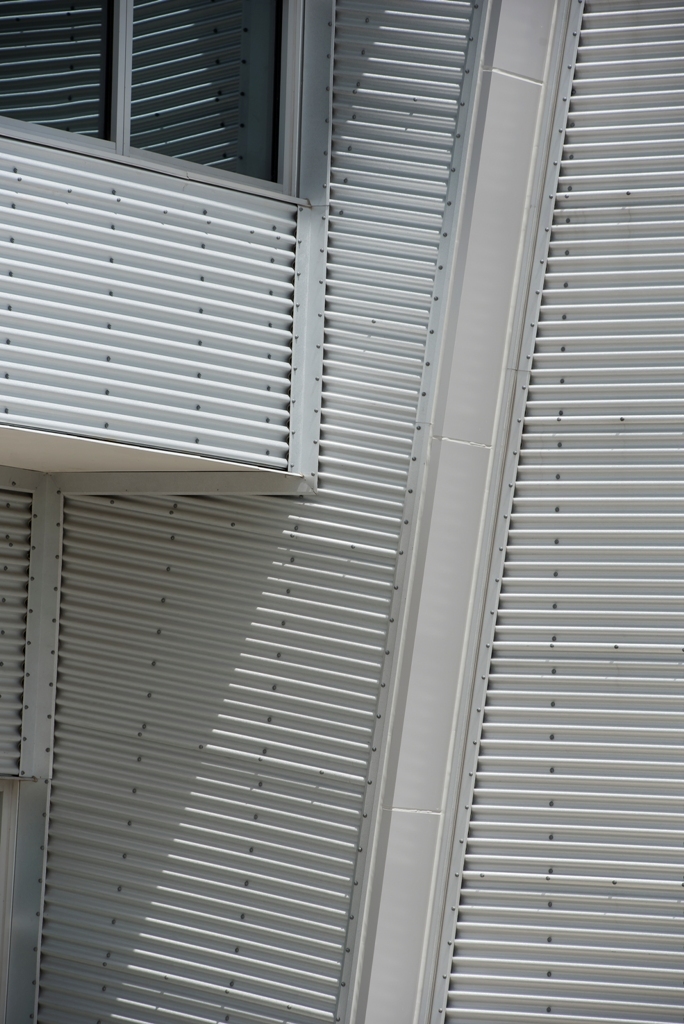
Photo: hortonphotoinc.com

 Photo: David Johnston Photography, courtesy of Oelrich Construction
Installer Insight
Due to the curved walls on the Cade Museum for Creativity and Invention, it was particularly challenging to install attachment brackets for perforated metal panels on the rotunda and attachment brackets for banners on corrugated metal wall panels on the south side of the building.
The radii on the outside of the wall assembly and inside of the wall assembly were different, so Architectural Sheet Metal measured both in order to attach the brackets through the walls. The banner brackets were attached to 16-gauge studs, through rigid board insulation and an underlayment. Architectural Sheet Metal also fabricated custom flashings in its shop for the details.
Michael Leonard, president at Architectural Sheet Metal, says the solution was to calculate how the brackets go through the wall assemblies and where they would be attached to the metal studs. “Everything needed to be in the exact position because there was no room for error,” Leonard says.
Loren Taylor, project manager at Architectural Sheet Metal, says, “We had to cut penetrations into the panels as they were being installed. Each one of those penetrations took four to five man-hours.”
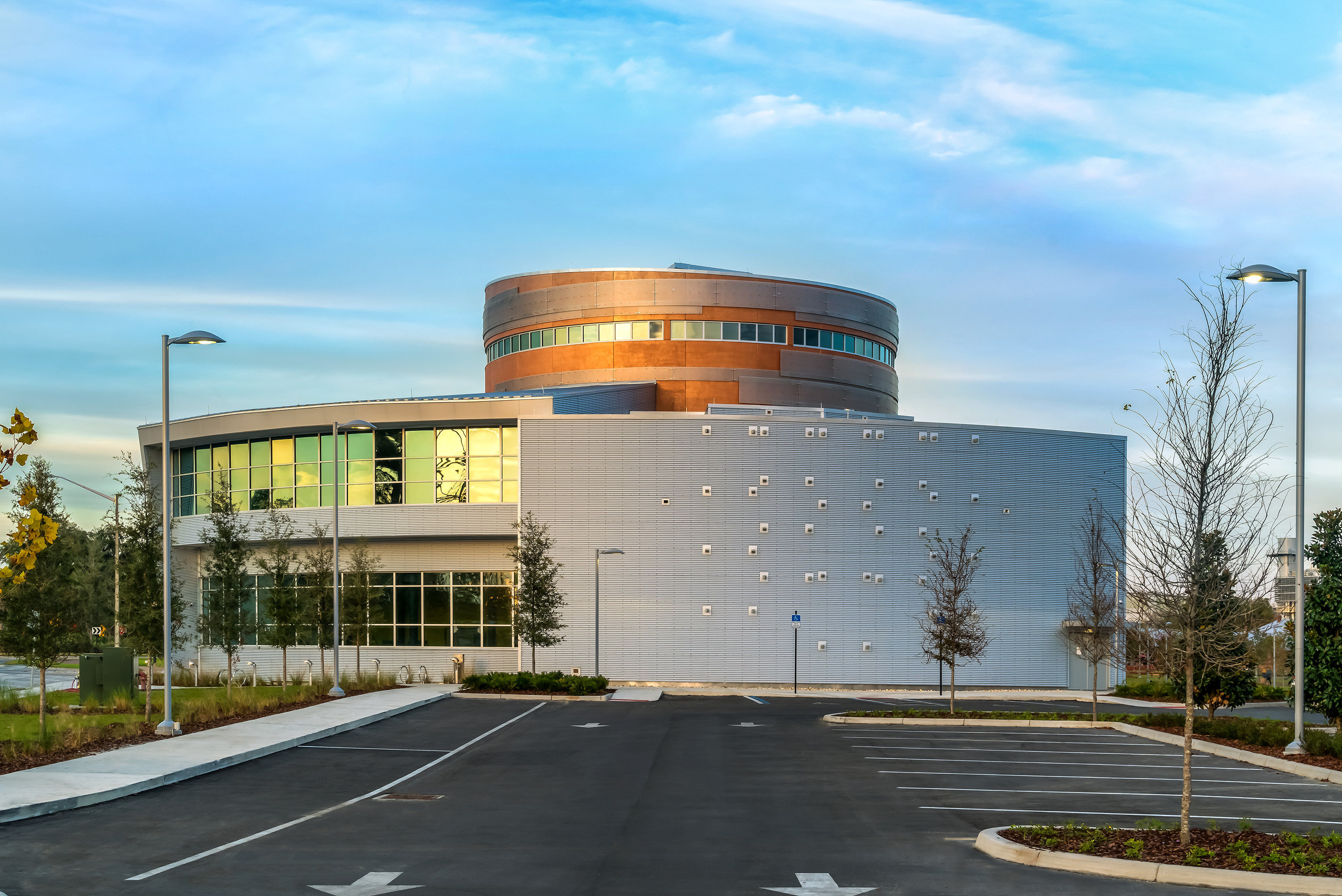
Photo: David Johnston Photography, courtesy of Oelrich Construction
Natural and Historic Proportions
In addition to the concept of brain plasticity, at the request of the Cade Museum Foundation, the museum’s owner, GWWO Architects’ design incorporates the Fibonacci number sequence, a mathematical concept with deep historical roots seen in nature, architecture and fine art. As numbers in the sequence increase, the ratio between successive numbers converges on the Golden Ratio, 1 to about 1.618. The Golden Ratio is a proportion seen in mathematics, art and architecture with origins that go back at least to the ancient Egyptians and ancient Greeks.
In the Cade Museum for Creativity and Invention, GWWO Architects used the Fibonnaci sequence and Golden Ratio proportions to determine the quantity of wedge-shaped spaces, eight, and the arcs of six concentric circles in the building footprint that spiral from the center point.
The radius of the rotunda, 34 feet, and heights of window mullions at 1 foot, 1 foot, 2 feet, 3 feet and so forth, are Fibonacci numbers. Likewise, the first floor ceiling is 13 feet high, the distance from the first floor to the second floor is 21 feet, and, in the rotunda where the building height extends above the second floor with an oculus skylight, the height to the primary structure is 55 feet, all of which are numbers in the Fibonacci sequence.
“The Fibonacci sequence is found in nature and in architecture as far back as we know,” Reed says. “And so incorporating that here in a less conventional way was really challenging and interesting for us. It was a technical layer, but it was a lot of fun, and it created some really interesting relationships.”
Surprising Optical Illusions
The visual relationships between the round and geometric forms and massing of the Cade Museum for Creativity and Invention yielded some surprising results after it was built. No two sides of the building look the same, and some viewing angles on the outside create optical illusions, Reed says. “The way the intersections of curved forms hit each other made for some interesting details. As the wedges radiate outward from the building, they create an optical illusion that the roof actually dips lower in the middle. In some ways, that was planned. We wanted it to be a very dynamic building, but we were pleasantly surprised when it came together and realized how dynamic it is in different lighting conditions, and as you experience it from different viewpoints.”

Photo: David Johnston Photography, courtesy of Oelrich Construction
Museum and Community Center
The museum functions as an attraction in Depot Park’s northwest corner. It is bound by a major roadway to the west, stormwater retention ponds to the east, and a parking lot to the south. Further connecting the museum and park, there are walking paths, bike trails and a series of bollard-like donor statues spiraling from one of the museum’s dual entrances into the park.
The museum is a pass-through building with egress at its sides, one open to the roadway and parking lot, and the other at the park side. It is used for daily activities and events like a community center, as much as a museum with exhibits, indicative of trends in modern museums, Reed says. “Museums can’t just rely on large donors anymore, so the more they involve the community and have programs and outreach, the better off they are. And, of course, this one is about creativity and invention, so there’s a maker space and some other spaces that they can really engage the community, which is really great.”
Planned Growth
GWWO Architects designed the museum with future additions that would, altogether, almost double the building’s size from about 25,000 square feet to 40,000 square feet. From the total build-out plan, the architecture firm subtracted the additions to arrive at its initial design. Some of the wedge-shaped spaces do not extend as far as they could, some are one story instead of two stories, and the entrance wedge on the park side has a flat roof with additional structure that can support an addition, Reed says. At another spot, an outdoor plaza was built over preinstalled column foundations to support an addition of an entirely new wedge-shaped, interior space.
“We took a holistic design approach, which was to design it so as it grows, there’s no apparent addition,” Reed says. “Going back to that brain metaphor, it grows organically. Brain cells grow with every new experience, so it’s the same sort of idea that this building would just grow organically over time, and it always feels the same, but it’s actually more robust and meaningful.”