

For occupants and customers, roofing may be one of the least noticeable features on a building. For building owners, roofing can be a key driver when it comes to the performance and longevity of a building. When it comes time to replace a roof, there are a wide array of options for designers and building owners to consider—from asphalt shingles to fiberglass, composite, or metal. In deciding on the material to be used, designers and building owners need to ask the following questions: How long will the roof last? Will the roof require ongoing maintenance? Will it deliver the right aesthetic for the building? Can it withstand the climate conditions?
Metal roofing, originally manufactured from copper and lead, has been used for centuries. With today’s modern technologies, though, metal roofing has advanced to meet the requirements of greater durability, enhanced performance, desirable aesthetics, and sustainability. Today, metal roofing—manufactured using primarily steel and sealed using various coatings and finishes—is often backed by a 20-year weather-tightness and 30-plus-year finish warranty. It has proven to be a durable yet functional option for architects to guarantee long-term results.
Leveraging performance
Metal roofing systems have superior structural capabilities that promise a high level of performance and longevity. Common traditional roofing systems need to be replaced as often as every 15 to 20 years, whereas a metal roofing system can last more than 60. This concept is particularly important to consider when installing solar panels over traditional roofing systems. The current projected longevity of solar panels is more than 30 years. When a shorter-life roofing system is used, it requires the solar panels to be removed, stored, and reinstalled. These actions risk damage to the panels themselves.
A building’s location and surrounding environment play a significant role in the material selected. Metal roofing systems are hail resistant and can be designed for extreme wind speeds and heavy snow loads. When choosing roofing for a coastal environment, a high-performance coating designed for such climates, or an aluminum system may be a preferred option to minimize corrosion risk.
Metal roofing systems can be either an insulated panel system or a single-skin architectural roofing system. With an insulated roof panel, an R-value of R-54 is achievable. This is significantly more efficient than a single-skin system installed over a metal deck with rigid board insulation or open framing with fiberglass insulation.
Consider Patriot Sales and Service in Plainville, Mass. Given New England’s hot, humid summers and cold, snowy winters, the building owners were searching for a roofing solution for the new structure that would lower energy costs. Insulated metal panels were the ideal choice for energy efficiency—without compromising on design and curb appeal.
Architectural appeal
The considerations for a roofing system can be heavily impacted by the type of application and the desired look a designer is trying to achieve. When selecting between a pre-insulated or single skin standing seam roof, consider the following questions:
- What is the building going to be used for?
- Is it going to be an industrial building with a low-slope roof?
- Are the owners looking for a more architectural look with a steep-slope roof?
- Does the design plan contemplate a roofing system for a basic geometry on a rectangular building, or does it have a complex geometry?
As designers narrow their application, they should consider that some roofing systems are better suited for certain types of buildings. Some are better suited for industrial, low-slope applications. For an architectural roofing system, a narrower standing seam roof panel may be more suited to meet the design intent. For an industrial application, a structural roofing panel system may be most appropriate.
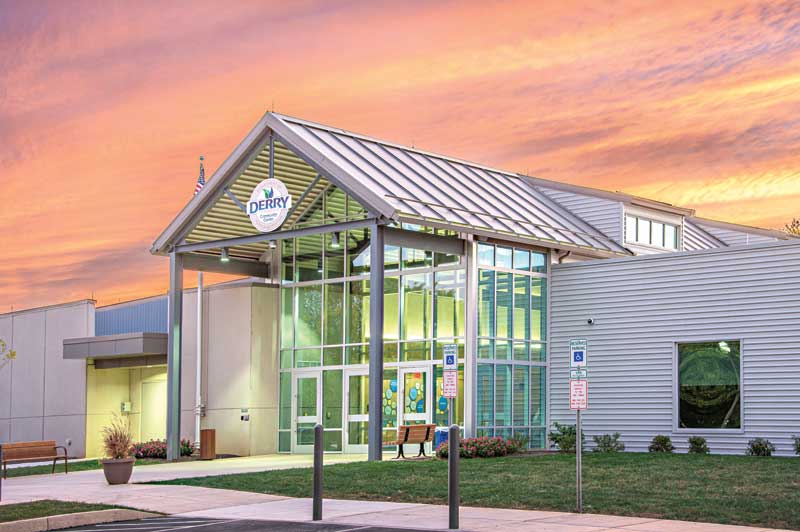
For the Derry Township Community Center in Hershey, Pa., a standing seam roof panel look was the perfect fit to meet the architectural features and forms that represent the building’s rural aesthetic. A prominent architectural feature of the facility, the roof is highly sloped but is also able to provide the insulation value the building requires.
Sustainable, smart selections
One of the main selling points on construction projects today is the specification of sustainable building products that can not only match performance requirements but also achieve the desired look and feel. Metal roofing systems are made from highly recyclable steel, minimizing product waste and increasing energy efficiency. Metal roofing systems, specifically those comprising American-made steel, have a lower embodied carbon footprint than other traditional roofing materials.
Metal roofing systems provide countless advantages to architects, building owners, contractors, and installers. With longevity and high-performance and flexible design options, metal roofing can meet virtually any building challenge to deliver unmatched results.
Arnold Corbin is the technical services manager for Metl-Span. Corbin’s areas of expertise include construction project management, estimating, product and installation training, building diagnostics, and product support. He is a committee member for the Metal Building Manufacturers Association (MBMA) and previously served on the board of directors for the Metal Building Contractors and Erectors Association (MBCEA).