Look back over the last 30 years of building product development and two themes jump out. First, manufacturers are designing products for easier installation. Second, they are designing products for better thermal performance. For curtainwalls, the same is true.
 Greg Galloway is the ProTek Brand Manager for YKK AP America Inc., Austell, Ga., and he identifies the two main trends in curtainwalls. “The two dominant things in terms of where curtainwalls are going is a movement toward pre-glazing or unitized construction, and improvement in thermal properties.”
The market forces driving the trends come from a couple of different directions. Much of the incentive comes from codes. When asked about the main motivation for thermal performance improvement, whether it’s code changes or a desire for better performing buildings, Galloway admits, “It’s a little bit of both.” “There’s a movement that is underway,” Galloway says, citing the net-zero energy movement as one driver of the change. “But it doesn’t hit the mass market until it gets into the codes.”
Thermal Properties
The improved thermal performance of curtainwalls comes from better glazing technology, of course, but also from advances in thermal break technology that prevents the transfer of heat through the frame. “The first generation of curtainwall products was, for the most part, not thermally broken. For a few decades, since the
’70s, we’ve seen either the thermal isolators or full thermal breaks in curtainwall systems,” Galloway says. “Now, it’s taking another step and going toward more advanced thermal strategies, which include two or more thermal breaks; and wider thermal breaks.”
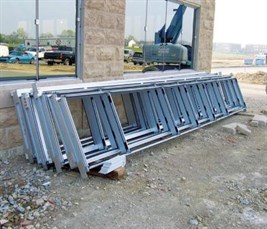 The focus is on improving every aspect of the system to make it work. Thermal simulations are commonplace and from those engineers can determine how make small changes to deliver big improvements. “Doing thermal simulations to find out that a little metal here versus moving metal there [improves performance]. Lots of things can make a little bit of difference, and in total they are a large difference,” says Galloway.
The use of thermal simulation tools itself has changed over the years, Galloway explains. When the tools first came out, they were used to test products to determine their thermal performance and assign a U-value. Now, the simulators are being used on the front end as a design tool to help create a product that works better.
Improving thermal breaks has also led to the introduction of perimeter air barriers. The wall may be high performing and the curtainwall may be high performing, but the juncture between them has, until recently, been a conduit for air infiltration. New perimeter air barriers, installed on-site, shut down that leak and give the building a higher performance.
Unitized Construction
Quality installation of curtainwalls has always been important, but the expectation for improved performance has made the detailing that occurs in the field far more important. Galloway says that the need for better control over installation is causing an increased in the use of unitized curtainwalls as opposed to stick-built. The unitized products are built in shops, while stick-built curtainwalls are put together on-site. “Part of that is the recognition that you can do better control of critical seals in a shop environment than you can out in the field. Even if you get the silicone in the right place, if it’s cold or dirty out in the field, that can affect the thermal performance.”
The majority of installations are still stick built. Part of that is driven by cost, but it also a result of the type of glazing contractors. Stick-built curtainwalls can be done by smaller companies that don’t need to invest heavily in warehouse and shop areas. “In doing research a few years ago,” Galloway says, “we say that companies installing unitized product tend to have about 25 people in the shop.”
That also translated to the type of work those companies landed. Larger shops with greater investment handled larger, more sophisticated projects. A three-story project may not allow for the full investment of unitized curtainwalls. For unitized installation, typically a company does a GPS survey of the site to make sure it identifies any anomalies prior to the installation, has to move lifting and safety equipment to the site, ship large materials, and have enough people on-site to make the installation work more quickly and smoothly. That means the costs of installation as a percentage of a small build can get too large. Better to stay with stick built.
However, unitized curtainwalls can be installed more quickly, and there are advantages to getting a building to the dry-in sooner. A general contractor can bring in other trades, such as plumbing and mechanical sooner, which can speed the overall construction time period. In addition, dry-in is often a major stepping stone in financing of a project, and getting to financing sooner may allow the lender to release the next stage of funding sooner.
Hurricane Andrew Strikes
Not only are there changes in the installation of curtainwalls as a result of the trend toward more unitized products, there also additional performance changes that have resulted from wind and pressure code changes. In 1992, Hurricane Andrew struck south Florida, causing extensive building damage. Since then, there has been a steady drumbeat of improvements for buildings in high-wind areas.
One example of that is the ProTek series of products manufactured by YKK AP America. This product is designed to be resistant to hurricane force winds and, in specific models, blast forces. The blast force protection has become an increasingly important security issue for many companies and the government.
According the Galloway, one offshoot of this increasing attention to wind performance is the focus on fastening systems. “Anchoring issues used to be left to the local professional engineer,” he says. “But we have started to take a different approach.” Part of the reasons is that in hospital jobs there are heightened anchoring requirements. “Now we provide much more anchoring engineering,”
he says. “We will provide specific size and type of anchor for each material and gauge.”
On the blast prevention side of the industry, the U.S. Department of Defense is the major driver of change, which is not surprising. Building performance in blast scenarios stipulate that the glazing should fail first, then the framing and finally the anchoring. That prevents the effect of any blast from transferring to another part of the building. But with new blast-resistant products, the anchoring could become the weak link, which could allow a blast transfer through a building rather than being isolated. Galloway says, “A bunch of manufacturers are now changing how they engineer anchoring.”
The changing demands in improved performance and the nature of the performance itself will cause increasing adaptations by manufacturers and glazing contractors handling curtainwall systems.
Photos Courtesy of YKK AP America