The United States Naval Academy Chapel in Annapolis, Md., was designed by architect Ernest Flagg and built from 1904–1908. Located on the grounds of the Navy’s service academy, the chapel played a vital role in its designation as a National Historic Landmark in July 1961. The chapel’s copper-clad dome highlights the grounds and is a dominant feature of the Annapolis landscape.
New copper cladding aids in fixing chronic moisture issues
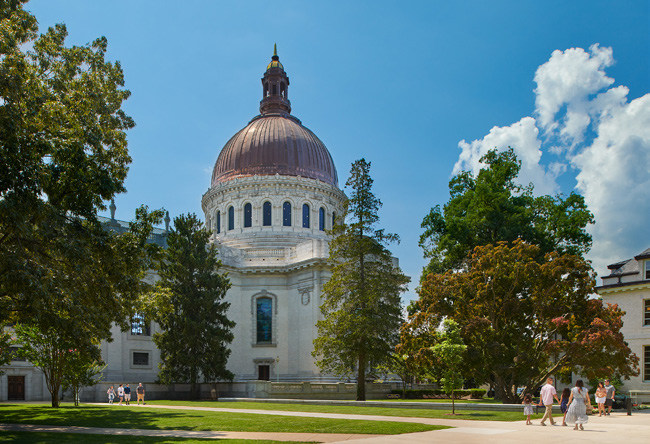
Photo: Anice Hoachlander
The craftsmanship and detail in the renovation of this historic chapel impressed the judges, winning the award for Metal Roofing Retrofit in the 2022 MCN Project Excellence Awards. Calling it the best project in the category, the judges thought it was beautiful.
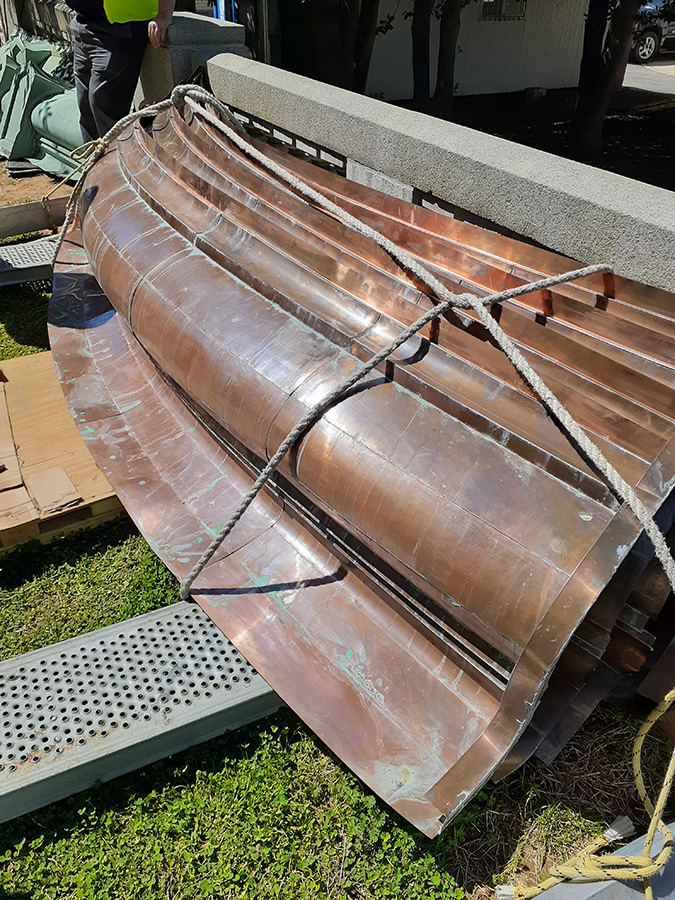
Photo: Anice Hoachlander
Chronic Moisture Problems
The dome, which is concrete, was originally clad in decorative terra cotta. After significant leaking at the dome was observed within a decade, the terra cotta was removed and replaced with copper in 1929. In 1938, Paul Phillippe Cret designed a nave that was added to the chapel’s northeast elevation. However, chronic moisture problems continued to persist throughout the first two decades of the 21st century.
The Naval Academy needed a solution to the chronic moisture problems that would respect the past, while developing a patina seen throughout the state capital, which would serve the institution with a low-maintenance, long-lasting roof for decades to come. For the project, the Navy engaged Rogers, Lovelock & Fritz Inc., Orlando, Fla., to provide AE services, who turned to BELL Architects PC, Washington, D.C., to serve as the lead architect.
As David Bell, FAIA, LEED AP, principal and founder, explains, BELL Architects’ process for historic properties begins with researching and evaluating the historic resources to analyze what has inherent value before guiding design decisions. The design team took a comprehensive approach using rope-assisted surveys, testing, laser scans and thermal imaging to guide the rehabilitation design. “We created a 3-D LiDAR scan and BIM of the building exterior and did up-close rope-assisted surveying, documenting damage and deterioration of the ornamental copper dome. Sampling and lab testing for structural and masonry materials was done to diagnose the root causes of moisture and staining problems. These informed the design alternatives and ultimately the selected solution for long-term upgrades to chronic building envelope problems.”
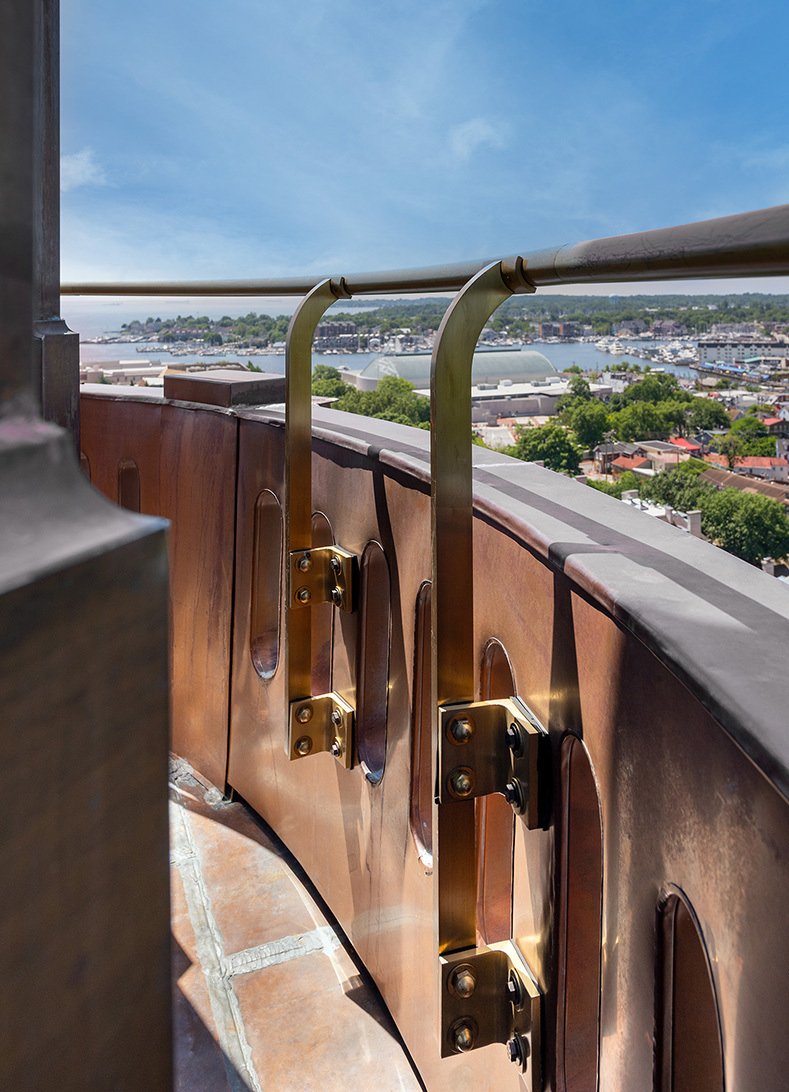
Photo: Anice Hoachlander
Overall, three design alternatives were investigated, with the final decision being to recreate the ornamental copper to replace the circa-1920s dome and lantern metal materials. “Custom bronze rails were created for life-safety at the lantern outlook platform above the dome,” says Joshua Kaltreider, project architect with BELL Architects. “They were designed to meet code and have a minimal effect on the how the dome looks.”
All in all, the project included the replacement of the entire ornamental copper cladding of the dome and lantern, custom copper-clad skylights, the introduction of through-wall flashing, structural reinforcement and masonry sock reinforcement at the parapets along the perimeter of the dome and nave, in addition to the replication of gold-leafed ornamentation at the lantern with an integrated lightning protection system.
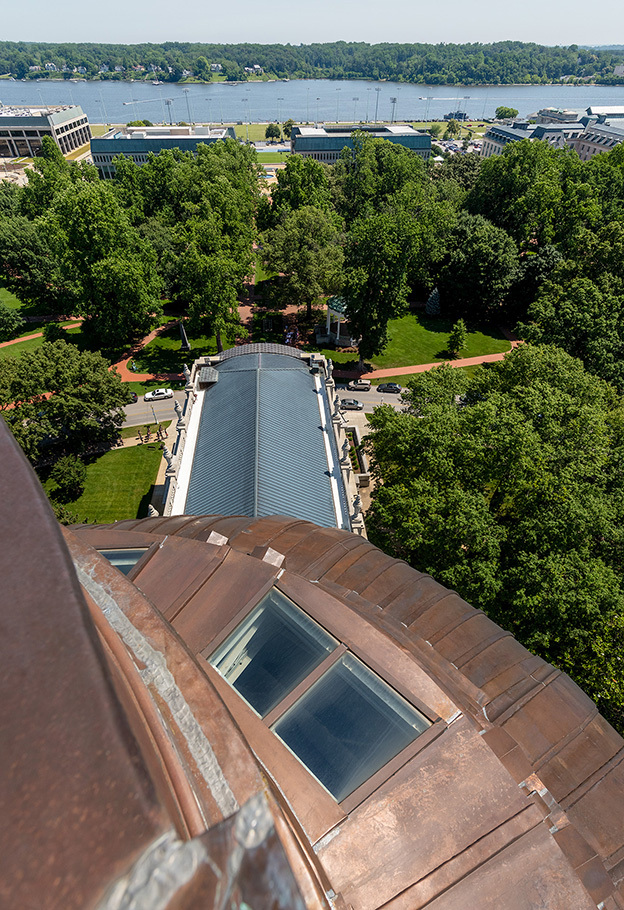
Photo: Anice Hoachlander
Renovation and Installation
The project required 20,000 square feet of 20-ounce soft copper sheets from Revere Copper Products Inc., Rome, N.Y. The H00 copper-rolled sheets were temper-formed to match the historic profiles. Additionally, the project used 50 feet of Brass-Alloy 385 tubes and plates that were used for the custom-fabricated guardrail.
The copper was installed starting at the base with relatively large, flat panels and progressed to the field of batten seam roofing. According to Dave Fyffe, principal, Seal Engineering Inc., Alexandria, Va., the installation was fairly standard, although at times tricky due to the curvature and changing panel widths. Another early area completed was the cupola floor that creates the cap for the crown. This installation consisted of standard flat locked and soldered copper panels.
While most of the project’s installation went smoothly, Fyffe says the dome ribs caused some challenges. As he explains, the intent was to match the original profile, however, the original seaming was discovered to have minimal overlap. To eliminate some of the vertical seaming and to make for better long-term performance and easier field installation, the contractor prepared panel mock-ups.
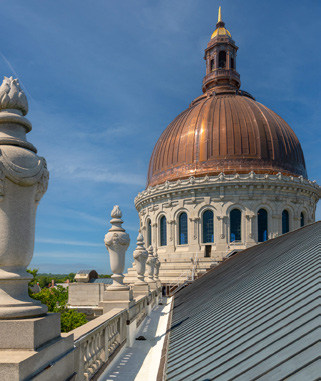
Photo: Anice Hoachlander
Decorative copper fabricated by CopperCraft, Fort Worth, Texas, was installed at the cupola. While details were generally two-dimensional, the trapezoidal sections rolled for the curved sections were seamed at the corners and horizontals.
Another challenge, Kaltreider says, was retaining augmented natural light within the dome. “The skylights were a source of deterioration and water infiltration,” he explains. “It was a challenge to design details and collaborate with the installers to meet the historical copper configurations while being watertight, safe and secure.”
Award Judge Ron van der Veen, FAIA, LEED AP, noted that it was great to see that kind of metal craftsmanship, which you don’t see that much anymore. “Ornamental sheet metal craftsmanship is a dying art,” notes Scott Knight, LEED AP, project manager and historic preservation specialist with BELL Architects. “The tools and skills for large-scale fabrications are being lost, making it much harder to achieve historically accurate recreations than it was even 20 years ago.”