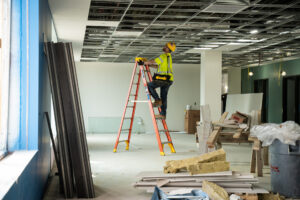
As metal roof installers, you’re already aware that the tools and equipment you use can directly affect your safety. Just like with any other trades, U.S.-made ladders are engineered to meet high safety standards set by American National Standards Institute (ANSI) A14. These ladders are built to withstand significant load factors and are rigorously tested for safety. However, no matter how well-designed a ladder is, whether it is safe or not ultimately depends on how you use it.
Here is what that means in your line of work. You may be working at significant heights and in challenging conditions, and even the safest ladder cannot prevent accidents if misused. In the metal construction industry, where tools and materials are often carried up to high roofs, it is easy to fall into a routine and become complacent about ladder safety—but that is when accidents happen.
Many ladder-related incidents occur because someone overreaches, leans too far, sets the ladder at the wrong angle, or does not follow basic safety protocols. As an installer, you must be proactive when approaching ladder safety. Think about every step–from setting up the ladder to climbing and working–and take the appropriate time to do it correctly.
Choosing the right ladder for your work
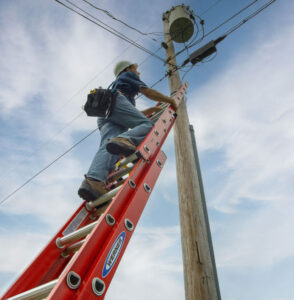
Before even setting up a ladder, you must pick the right one for the job. As a roof installer, you will often work around electrical sources using a fiberglass ladder, not a metal one. Also, ladders come in different types, each with a specific function–extension ladders, articulated ladders, step ladders, and combination ladders. And do not forget about duty ratings!
Roof work will likely require an extension ladder, which is rated for heavier duty. These ratings range from light duty (Type III, 91 kg/200 lbs) to extra heavy duty (Type IAA, 170 kg/375 lbs). Ensure your ladder supports your weight and any tools and materials you carry.
Consider the conditions where you’ll be using your ladder. Will it be on uneven ground? Is there a lot of clutter around? Are you carrying heavy materials up to the roof? These are all factors to think about before choosing a ladder.
Pre-use inspection and proper set-up
Each time you use a ladder, inspect it thoroughly. It is easy to assume that just because the ladder worked fine last time, it is safe to use again. But things change–ladders get bumped during transport, the ground conditions change, or the ladder’s feet may not be positioned properly. Even if the ladder’s been stationary for a while, check it to ensure it has not shifted or settled into soft ground.
Key things to check for extension ladders include stable footing, making sure all feet are securely placed on a flat, solid surface, and that the ladder is at the correct angle. For extension ladders, set the ladder at a 75-degree angle. When you stand with your toes at the base, extend your arms straight in front of you at shoulder height and grasp the ladder side rails with your palms. Never climb higher than the top two rungs for step ladders; they are meant for stability, not climbing.
You can even tie your ladder for extra stability or have someone hold it, especially when accessing a roof. Occupational Safety and Health Administration (OSHA) requires that ladders be secured to access elevated work areas. Using accessories like levelers for sloped surfaces or foot cleats prevents ladder feet from sliding.
Safe climbing practices
Always maintain three points of contact when climbing a ladder–two hands and one foot or two feet and one hand–to ensure maximum stability. Climb deliberately and avoid jerky movements. Keep your body or belt buckle centered between the side rails and never lean too far to one side or overreach. This is especially important on a metal roof, where the terrain may be slippery or uneven.
While climbing, use a tool belt or a towline to keep your hands free for balance. Never attempt to move a ladder while standing on it–this can easily lead to a fall.
Ongoing safety training and resources
The construction industry takes safety seriously, and there are great resources available to help contractors stay safe when using ladders. One excellent free resource is LadderSafetyTraining.org. This website contains safety content to reinforce the best practices for safe ladder usage. It is designed for both professional installers and everyday ladder users, so take full advantage of it.
National Ladder Safety Month (every March) also focuses on educating professionals in ladder safety. It is the perfect time to refresh your knowledge and ensure you follow the latest safety guidelines. ALI released an updated version of the Single and Extension safety video this March, which now includes safe practices for telescoping ladders.
The importance of ladder labels
You may have noticed all the safety labels and notices on ladders–while they may seem like a lot, these labels are there for your protection. They are essentially a built-in user manual and provide clear guidelines for proper usage. Be sure to take a few moments to read and follow the instructions.
Ladder safety is just as much about awareness and habits as the right equipment. You can significantly reduce the risks of working with ladders on metal roofs by staying vigilant, choosing the right ladder for the job, conducting pre-use inspections, and following safe climbing practices. Your safety and ability to do your job well depend on it. Stay safe, and do not rush!
Mike Van Bree is director of product safety and engineering at Louisville Ladder Inc. and president of the American Ladder Institute (ALI), the industry trade association. Van Bree has years of mechanical engineering experience in various industries and with a broad scope of products. His expertise includes climbing equipment and support structures, and he specializes in product design, manufacture, warnings, testing, safety analysis, incident investigation, failure analysis, and human interaction with climbing products. Van Bree has performed hundreds of incident investigations, including product and site inspections, human factors and ergonomics evaluations, mechanical and failure analyses, product testing, and accident reconstruction.