Long-span trusses are 60 feet or greater in length. Fulfilling developers’ needs for wide-open space, long-span trusses offer an efficient and economical way to support building roofs.
Correct pre-planning and procedures ensure safe and accurate long span installation
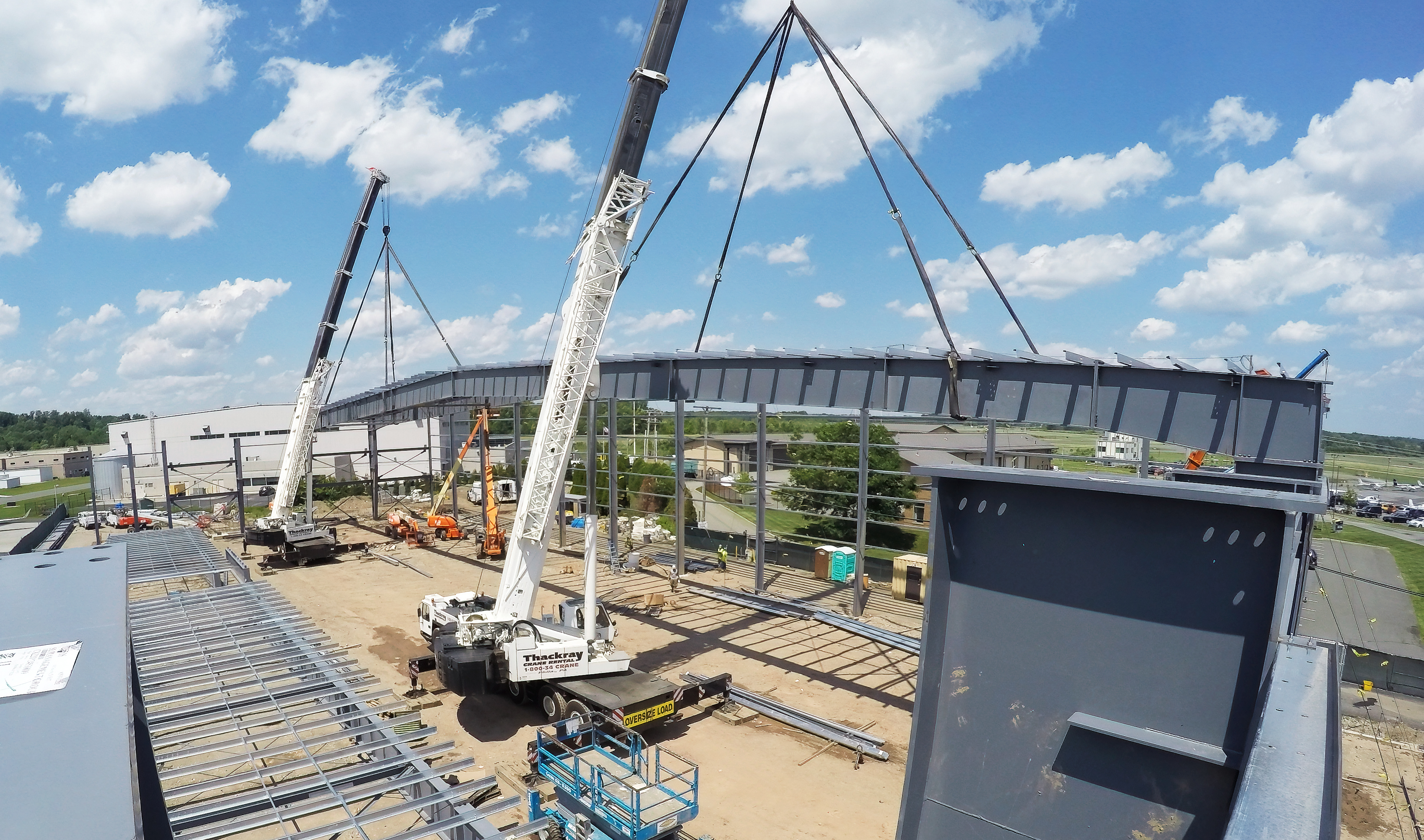
A 266-foot clear-span erection. (Photo courtesy of Thomas Phoenix International)
But because of their longer span, they can be dangerous to install, requiring more detailed safety and handling measures than short span trusses. Their increased dimensions and weight can create instability, buckling and collapse if not handled, installed and braced correctly.
PrePlanning
Preplanning makes long span installation easier and safer. Nick Weiss, senior project manager and Dallas general manager at O’Donnell Metal Deck, Dallas, stresses that communicating with your long span cold formed steel (CFS) truss supplier well before delivery is very important to ensure a successful plan for receiving, unloading, storing and erecting the over-spanned joists on the day of delivery. “It even starts as early as quoting or during the approval drawing process. Look into getting the joists spliced at the midspan to make them more easily handled during erection. [Also,] the freight cost savings can be huge instead of shipping 100-foot joists requiring escorts, permits, etc. You can ship twice as many 50-foot joists on standard 53-foot trailers that can be bolted in the field during install. Splicing the joists does raise the cost of the joist themselves but there’s a point at which the freight cost savings makes sense.”

(Photo courtesy of Alpine TrusSteel)

(Photo courtesy of Alpine TrusSteel)
William Harlow, vice president of construction at Red Dot Buildings, Athens, Texas, says a pre-construction meeting should be conducted prior to material delivery and commencement of erection. “At minimum, the controlling contractor (GC), erector, and any other subcontractor involved in erecting the building should be in attendance.” He says the following topics should be discussed and agreed upon by all parties:
• Site logistics and storage locations for materials
• Erector mobilization date
• Equipment to be used during the erection process
• Delivery dates for materials
• Erection plan with sequence of erection
• Crane(s) placement
• Lift plan (usually created in collaboration between erector and crane operator). To be reviewed and approved by controlling contractor
• Bracing plan for both temporary and permanent bracing
• Safety procedures
• Locations and number of deadman concrete anchor locations for temporary bracing if needed
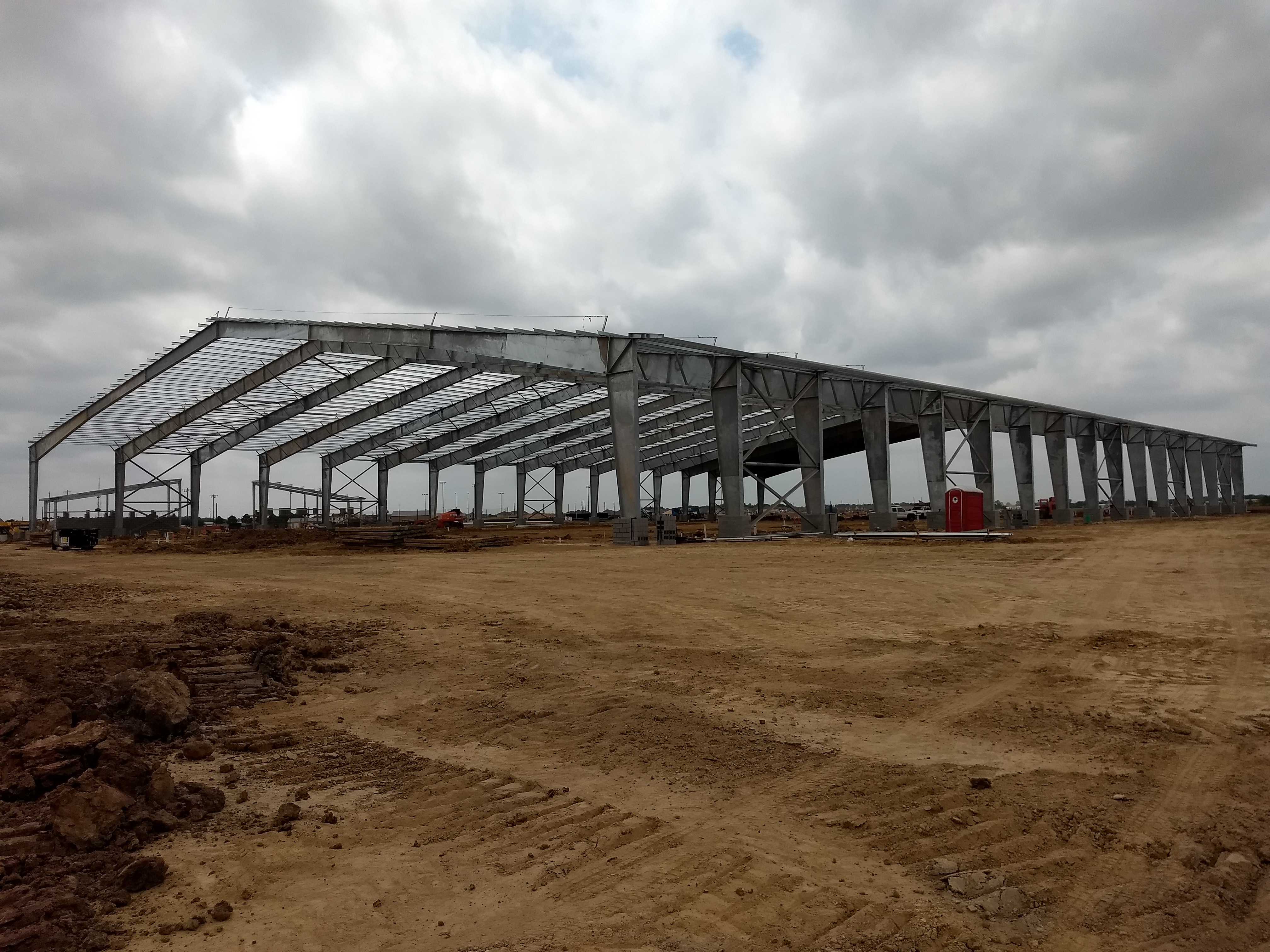
(Photo courtesy of Red Dot Buildings)

(Photo courtesy of Red Dot Buildings)
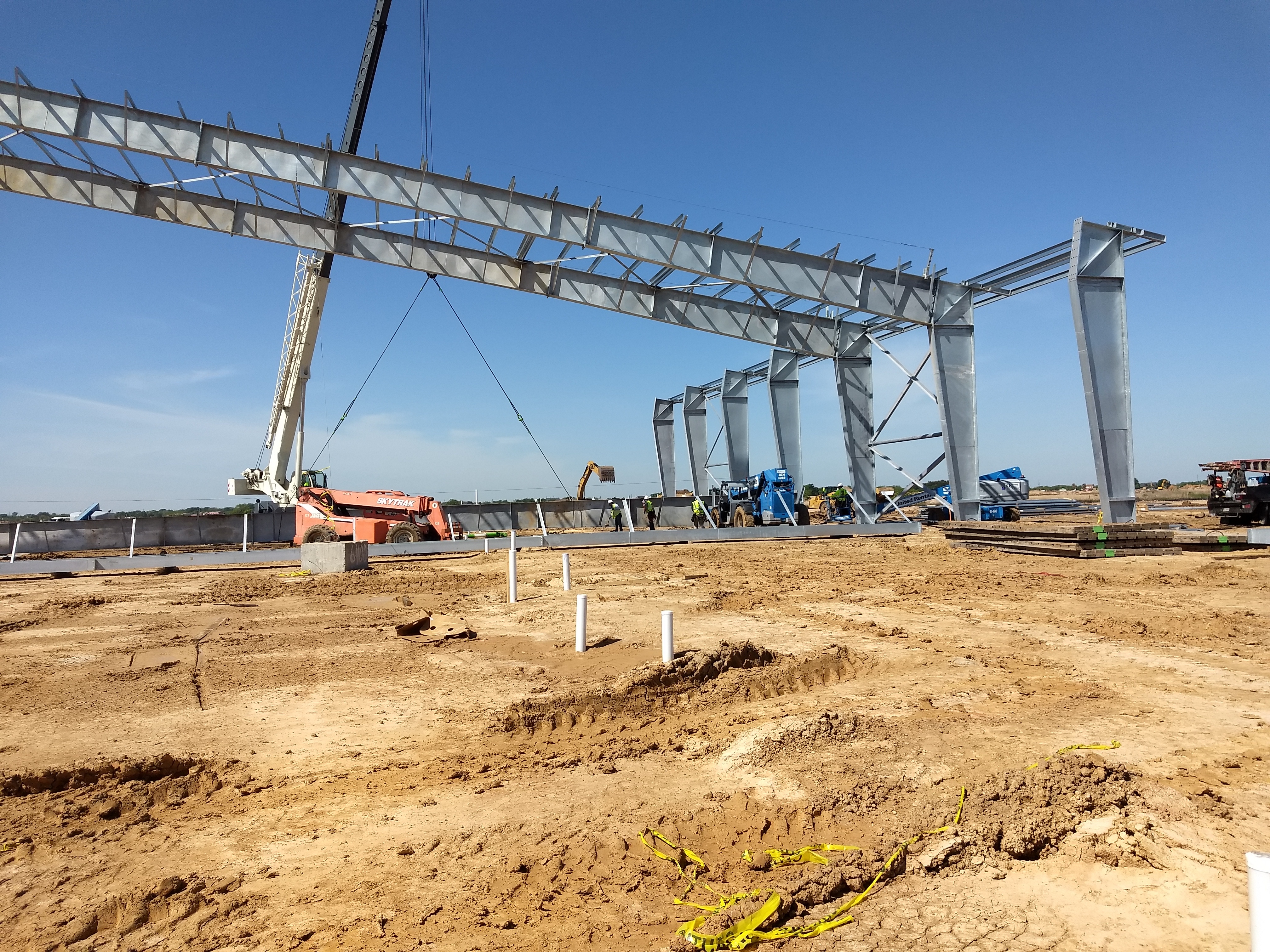
If a rafter spans over 80 feet, Joseph Allen, project manager, and safety and training manager at Thomas Phoenix International Inc., East Hampton, N.J., agrees the erector must study the shop and erection drawings carefully to make sure the span will be rigid enough to fly with standard rigging. “Spreader bars and/or chainfalls may be necessary to provide enough support. PEMB clear spans need to be braced sufficiently before being released, either with temporary cables or by tying into the existing braced erection with beams, girts or purlins. Planning must include appropriate anchorages for temporary bracing cables. Depending on the building design, it can be safer to build large modules and erect a full bay at a time, including rafters, purlins and all bridging at bracing together. This has the advantage of letting a large portion of the work be done at ground level instead of in the air, and can provide a more rigid structure with all permanent bracing installed before being flown into position. This means planning for a larger crane than a typical stickbuild.”
Bruce F. Brothersen, PE, senior innovator–innovation services group at Vulcraft/Verco Group, Brigham City, Utah, explains that these long-span joists will likely have a bolted field splice due to shipping restraints. “Properly tightening the bolts is a key component to the erection. The joists are assembled as one piece in the shop and then pulled apart to weld and handle. Consequently, the individual halves must be mated with the appropriate piece. There are mark numbers on the two pieces that indicate which pieces go together. Properly tightening the bolts is a key component to the erection.”

(Information courtesy of O’Donnell Metal Deck)
Bill Babich, PE, director of engineering at Alpine TrusSteel, Orlando, Fla., says, “It is important to have all the parties be familiar with the CFS Building Component Safety Information (BCSI) document published by the Cold-Formed Steel Council (CFSC) of the Structural Building Components Association (SBCA). This document outlines essential information regarding the handling, installing, restraining and bracing of CFS trusses. Other necessary documents on the job site during this process are the truss submittal package, the truss placement diagram, the construction documents, and any other required OSHA lifting and fall restraint information.”
Lifting, Hoisting, Craning
Care must be taken when moving long-span CFS trusses to ensure they do not bend out-of-plane. Because of their long length, these joists are unstable. When lifting, make sure there are multiple points of attachment, and a spreader bar of sufficient strength is used. Babich says Chapters B1 of the CFS BCSI document should be referenced to for important information. Allen explains that because systems-engineered rafters are welded plates, it’s not safe to assume that the members can always be picked by using a standard beam clamp on the top flange. In these cases, he says picking from the bottom of the rafter members with a choker can avoid the possibility of cracking welds or bending the top flange.
“If picking large-span members with girder clamps, it’s preferable to use those rated for side-loading which include a threaded web locking point to prevent slippage,” Allen adds. “When choking clear-span rafters, softeners must be used at all four pinch points. Black iron pipe can be slotted to the flange thickness to provide a radiused edge, but must be secured so they cannot fall when slings tension is released. On some large spans, spreader bar use can be avoided by adding a chainfall to the center of a two-point pick. By carefully adjusting the chainfall, this additional support in the middle of a rafter can help stabilize the piece before lifting into position. Cranes and forklifts should hold rafters in position until each new section is sufficiently tied back in to the existing erection.”
Harlow says rafter erection should be started in a brace bay. “After this brace bay is installed, it should be racked and plumb prior to proceeding to the next bay. Rafters may be erected individually, as a complete rafter line, or in pods. The method is dependent upon many factors, including the number and size of cranes to be used, weight of individual members, erector preference, and how much area is available on-site for rafter pre-assembly on the ground. Regardless of the method, members should be strategically located for ease of picking with a crane prior to the arrival of the crane on-site.”

(Photo courtesy of Alpine TrusSteel)
Bracing
One of the most important aspects of an acceptable long-span CFS truss installation is the proper placement and attachment of the members used to brace and restrain the trusses. This is equally important for both the temporary bracing used during installation of the trusses as well as the permanent bracing that will be installed for the life of the structure.
“Since trusses are slender in the out-of-plane direction, it is necessary they be braced and restrained to prevent movement,” Babich says. “The lateral braces used to restrain the series of trusses are important, but of equal importance is the placement of diagonal braces that allows the bracing to function as a system to restrain the trusses. Refer to Chapters B1 and B2 of the CFS BCSI document for important information regarding installation bracing and Chapter B3 for permanent bracing. When installing CFS trusses, careful planning must be made regarding the sequence of events. Chapter B2 of CFS BCSI gives a step-by-step procedure for the installation of the trusses. When the temporary bracing requirements set forth in CFS BCSI are not followed, it can lead to disastrous results during construction. When the permanent bracing is not located as detailed on the truss design drawings and not properly anchored, the trusses may not be able to support the loads as needed.”
(Photo courtesy of Red Dot Buildings)
Allen agrees that inadequate bracing is probably the most common reason that a building fails during the erection process. “OSHA has firmly placed the responsibility for maintaining stability during all phases of erection squarely on the erection company. This is an area where contractors who are accustomed to working with smaller systems-engineered buildings or structural steel get in over their heads. Make sure to flag all temporary bracing with hi-visibility tape or reflectors to avoid unintended collisions or entanglement. All flange braces should be connected as soon as possible when rafters are flown into position and tied back to the previously erected steel. This helps to keep the rafter plumb and provides the triangles necessary for rigidity. In most instances, the column-to-rafter connections should be made before joining rafters at the peak. This means that rigging should be attached accordingly so that the correct slope is achieved before flying into position. Measure how far the peak gets before the haunch comes off the ground and make sure that it’s slightly higher than it needs to be.”
Brothersen explains that generally, the joist manufacturer will provide the bracing, which many in this industry call bridging. “The Steel Joist Institute has a specification and there are requirements in this specification for the bridging requirements. In all these cases the bridging is bolted and in the configuration of an X. With these members erectors must give some thought to the size of the equipment that must be used to safety erect these joists. Joist manufacturers are willing to provide the information to assist the erector.”
Allen says the Metal Buildings Institute published “Temporary Bracing Guidelines for Metal Building Systems” in 2021 by consulting with engineers and erectors to create a practical guide for ensuring that there is an informed starting point for steel companies to develop proper temporary bracing plans.

A chainfall stabilizes a rafter pick. (Photo courtesy of Thomas Phoenix International)