Moving metal construction materials on job sites can involve various operations such as lifting and installing panels, stacking or storing materials, and operating heavy machinery. With the right strategy and the proper equipment, contractors can increase productivity, keep workers safe and protect construction materials from damage. Yet every day, using the wrong equipment or improper handling and storing of materials cause costly injuries and damage to construction materials.
Tips and equipment to move your construction materials around
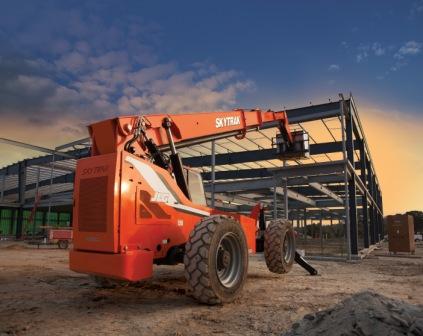
To successfully and safely move materials on-site, it is important to assess the job site and the materials, determine the appropriate equipment needed and implement the correct strategy to tie everything together. This requires preplanning.
“In the planning stages of a job, we work together with the general contractor and tradesmen, such as sheet metal workers or ironworkers, to determine the ideal methods, equipment and machinery needed to move materials on the job site,” says Richard S. Randall, operations manager, The ALL Erection & Crane Rental Corp., Cleveland. “Much is covered in pre-bid planning as it relates to logistics, and every day we meet and discuss the activity of the day ahead. Communication is key. That said, some of the important considerations to plan around are obstacles. We consider everything from power lines and communication lines, to public walkways to gas and water lines underground. Experienced planning at this level can make the difference between increased productivity and downtime, not to mention liability. Without careful planning, you can end up inconveniencing a whole lot of people, or worse.”
Art Hance, president of Hance Construction, Washington, N.J., also stresses preplanning, saying that he witnesses the most efficient material handling executed by erectors who read and understand the erection drawings prior to arriving on-site. “The erectors who have a plan on how they want to erect the building know where they want material placed and what order they want it shook out,” he says.
Forklifts
From unloading trucks in a storage yard to moving pieces to their final destination, the staging of job-site materials can be addressed and strategized using many different types of equipment. “The equipment selected directly impacts how efficiently and quickly the job may be completed,” says Len Lawrence, industry manager-metals, Hyster Co., Greenville, N.C. “When navigating through compact spaces, a high-capacity forklift with a short wheel base combines durability, increased maneuverability and a tighter turning radius for more efficient load handling.”
When Raymond, N.H.-based Jewett Metal Buildings
& Steel Erectors has to move materials at its job sites, its most commonly used piece of machinery is a rough terrain forklift. “We depend on them for everything from offloading a building from the truck and moving materials around the site, to erection of the metal building or steel itself-even occasionally getting other equipment unstuck,” says Jewett’s development director and estimator Tom Morton. “We also use them for relocating equipment like welding machines to various levels of the building. Forklifts work well to shake out the steel (sort, separate and stage) on the job site.” Randall says telescopic forklifts provide excellent control when lifting materials up to five and even six stories.
Telehandlers
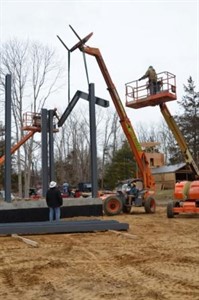
Hance sees the telehandler, or lull, as one of the most versatile pieces of equipment on his job site. “From unloading trucks to use during erection, the telehandler provides pinpoint accuracy over a variety of site conditions,” he says. “With a spreader bar it can lift and place long bundles of roof and wall panels. Using appropriate slings, it can place most structural members depending on building size. Today, metal building shipments combine many aspects of the project on one truck to get the most from freight dollars. This can make staging very difficult. The telehandler allows you to pick material from the truck and if structural parts such as columns and rafters are placed on the ground for shake out, subsequent pieces coming off the truck to be used later can be set behind them so the parts are arrayed for efficient access during erection.”
Brian Boeckman, global product director of telehandlers at McConnellsburg, Pa.-based JLG Industries Inc., agrees telehandlers are essential machines at metal construction sites, calling them the primary machine for unloading trucks, transporting material around the job and placing material at height. “These versatile pieces of equipment pick and place materials to heights of 55 feet and have the ability to carry loads of 12,000 pounds,” he says. “Benefits include an array of attachments to keep productivity high, ultra-strong booms to lift materials in heavy applications, side-mounted engines for easily accessible maintenance, and three steering modes (front wheel, all-wheel and crab steer) for maneuverability around the job site. Telehandlers’ reach capability gives them an advantage over straight mast forklifts.”
Cranes
Cranes are a familiar sight on construction sites. When delivered materials have whole bundles that can be removed at once and these materials need to be moved further and higher, a crane is optimal. “Depending on the size and height of the building, we’ll use a crane-especially if bar joists are involved rather than purlins, because the framing members are heavier,” says Morton.
Cranes have numerous end effectors that aid in the lifting and moving of materials. “Some can pick-and-carry a load, including industrial cranes and smaller, four-wheel drive, rough-terrain cranes,” says Randall. “Other cranes are planned and positioned to be in a fixed position on the job site so they can perform their main lifting function. In these cases, trucks need to bring the material to within radius of the positioned crane. Finally, tower cranes are ideal material handlers for larger, vertical construction projects. They are positioned in such a way on the job site where their horizontal boom with rolling trolley can pick and then place a load anywhere on the project site. But there is no silver bullet. Every equipment choice we make is driven by the construction schedule and the nuance of the load itself.”
Vacuum Lifters
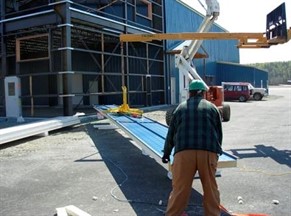
Vacuum lifters are being used more and more on job sites. They can be mounted on a forklift, telescopic handler or suspended from a crane. The metal construction industry has utilized this equipment for some time in Europe, but it is newer to the United States. Contractors utilizing vacuum lifters versus traditional methods to install insulated metal panels see increased worker safety and productivity, and less chance of damage to valuable materials.
“Vacuum lifting securely holds material, eliminating the need to strap or chain materials,” says Lisa Hagel, advertising and marketing coordinator at Wood’s Powr-Grip Co. Inc., Laurel, Mont. “Vacuum pads attach directly to the face of insulated metal panels, keeping edges free for exact panel placement. Vacuum lifters provide quick and convenient ways to get a better grip on awkward loads, placing handlers at a safer and more advantageous distance from the load, and in most cases, they take the weight of the load completely off of the worker.”
Moving Material, Staging Strategies
Again, construction site material moving and staging strategies begin at initial job-site meetings determining where materials should be unloaded from and stored at. “Initially, you should be sure your materials are properly barricaded once you’ve established a location for them,” says Morton. “This not only prevents damage, it also increases site safety. We always place panel and trims at the furthest (and therefore safest from damage) point from the actual building itself and elevate roofing and siding on one end to allow water to run off.”
Morton shares these other moving and staging tips:
- Make sure the area is somewhat flat and use plenty of blocking to keep materials off the soil and to allow re-picking either with chokers or forklifts.
- Always have a ground person to aid in unloading and/or moving, and always locate the center pick point of longer panels or steel members.
- Ensure all personnel are properly trained on moving equipment and materials around.
- Ensure each employee knows and understands proper signals. If a signal person is used, both operator and signal person must know and use the same signals.
- Ensure that the disturbed ground surface has been compacted sufficiently to support equipment and loads placed on it.
- Be aware of your surroundings. Look for overhead power lines, trenches, open holes and storm drains.
- Always ask the controlling contractor if they have any type of buried piping or tubing before setting up a crane.
- Be aware of other trades and what they may be using for equipment in your area.
Randall uses the term “boom bound” to describe crane strategy. “That means you have to work within a very specific radius so materials can’t be staged too far or even too close-both affect the lifting capacity of the machine,” he says. “The staging site also must coordinate with the final lift plan. For example, if the crane is positioned on the east end of the building and you are going to swing all material to the west, all staged material has to be positioned to the east of the crane. After that, you want to simply stage materials such that what you need first is positioned first, and so on.”