Why metal ceilings are a good choice
Installing a drywall or drop ceiling typically is the most obvious answer for specifications, but it isn’t the most aesthetically pleasing, sustainable or maintenance-free solution. Today, metal manufacturers have evolved beyond traditional tin tile ceilings, allowing a custom look with easy installation-for any commercial or residential space, for interior or exterior applications.
Installation
Many manufacturers offer carrier systems to which metal tiles or panels can be attached. Allentown, Pa.-based ATAS International Inc.’s carrier is roll formed from prepainted 0.040-inch aluminum. The standard length is 12 feet. To make installation easy, holes are prepunched in the top and sides for mounting. The ceiling can be suspended by wires or other hangers, as well as rigidly attached directly to the structure.
 Once the installation space is prepared, the ceiling panels snap onto the carrier. Filler strips can be removed to allow for ventilation or soundproofing. The carrier track repeats in 4-inch increments, making different ceiling panel sizes interchangeable.
Thermal movement can be a concern for some when using any type of metal product. This can be overcome by allowing a space between panels for thermal movement. ATAS recommends a 1/8-inch gap. Also, the hairline connection should be at least 4 feet and three courses apart on a staggered formation to minimize visual sight lines.
“To keep a cohesive look, all accessory pieces are available in the same quality materials as the panels,” says Jim Bush, vice president of sales, ATAS. “To create a different look, filler strips also are offered in accent colors.”
Questions also arise when considering acoustics. Assumptions are made that a metal ceiling will cause echoing in the installation space. For acoustical efficiency, a low-density black fiberglass blanket often is placed across the top of the panels between the carriers.
Regardless of what you choose, customers will thank you for a clean installation. “Unlike a drywall installation, there is no tape, sanding and painting to consider. You also don’t have to repaint a metal ceiling every few years like you do with a drywall ceiling.”
Aesthetics and considerations
One of the main reasons metal ceilings are chosen is the look. An option that adds instant appeal is using curved panels. “If contractors are installing a curved ceiling, the panels should be installed on a radius carrier, which will need a solid support. The length of the ATAS radius carrier is 12 feet,” Bush says.
Styles, colors and finishes create a virtual array of aesthetic options. You should verify that the metal panels have a quality coating, such as Kynar 500 or Hylar 5000, which will help extend the panels’ life and retain the original color. Another bonus of using metal is environmental concerns are eliminated. Metal will not shrink, rot or decay like other materials when exposed to water. Metal also brings noncombustible installation, wind resistance and weatherability.
The panels can be recycled at the end of their life span, which many building owners appreciate as they look for green materials.
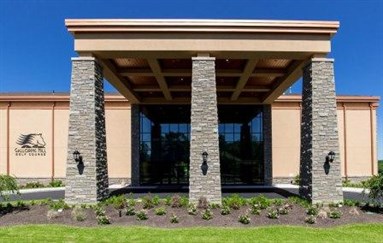
The Galloping Hill Golf Course, a premier public golf facility in Kenilworth, N.J., opened in 1928 and is slated to host the 2016 New Jersey Open. This will mark the first time a public club has hosted the event. To prepare, KemperSports, Northbrook, Ill., and Netta Architects, Mountainside, N.J., designed a new 34,000-square-foot Club House with a separate Learning Center. The Club House features a banquet area with a grill, pro shop and locker rooms. The space also is the headquarters for the New Jersey Golf Association, which includes a golf museum. The Learning Center has 52 practice stalls, a state-of the-artvideo instruction system and a 40,000-squarefoot practice area.
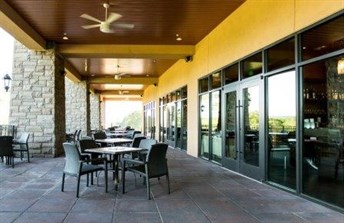
The Tuscany-style building is clad in stone and stucco, and a lower terrace at the building’s rear highlights the bar and grill. This is where metal ceiling panels were installed to add a pop of style. Hong Jin, RA, ASID, LEED AP, the director of sustainable design and interior design with Netta Architects, says the goal was to create timeless appeal with a variety of “beauty, healthy and purpose spaces.” The Linear Ceiling
(LCB338) system from ATAS was installed by Claremont Construction, Far Hills, N.J. The system was chosen because it is manufactured regionally and a recycled product. It also allowed a sophisticated look that really makes a statement to come to life.
This 10,649-square-foot panel installation features 0.032-inch aluminum panels in Coppertone. The linear ceiling is available in two profiles: round edge or a square box that can be installed with or without filler strips. Each profile has a choice of three widths that are interchangeable because of the carrier system’s 4-inch increments. The three ceiling widths provide coverages of 4, 8 and 12 inches.
Consider it
Just because one’s mind doesn’t instantly think metal and ceiling, there are many reasons to consider it. Aesthetics, weatherability, durability, acoustic control and sustainability are just a few. As a contractor, installation won’t be a challenge if you work with the manufacturer to determine the best carrier system and panel spacing needs. When your next customer is looking for an indoor or outdoor ceiling solution that will bring more than a white slab to the space, suggest metal. It might just help you gain a happy customer for life.
Kate Gawlik is a marketing consultant for ATAS International Inc., Allentown, Pa. She writes about design and construction from Lockport, Ill. For more information on ATAS visit www.atas.com.