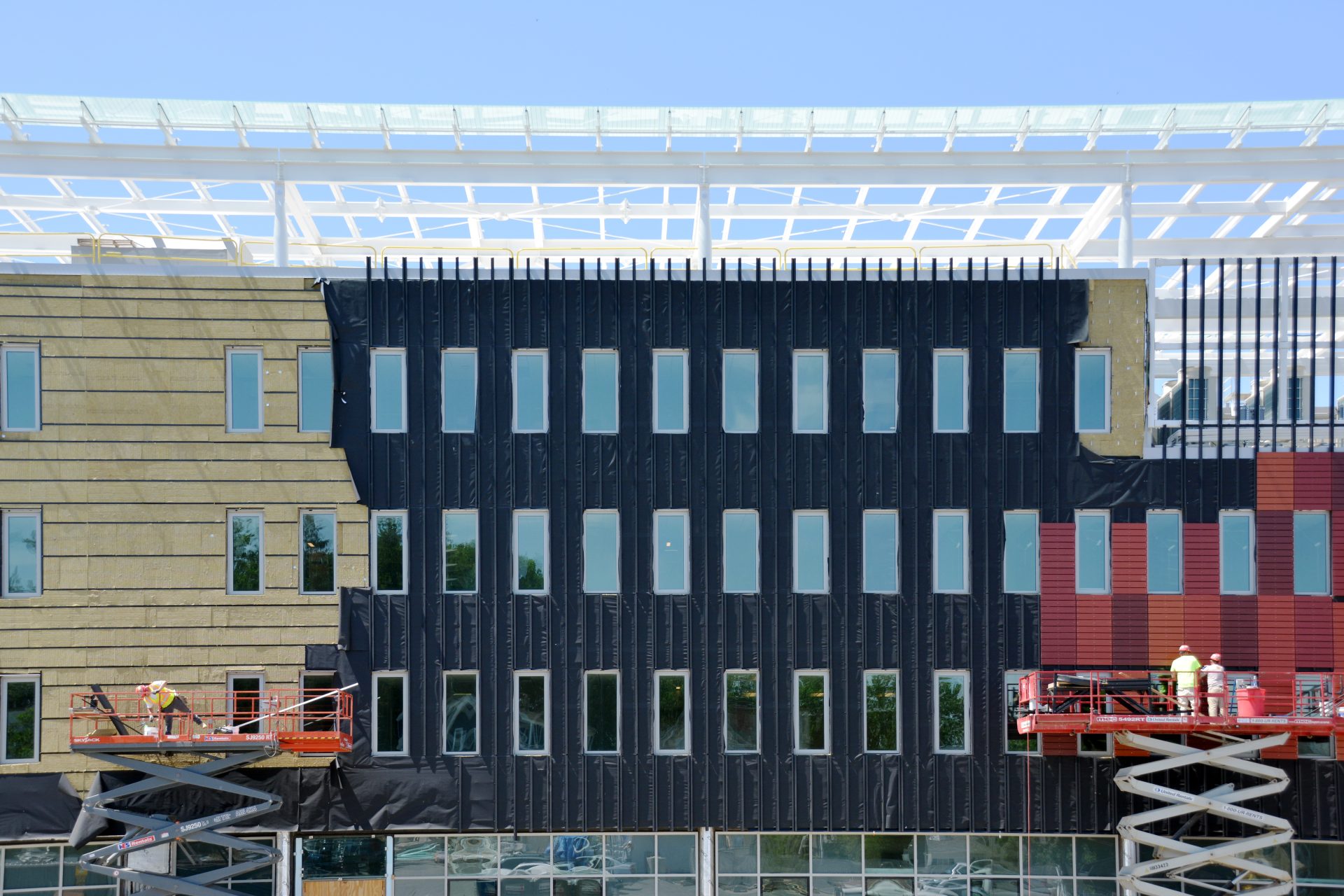
Open-joint metal cladding systems are commonly used in contemporary building design, offering a sleek, modern aesthetic. While visually pleasing, they also fulfil critical control functions, particularly when installed to perform as rainscreens. These systems have gained popularity due to their enhanced ability to manage moisture, their use of continuous thermal insulation, and their contribution to the overall durability of the building envelope. The effectiveness of these systems is enhanced by incorporating additional elements, such as air barriers and UV-resistant water-resistive barriers (WRBs), which improve moisture management and extend the longevity of the cladding and substructures.
This article examines how air barriers and UV-resistant WRBs enhance the durability of open-joint metal cladding in a rainscreen assembly.
Open-joint metal cladding in rainscreen systems
Before delving too deeply into the details, a review of common terminology will help ensure an understanding. One excellent resource for this is the industry association dedicated to supporting performance-driven assemblies, RAiNA (Rainscreen Association in North America). RAiNA provides definitions for several relevant terms:
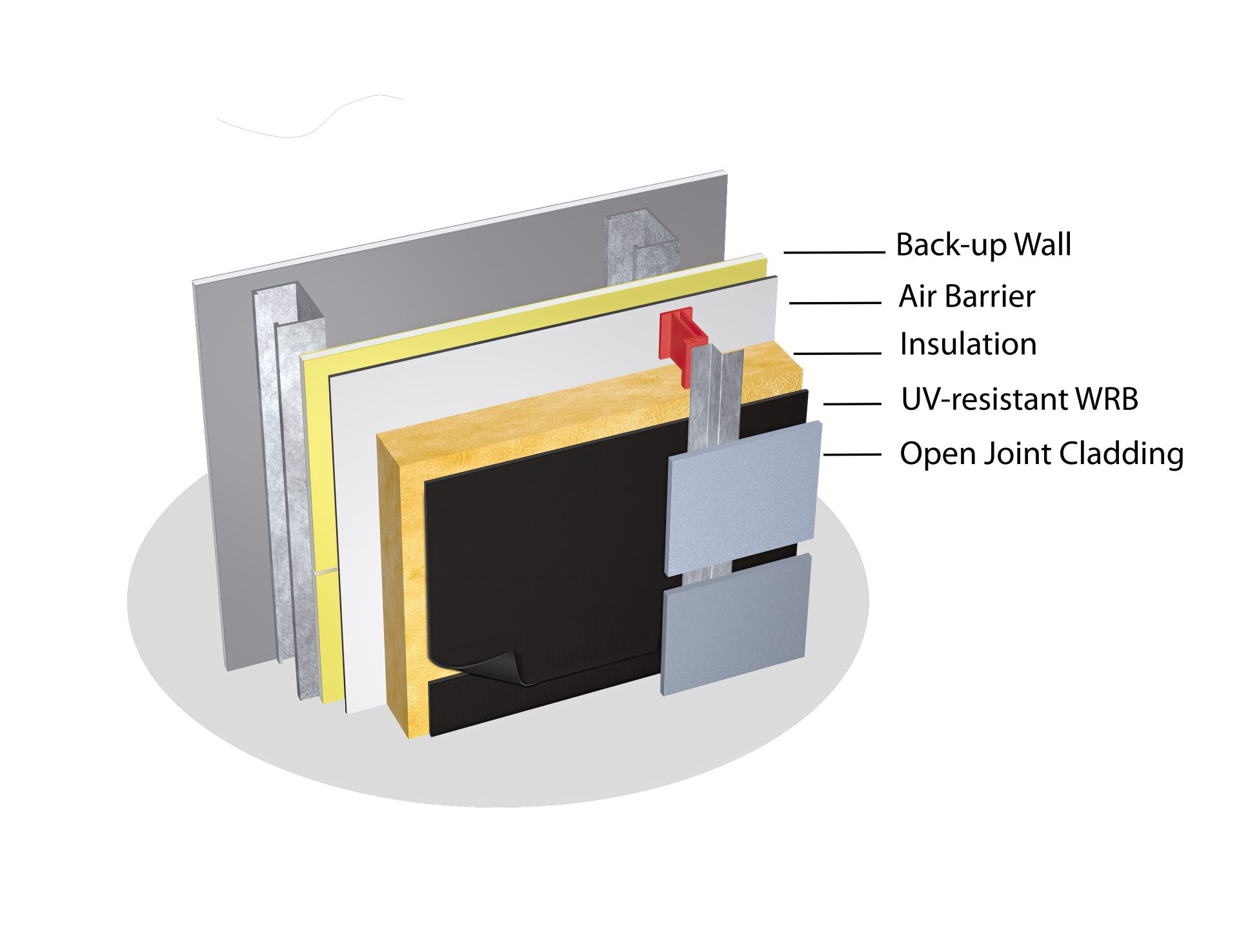
- Rainscreen: An assembly applied to an exterior wall that consists of—at a minimum—an outer layer, an inner layer, and a cavity between that is sufficient for the passive removal of liquid water and water vapor. The design typically consists, from the outside in, of an exterior cladding (such as metal panels, wood, or stone), an air gap (or cavity), a water-resistant barrier, a substructure, thermal insulation, and an air barrier.
- Open-joint metal cladding: A system with a gap or reveal between adjacent cladding edges or between cladding panels and adjacent components, designed to accommodate movement and allow water, air, and daylight to penetrate the rainscreen cavity.
In simpler terms, there are visible gaps between the panels, allowing air to circulate freely behind the cladding. This design creates a ventilated cavity that helps prevent moisture buildup and enables the cladding to drain and dry out efficiently after rain or other wetting events.
While open-joint cladding systems have aesthetic and functional benefits, their performance depends significantly on how well they manage air, water, and moisture. Here, the role of air barriers and UV-resistant WRBs becomes critical in ensuring the durability and longevity of the rainscreen assembly.
Air barriers in rainscreen systems
An air barrier is a critical component of the building envelope that controls the movement of air between the interior and exterior of the building. The best definition here comes from the Air Barrier Association of America (ABAA):
- An “air barrier” is a combination of materials designed and installed in such a manner in order to drastically reduce or even stop the flow of air into and through the building enclosure. The air barrier of a building is an “air barrier system.” The air barrier system is comprised of “air barrier assemblies.” Air barrier assemblies are comprised of “air barrier materials” and “air barrier accessories.” (ABAA Technical Note #1)
To be clear, an air barrier assembly is a system requiring specific components to perform as desired. This is particularly important in climates with significant temperature and humidity fluctuations, as uncontrolled airflow can cause moisture infiltration that eventually degrades building materials.
In a rainscreen system, an air barrier on the backup wall prevents moist, warm indoor air from entering the cavity behind the cladding, where it might condense and cause issues such as mold growth, rotting, or metal corrosion. Air barriers enhance the system’s ability to control moisture and maintain a dry, ventilated environment behind the cladding.
UV-resistant WRBs
Typically, a UV-resistant WRB is located behind the cladding panel but in front (to the exterior) of the continuous insulation (c.i.). The function at this location is to prevent water from penetrating the building envelope while still allowing water vapor to escape. To that end, it must be highly moisture-vapor-permeable. In open-joint metal cladding systems where the cavity behind the cladding is ventilated, a WRB becomes even more critical because it acts as a primary line of defense, especially during heavy rain, strong winds, or storms when water can be driven behind the cladding.
Wind-driven rain can force water through joints, which could lead to water damage, rusting, or staining of the cladding material. Without this WRB, water infiltration could soak the insulation and reach the sheathing and framing, potentially causing structural damage.
The role of a UV-resistant WRB is particularly important in areas where the cladding may be exposed to direct sunlight for extended periods. UV rays can break down materials over time, causing regular WRBs to lose water-resistant properties and the ability to prevent moisture and wind from entering the wall assembly. A UV-resistant WRB is designed to withstand the degrading effects of UV radiation, ensuring that the membrane maintains its integrity and performance over the long term, while adding the 3D look desired by designers.
The combination of an air barrier behind the insulation and UV-resistant WRB in front creates a robust defense against environmental factors that can degrade both the cladding and the building’s structural components.
Combined benefits of air barriers and UV-resistant WRBs
When integrated into a rainscreen assembly, open-joint metal cladding, air barriers, and UV-resistant WRBs work synergistically to increase the durability and performance of the building envelope.
The air barrier on the backup wall effectively minimizes moisture infiltration and regulates airflow. Meanwhile, the UV-resistant WRB behind the cladding ensures any water that enters the cavity is effectively managed and directed away from the building’s interior before it can penetrate deeper into the wall system.
This combination of protective layers also improves the building’s thermal efficiency. By controlling air movement (wind-washing) and moisture levels, the rainscreen assembly helps regulate indoor temperatures, reducing the need for energy-intensive heating or cooling systems. This contributes to the building’s overall sustainability, reducing its environmental impact.
Further, the enhanced durability of open-joint metal cladding systems with air barriers and UV-resistant WRBs translates into reduced maintenance costs and an extended service life. Look for guide specifications that provide a complete system, integrate products into a full assembly that delivers high performance, and ensure compatibility among various manufacturers.
Conclusion
Incorporating air barriers and UV-resistant WRBs into open-joint metal cladding systems enhances the durability of rainscreen assemblies by improving moisture management, protecting structural components from water damage, and ensuring the longevity of the cladding itself. These components work together to create a building envelope that is not only more resistant to environmental stresses but also more energy-efficient and cost-effective over time. As building designs continue to prioritize sustainability and performance, the combination of open joint cladding, air barriers, and UV-resistant WRBs will remain a critical strategy for ensuring the durability and resilience of modern buildings.
Peter Barrett is the product and marketing manager for Dörken Systems Inc. and has been with the company for more than 17 years. His involvement with the design community and building materials industry spans over 30 years. Peter earned a BA (Hons.) from Queen’s University and an MBA from Wilfrid Laurier University. He currently serves on the board of directors for the Air Barrier Association of America (ABAA), chairs the audit committee, and serves as co-chair of the Rainscreen Association in North America (RAinA) residential rainscreen committee. Peter has also contributed technical articles to The Construction Specifier, Construct Canada, Tunnel Business, and Masonry Magazine.