Two standards validate and quantify the weather resistance of a rainscreen wall system
In recent years, rainscreen wall systems utilizing metal cladding panels have become an increasingly popular choice for architectural exteriors. Currently, there are few metal panel manufacturers that offer a weathertightness warranty on a complete rainscreen assembly, and water-resistive barrier warranties are generally limited to defective material replacement only. So, the general contractor and subcontractors assume much of the liability for the weathertightness of these systems.
The performance testing and requirements applicable to rainscreen wall systems may be less familiar to industry professionals than those for metal roofing systems. Principal among the testing standards for rainscreen wall panel systems are the American Architectural Manufacturers Association (AAMA) 508 and 509 testing protocols. These two standards aim to validate and quantify the weather resistance of a rainscreen wall system.
It is important to keep in mind that the rainscreen design principle relies on the metal cladding panel to resist wind loads, protect the wall system from UV exposure, limit water intrusion into the wall system, and allow trapped moisture to escape to the exterior of the wall system. As such, the two test standards that will be discussed evaluate the capability of the metal panel system to minimize water infiltration and maximize drainage and ventilation to the exterior.
 AAMA 508
The AAMA 508 standard, titled “Voluntary Test and Classification Method for Pressure Equalized Rain Screen Wall Cladding Systems,” is intended to demonstrate weather resistance by testing the panel system for static and dynamic water infiltration, and documenting achievement of pressure equalization between the interior leaf of the rainscreen assembly and the exterior of the wall.
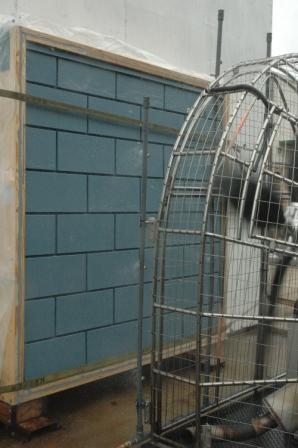
Before the tests are conducted, the sample wall assembly is intentionally made to be leaky with respect to air tightness. Holes are drilled in the interior surface of the assembly (where the air barrier is located), until approximately 0.12 cfm/sf of air leakage is experienced (as per ASTM E283). This is to simulate an imperfect air barrier installation.
Next, the ASTM E1233 pressure cycling test is performed. As cyclical pressure is applied to the assembly, the internal air cavity within the rainscreen assembly must reach equilibrium with the pressure chamber. The time allowed to achieve pressure equalization at each of the 100 cycles may not lag by more than 0.08 seconds to pass this portion of the standard.
Lastly, water infiltration rates are tested as per ASTM E331
(static pressure) and AAMA 501.1 (dynamic pressure). For each of these tests, water droplets observed over more than 5 percent of the air barrier area constitutes system failure.
AAMA 509
The AAMA 509 standard, titled “Voluntary Test and Classification Method for Drained and Back Ventilated Rain Screen Wall Cladding Systems” provides quantitative measurements and performance classification values for rainscreen wall systems. In addition to measuring water infiltration through the metal cladding, this standard accounts for water drainage out of the system, and air ventilation through the system.
Again, a simulated real-world imperfect air barrier is calibrated prior to system testing. Next, a series of ASTM E283 air infiltration tests are conducted, isolating each of the assembly head, sill, and panel transverse and longitudinal joints. Leakage through these joints constitutes beneficial air ventilation which can remove trapped moisture from the rainscreen assembly. The tabulated air ventilation value is expressed as a rating from V1
(minimal ventilation) to V11 (extreme ventilation).
Finally, a series of static (ASTM E331) and dynamic (AAMA 501.1) water penetration tests are performed. For these tests, water that drains off, or penetrates through, the air barrier layer is collected and quantified. Again, a rating is applied from W1 (no or minimal water penetration) to W11 (excessive water penetration).
While each standard provides a measure of performance assurance in its own right, each standard is also limited in scope. It is recommended to specify and supply a system that has been tested, with excellent results, to both standards. This helps to achieve the primary function of metal cladding as a component of a rainscreen wall system, which is to limit the quantity of water intrusion from the exterior, and provide effective means of draining and drying trapped moisture from within the wall system.
Frank Resso, PE, director of research and development and business development at IMETCO, Norcross, Ga., has been with IMETCO in a variety of technical and operational position for 17 years. For more information, go to www.imetco.com.