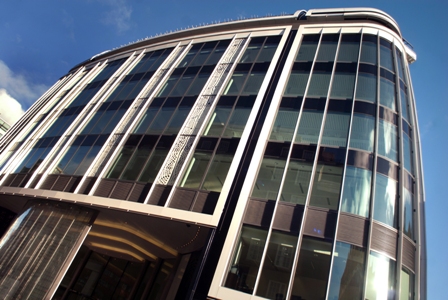
Powder coatings are available in a myriad of colors, glosses, textures, including attractive metallic effects
 Powder coatings are still considered a novelty by many contractors, and given the long experience and track record of liquid coatings it is considered safe to continue purchasing and installing liquid-coated parts.
The truth is that metal for construction has been powder coated for over 40 years, and technically the properties are every bit as good as liquid analogs.
Whether for aluminum façade profiles and panels, metal ceilings, lighting units, fencing and railings, or internal partitioning, there is a powder coating alternative, and a qualified job shop capable of coating the parts.
Properties
Powder coatings are essentially the same as liquids, containing polymers as the backbone, with pigments to give the color and special additives to give specific properties, such as lower gloss, textures, soft-feel or anti-yellowing. The difference is that in liquid paints these are dispersed in water or solvent, where for a powder coating they are in dry form, and become liquid through the application of heat.
Metal parts are coated by charging the powder electro statically and spraying it at the metal to form a thin layer. The metal parts then move through an oven at typically 375 F where the polymer melts to form a liquid, flows to make a smooth film, and reacts to form a 3-D network.
The end result is a tough, durable film. As there is no solvent, there is minimal waste, no emissions to the atmosphere or need for incinerators, and no wasted fuel in transporting solvent which does not end up in the finished coating. The Powder Coating Institute promotes these properties with its Powder Coated Tough stamp, which has the tag line “Stronger. Greener. Better.”
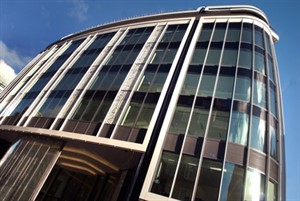
Around 20 percent of the cost of a modern high-rise building is the façade, with the metal contributing a major part of the cost. Repairs and re-coats are a costly burden so it is important to choose the right materials and partners to work with. The American Architectural Manufacturers Association (AAMA) is an industry body bringing together suppliers of glass, aluminum, wood, vinyl and other window materials, coatings, pre-treatments, adhesives and sealants. Collectively they have written and continued to refine a series of standards for the coating materials used on aluminum for fenestration. Readers may well have heard of AAMA 2603, 2604 and 2605.
These are the standards which set out the tests to be met by coatings for aluminum, covering important items such as mortar-, acid-, and detergent-resistance, corrosion resistance and weathering. No matter whether liquid or powder, the coatings for the aluminum need to meet the same standard.
 Capabilities
AAMA runs a product certification program that can help with finding the right products, but while choosing a trusted coating is important, getting the right people to apply it is equally important. Coatings manufacturers run approved coater schemes which involve rigorous auditing and testing of the coaters to qualify the best applicators. All major powder coating manufacturers will have a list of approved coaters.
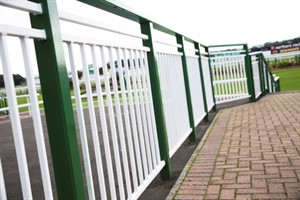
The powder coatings used for fenestration are also useful on railings, where similar levels of durability and weatherability are called for. When the railings are made of steel rather than aluminum, extra steps need to be taken to ensure corrosion resistance. This could include using galvanized steel, or a powder primer coat underneath the top decorative coat. In recent years, powder coatings have taken an increasing share of the market in North America for coating of metal building components, with an emphasis on aluminum components such as fenestration elements and decorative façades.
Why is powder coating becoming a leading choice? What do you need to know about the coating process and how does it affect performance of the components you will install?
In other parts of the world, especially in Europe, powder coatings have been used on aluminum building components for over 30 years. In the United States, liquid coatings systems, including coil coatings, and anodizing, continue to hold a majority share of the market, and are familiar to most architects. However, a growing understanding among architects and specifiers about the attributes of powder coatings are changing the market mix.
Process and Color
One important factor with powder coatings is that both in the process of producing the powder, and in its application, no liquid solvents are required. Therefore, powder coatings are essentially a volatile organic content (VOC) -free coatings system, increasing their desirability as builders and architects vie to produce increasingly green projects.
Secondly, the range of color and appearance capabilities in powder coatings has developed rapidly, allowing powder coatings to replace liquid coatings in almost all kinds of design work. While metallic coatings may continue to present some challenges, even these can be accomplished with powder coatings for most applications. With the use of sublimation processes, powder-coated components can now even be produced with wood grain and other special-effect appearances.
Further, many component suppliers have noted that powder-coated components have a more scratch- and chip-resistant surface than comparable liquid coatings. This means that these components fare better during and after shipment to job sites, with less issues of on-site damage requiring repair.
Various Formulations
Powder coatings are also available in various formulations, allowing applicators to provide systems that meet American Architectural Manufacturers Association (AAMA) 2603, 2604 and 2605 levels of performance. Many major powder coatings suppliers to the architectural market run certification programs to identify competent applicators, who in many cases are then provided with significant warranty programs on a job-by-job basis. Through an initial in-depth process audit, with follow-on checks
For metal ceilings, the key property is color and gloss consistency, as any variations can make the ceiling appear like a patchwork quilt. A reliable supplier who can get the same result consistently is thus crucial, and a coater who can apply a consistent film thickness, with a stable oven temperature and robust quality control (QC) testing completes the supply chain.
Powder coatings are available in a myriad of colors, glosses, textures, including attractive metallic effects. There are grades resistant to high temperatures, UV, scuffing and marring⎯whatever your demand⎯there will be a powder coating to meet it. Powder is no longer the new kid on the block, having been around for over 40 years and present in everyday objects that you may never even notice. If you haven’t tried it yet, take the time to learn more about coaters and powder suppliers that can meet your need.
Russell Deane is global specification manager of architectural powder coatings at AkzoNobel, Columbus, Ohio. To learn more, contact Russell.Deane@akzonobel.com or visit www.interpon.com
.