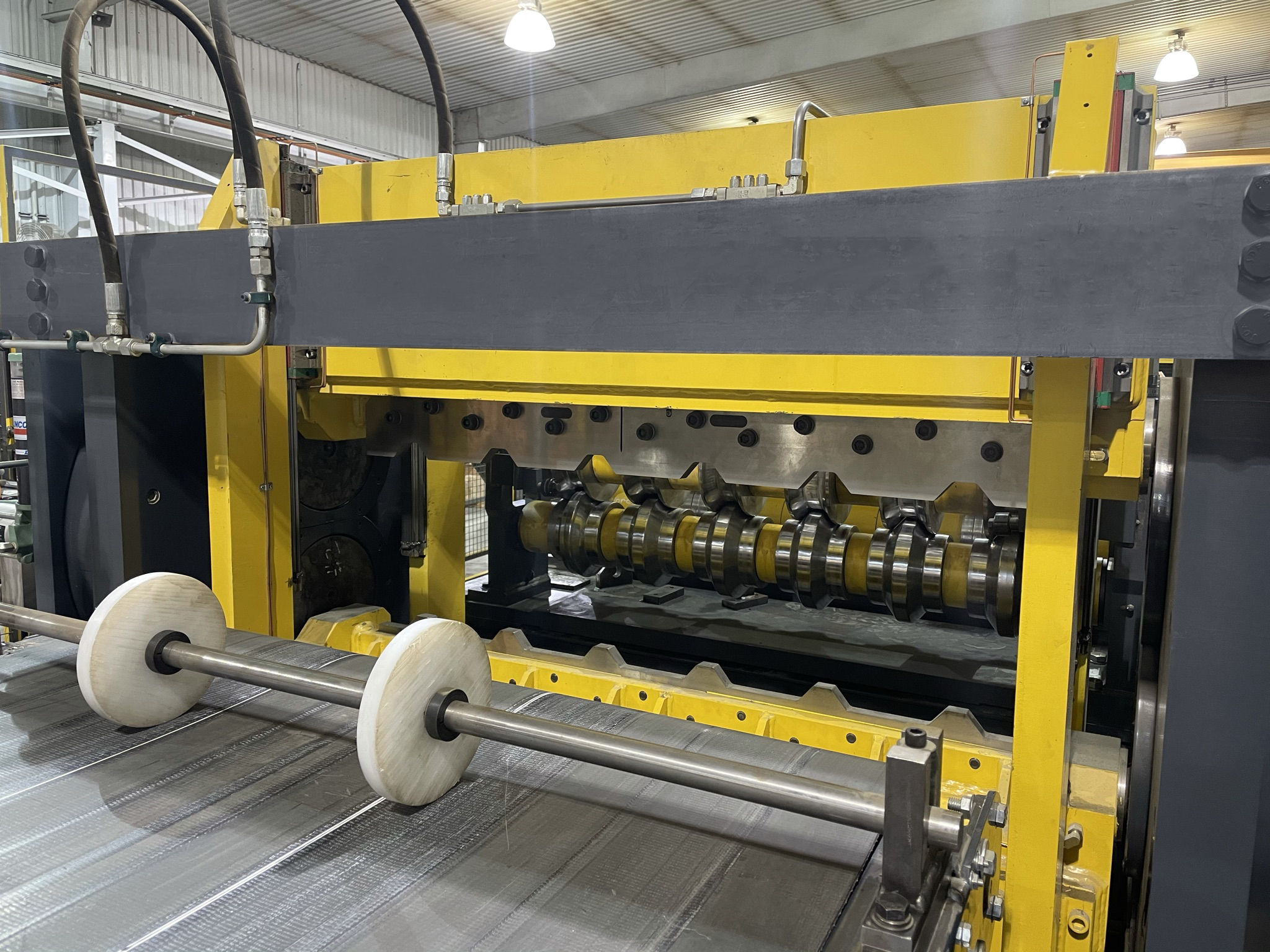
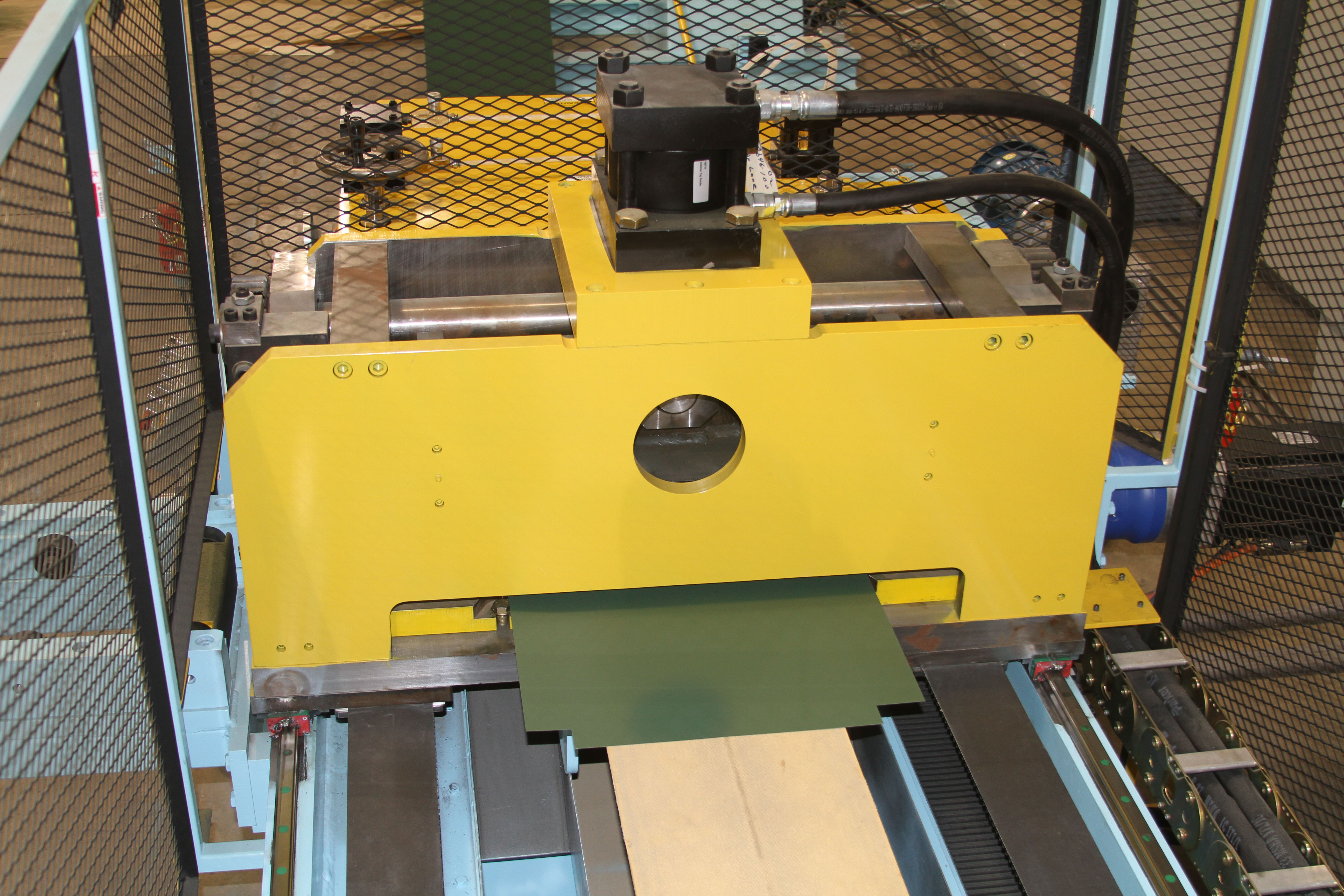
There are two typical ways rollforming lines are configured to produce length-specific formed parts. Pre-cut lines cut the steel coil before it enters the rollformer while post-cut lines have a profiled shear that cuts the formed part. There are definite advantages to both. It will depend on a few specific factors to decide which method may be better for your production requirements.
Examining the two ways rollforming lines are configured

Pre-cut Advantages
Since the shear is cutting in the flat, it can feed the rollformer producing multiple profiles without changing shear blades. There is no need for a slug cut or a profile-specific blade. Pre-cut rollforming lines are ideal when running multiple profiles on the same line. Cee and zee purlin lines, double-high lines, rafted rollforming lines, or standing seam lines that run multiple width variations work well with a pre-cut shear.
Pre-cut shears can be advantageous in higher production lines. Whether the machine accumulates steel in a pit to allow the shearing process with minimal stop time or if a rotary shear is in use, production rates can be higher.
For example, a BOSS pre-cut rotary shear can run metal building panels at 300 feet per minute. This production speed is possible with a flying post-cut shear but typically at a higher investment.
Flat blades on a pre-cut shear can typically be used on all four sides before sharpening, whereas profiled blades on a post-cut are not reversible and require precise surface grinding. If there is a requirement to produce flat sheets to feed a secondary operation, a conveyor can be added to a pre-cut line after the shear, allowing you to remove the blanks before they enter the rollformer. Pre-cut shears designed to shear a flat pattern allow for features like notching and punching holes or tabs to be integrated into the end profile.
Post-cut Advantages
There is no minimum length requirement since the rollformer is full of material. This is very helpful when running short sheets for soffit, wainscot or to produce formed ridge caps. If the rollforming line is not capable of producing short sheets, then it becomes necessary to manually cut longer sheets down, adding the cost of the additional shear and the labor to manually shear and handle them.
There is minimal end flare. A pre-cut rollformed part will have some end flare, with the leading edge flared in and the trailing end flared out due to the different spring back throughout the part. The amount of end flare can be reduced drastically on a precut line by controlling the part better with additional roll tooling and flare or side roll fixtures. With post-cut machines, end flare is very minimal because one long part is formed continuously and then cut into smaller lengths.
Typically, a post-cut machine requires a shorter footprint. There is no need for an entry conveyor as the infeed table is directly mounted on the entry of the rollformer. There are minimal alignment issues since the machine is constantly full of material and contained in the tooling while running production.
Tooling wear is minimal for a couple of reasons. Post-cut machines do not need powered upper tooling passes to drive the sheet, which allows the tooling to turn freely. In turn, this reduces mismatched speeds and friction against the part while being formed. After thread up, the post-cut machine is full of steel, so there is no leading edge of steel entering each pass.
Technology is Changing the Game
As technology progresses, both pre-cut and post-cut lines can be effective and efficient line configurations. The use of servos and closed-loop controls gives more speed and accuracy to post-cut flying shears. Anti-flare fixtures can be servo-controlled to adjust on the fly, making a pre-cut line flare tolerance comparable to a post-cut. Some rollforming lines include pre-cut and post-cut shears and an advanced control feature that tracks the last part. The entry shear makes the final cut for the order, eliminating scrap traditionally associated with post-cut lines. With these advancements, it is best to have a consultation with the rollforming manufacturers to understand what the equipment capabilities are and what will be best for your production needs.
Matt Werner is senior manager of global marketing and inside sales at The Bradbury Co. Inc., Moundridge, Kan. To learn more, call (800) 397-6394 or visitwww.bradburygroup.com.