
 If you have been in the business long enough, something on your job site has grown legs and walked off. It’s not the change orders or charge backs that can ultimately cost us; it is theft from our job sites. In reality, security at your job site is probably something left to be desired; usually deadlines and safety take our attention. From tools to building supplies, sometimes the things we need to make a living disappear.
Construction site thefts are traditionally a local issue. Not many organized crimes rings are going state-to-state, stealing socket sets and air compressors. In most of these cases, when an item is recovered, it is recovered within the same state or area and was stolen by someone that has knowledge of the surrounding community. That is, if it is recovered. Due to lack of security, vague descriptions and easy access to job sites, recovery of items taken from construction sites can be as little as 21 percent. In recent years, job-site thefts account for more than vandalism, fire damage and collisions combined.
According to the season, crime increases or decreases at different times of the year. During the slow winter months, you should prepare to protect yourself during the busier months that lie ahead. Areas that have a large construction presence naturally have the most equipment to be stolen and therefore see the highest crime rates. These areas should take the most precautions.
There are private security firms in almost any city that provide overnight security. If you are staying on-site, you may want to invest in a wireless camera system. These systems can be monitored from your trailer. Temporary fencing is also an option, but it requires more time and money. Baltimore- based DEWALT Industrial Tool Co. makes a product called the MOBILELOK that can be used to put inside smaller storage lockers. Radio-frequency identification
(RFID), proximity cards (prox cards), photo IDs, mobile readers and other monitoring systems are available that can help you setup onsite for a low monthly fee.
Realistically, you can’t totally secure your entire site. Keeping it well lit at night helps, and so does holding crews and subcontractors accountable for losses for their indolence in locking up properly. You simply have to judge each site and determine what steps need to be taken.
Thieves look at two key factors when looking over what you may have to offer them: value and mobility. Value is the most important though. A bulldozer is very valuable, but difficult to move without detection. Skid steers are valuable and can be loaded fairly quickly. You should always consider the mobility of your equipment along with its value to plan security efforts accordingly.
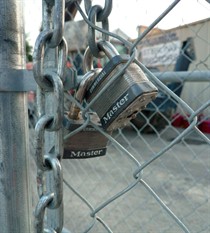
Small items that can be carried or loaded by hand are easy prey. Drills, hand tools, roof seamers or even a welder can be quickly stolen and quickly disposed of with little way to track them. In most cases, a couple of padlocks are the simplest and best defense against theft.
Job sites range from urban to rural areas and different steps need to be taken with each one. In all cases, following these simple steps can help prevent costly thefts:
- Lock all storage containers when not in use.
- Require visitors to sign in and out when entering the job site no matter how small the job. You must know who is on your site and what their purpose is. This information is good both for safety and security.
- All employees should be diligent in reporting suspicious activity.
- You must be diligent in following up on all reports.
Unless you are in a metro area, most law enforcement agencies do not operate like they do on television shows. Economic hardships even reach the police departments. If something comes up missing, do not expect a van to come skidding up with a team of criminologists with cameras and fingerprint kits to jump out while a helicopter hovers overhead. Police are going to answer calls of domestic violence and other violent crimes before they spend an evening staking out your job site. You have to be proactive and take preventive measures.
If you have short-term laborers on your work force, they should always be held accountable to a senior member of the crew. In most cases, a thief cannot keep his mouth shut. It may take a few days for him to be confident enough to brag, but he will tell someone. Offering a cash reward or other incentive may be a good way to get information flowing.
I wouldn’t worry about the load of lumber in the front, but the new stainless refrigerator might be a target on a residential site. For commercial sites, tools like roof seamers, tool boxes and spools of copper wiring are easy targets and cost substantial amounts of money. Unless you can lock the project down completely, it may be best to leave doors open so pedestrians or security can easily see in and through the building.
If you happen to drive by the site after hours and notice a strange car or person in the area, do not hesitate to document descriptions, tag numbers and other pertinent information. It is probably not a good idea to approach the person and attempt to handle the situation yourself.
Check your state and local laws to understand steps that can be taken to better protect yourself and property. In most cases, consult your local law enforcement-that’s what they’re there for. If you are new to a region or city, they can give you information about local resources, such as Neighborhood Watch programs.
Any expensive items, including tools and large-ticket items, should be catalogued along with serial numbers and descriptions. This information should be kept in a secure location in case anything happens. As a former law enforcement officer, I have learned that if something is not documented, it didn’t really happen. If anything comes up missing, is stolen or looks suspicious, document it. Police reports of even the simplest thing can save you heartache and trouble down the road, and help dissolve you of liability in larger situations.
Most thefts are reported in the mornings; Monday mornings to be specific. If a job site is left unattended for the weekend, it is a prime target for criminals.
If you want to see your items again, this is where the serial number, photos, receipts and descriptions come into play. A “white refrigerator” is not an acceptable description to identify an item that may have been stolen. There are also national services that allow you to register your equipment with them for monitoring. Law enforcement may have access to this information in the event of a theft and it can be tracked more easily using the National Crime Information Center (NCIC).
As tightly as everyone seems to be running their job sites, margins are very slim right now. Even with the slow rebound of the economy, we still have to take steps to protect ourselves. The loss of a large load of materials or equipment could make the difference between a profitable job and making overhead this month.
# # #
Jonathan Rider, a former law enforcement officer with more than 14 years in emergency services, now works as the marketing coordinator for Developmental Industries Inc. DI Roof Seamers provides quality roof seamers across North America. With years of experience on job sites across the U.S. and Canada, Rider recognizes that a keen eye must be taken to guard against theft and property damage.