Attain energy efficiency, comfort and compliance with metal building insulation
Energy conservation is the first step toward improving the baseline energy performance for buildings seeking certification under the LEED Green Building Rating System from the U.S. Green Building Council (USGBC).
ASHRAE 90.1-2007 is the current standard for calculating the baseline building performance as LEED requires. Adding insulation, improvements to HVAC and energy-efficient lighting are the three best ways to achieve a percentage improvement in energy cost savings as the relevant LEED Energy and Atmosphere prerequisite and credit require.
New and existing metal buildings can be made more energy efficient, comfortable and attractive with reflective insulation systems applied to the ceilings and walls. Systems are defined as having a reflective insulation and an enclosed air space along with an air film on the assembly’s building side. Hybrid systems can include reflective insulation combined with other insulating materials to provide other benefits such as air sealing, lower vapor transmission and higher thermal performance. Reflective technologies, like other insulation technologies, are evaluated by a number of consensus standards published by the American Society for Testing and Materials International (ASTM).
Reflective air spaces
According to a recent paper titled “Turning Empty Air Space into Thermal Resistance,” by David Yarbrough, PE, Ph.D.: “Much of the commonly used building insulation relies on the low thermal conductivity of air to provide thermal resistance. This is true of fibrous or mass insulations like fiberglass, rock wool, cellulose or open-cell foams. The same is true for reflective insulation systems.
“Metal building structures have many opportunities for creating enclosed reflective air spaces that have demonstrated thermal resistance (R-value). Reflective insulation reduces heat flow across the region it occupies by blocking thermal radiation from the warm side to the cool side. Enclosed reflective air spaces
(reflective insulation assemblies) are regions with a low-emittance material on at least one surface. The low-emittance surface that is part of a reflective insulation is installed in the walls, ceiling or floor of a building so that it is perpendicular to the direction of heat flow. Emittance is a property that indicates how readily a surface gives off thermal radiation (heat). A low-emittance surface, such as metalized film or aluminum foil, gives off radiant energy at a much lower rate than high-emittance surfaces like steel.”
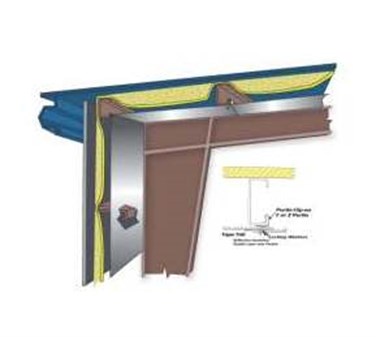 |
Reflective insulations can be combined with other insulating materials, such as spray-foam or fiberglass insulation, to form a hybrid insulation assembly. This can be done in new or existing buildings; the latter often includes a fiberglass batt draped over the purlins installed when the building was constructed. The image on this page illustrates the addition of a reflective insulation on the bottom of the purlins to create an enclosed reflective air space. The total R-value is the sum of the fiberglass R-value and the R-value for the enclosed reflective air space. Combinations of insulation technologies like this greatly increase the possibilities for effective and economical insulation packages.
A solution
Reflective insulation manufacturer, Fi-Foil Co. Inc. of Auburndale, Fla., assists contractors in achieving energy efficiency with its RetroShield System. The system consists of a reflective insulation and a revolutionary fastening device called the Clip & Pin. The Clip & Pin simply snaps onto the lip of the C or Z purlin, structural beam, bar joist or wall girt. The insulation is impaled on the pin and secured with a lock washer. The edges of the insulation are overlapped on the purlin or beam and are sealed by an integrated tape tab.
The double layer of reflective provides an R-2 thermal break over the exposed purlin. There is no support strapping needed. This allows each section of the building to be insulated in a single pass thus minimizing the impact on the use of the building space during the installation. That is especially important with retrofit installations for building owners that need to continue to use their facility during the installation.
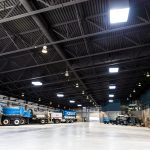
The facing colors provide other benefits, especially for project teams seeking certification under the LEED rating system. It provides a strategy to enhance the energy efficiency of interior lighting due to its reflectivity. This important feature benefits a building owner from an initial cost perspective and long-term due to the lower energy costs associated with less lighting fixtures. This is especially desirable in metal buildings without many windows, skylights or clerestory glazing systems.
Paul Nutcher is president of Green Apple Consulting, Maitland, Fla., and Bill Lippy is president and chief marketing officer of Fi-Foil Co. Inc., Auburndale, Fla. To learn more, go to www.fifoil.com.