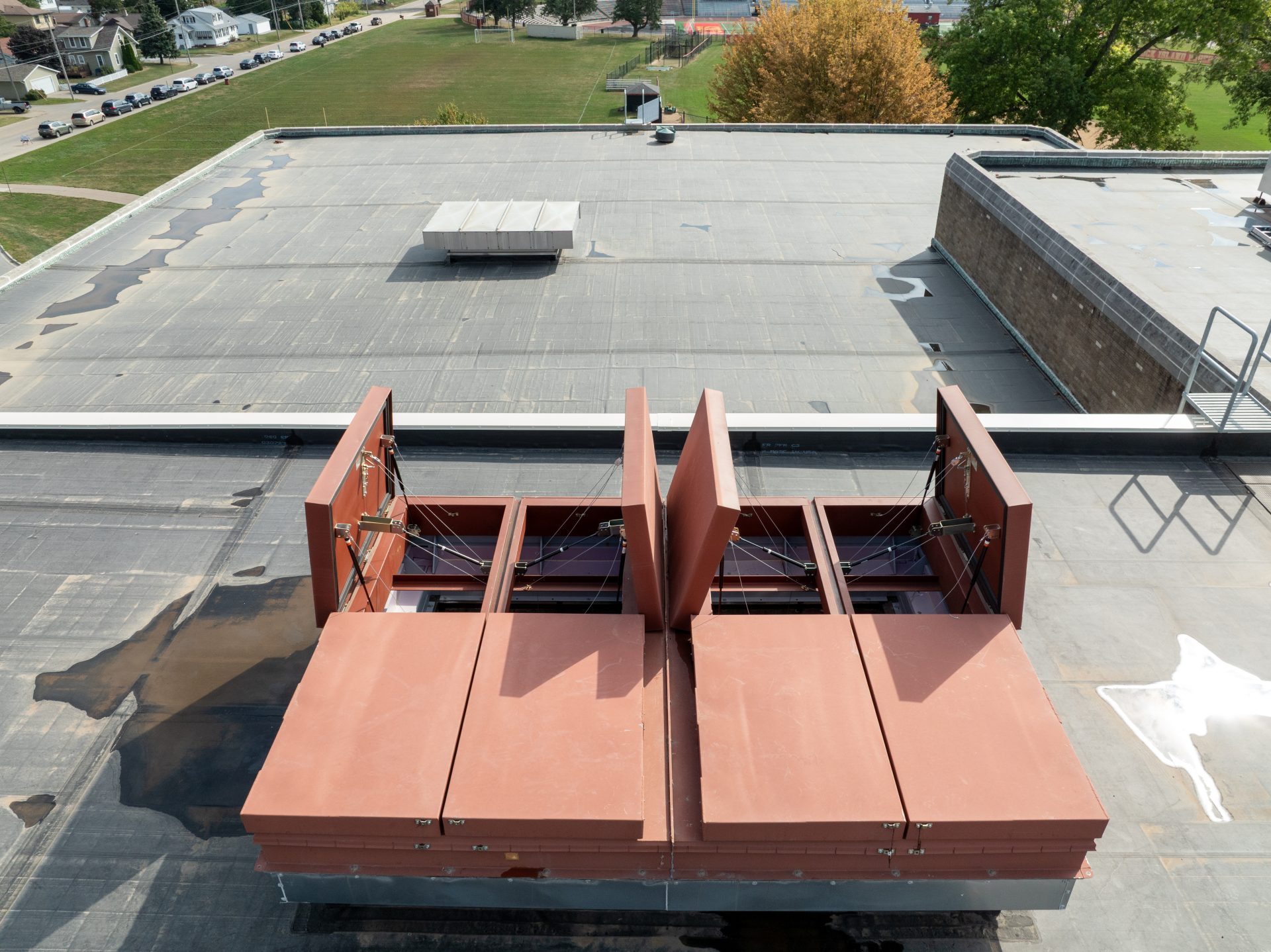
For a building that opened in 1937, there are few blemishes in the history of Rock Island High School in Illinois. A recently completed project enhanced the appearance of the Art Deco-style building, improved its fire protection capabilities, and reduced noise interference.
A team from RTM Engineering Consultants recently removed a “doghouse” style smoke vent that had stood atop the high school for decades. Common decades ago, the aging equipment, likely installed in the 1950s, had outlived its useful life; the vent in place at Rock Island had also reached its end. Leaks around the smoke vent and patchwork repair to maintain functionality could no longer be sustained.
One of the primary challenges facing RTM was dismantling the existing smoke vent. “We had to find the correct areas to cut it apart and dismantle it, but the existing roof needed to be left in place. It had to be removed piece by piece,’’ said RTM project manager Mitchel Boever.
Staying safe
Every student in the United States knows the proper behavior in a routine fire drill: stop immediately, evacuate calmly, listen to instructions, and remain outside until authorities determine it is safe to re-enter the building. Fire drills are vital to keeping students and staff safe.
What’s less commonly known is the frequency of school fires and their importance as an example of lethality.
According to the National Fire Protection Association (NFPA), local fire departments responded to an average of 3,230 fires per year between 2014 and 2018. Most of the fires were “confined” fires in chimneys and boilers or caused by cooking equipment. Approximately 43 percent of school fires were intentionally set, according to the NFPA. While fires are common, resultant deaths are rare.
That was not always the case, and a horrific blaze in Chicago—only about 170 miles away from Rock Island—forced dramatic changes in fire protection codes at U.S. schools.
The fire on December 1, 1958, at Our Lady of the Angels School killed 95 people, including 92 students. Smoke, heat, fire, and toxic gases cut off normal means of escape through corridors and stairways. Approximately 1,300 students attended the school, which had passed its fire inspection just two months before the fire.
Investigators found numerous flaws. Extinguishers were mounted 2.1 m (7 ft) off the ground, making them unreachable for all students and most adults.
The building had only two pull stations in the south wing of the school, while the blaze originated at the north end. The school was built in 1910 and remodeled in 1958; however, due to a grandfather clause, it did not have automatic fire alarms or a sprinkler system.
In the wake of the tragedy, the NFPA adopted requirements that apply to public occupancies, including schools. Automatic fire sprinkler systems are required in any fire area exceeding 1,858 m² (20,000 sf). Classrooms and corridors must be separated by one-hour-rated walls, and stairways and other vertical openings must be enclosed.
Smoke vents are an indispensable component of any fire protection system, as they promote safe building evacuation by removing heat, smoke, and toxic fumes from a burning building.
Important code changes

A fire at a General Motors factory in 1953 forever changed fire protection measures and the role of smoke vents in commercial structures.
The blaze at the GM facility in Livonia, Mich., is considered the most destructive fire in America’s industrial history. Sparked by a welder’s torch, the fire caused an estimated $50 million in damage.
The building spanned more than 139,355 m² (1.5 million sf) across 0.4047 h (34.5 acres), and 4,200 employees worked every shift at the massive complex, building automatic transmissions for Cadillacs, Pontiacs, and other vehicles. Several thousand gallons of flammable liquids were confined in the building. Only 20 per cent of the structure had smoke vents, and the roof lacked them. “It was literally raining fire all over the building,’’ according to John Stinson, a construction superintendent for GM.
Six people died and many others were injured because of the fire. It also spurred changes in fire codes. “The major change was the demand for smoke and heat vents,” Stinson said.
Following the fire, it became a common practice to install automatic smoke vents in large commercial buildings. They are designed to open automatically when excessive heat is detected, releasing smoke and heat from the building.
Out with the old

For the project at Rock Island, the RTM team had to dismantle the existing vent and install an updated model. The “doghouse” style vent—so-called because they resembled small cages for animals—was installed in many buildings during the 1940s and 1950s.
The existing structure of Rock Island High, which opened in 1937 after three previous buildings had been reduced to rubble by fire, was rebuilt again in 1949 due to another fire. Workers completed the rebuild in 1953.
Boever said removing the existing vent posed the most challenging part of the project.
“It was a very intense, lengthy process,’’ he explained. “The doghouse smoke vent was all one piece. We had to make sure it was properly supported and find areas to cut it apart.”
Crawford Company was the installing mechanical contractor for the project. The Crawford team replaced the existing unit with an acoustical smoke vent manufactured by BILCO, a maker of specialty access products.
“We wanted to match the same curb area and upgrade it to a new smoke vent,’’ Boever said. “BILCO was able to provide a customized solution, making the roof work minimal, which is a huge cost savings for a public school district.”
Acoustical smoke vents serve the same function as standard vents but also offer the added benefit of reducing noise intrusion. The vent for the Rock Island school was installed above the school auditorium, which is used for concerts, theater performances, and other school activities.
“There wasn’t an obvious threat from exterior noise,’’ Boever said. “Because it was over a stage, we wanted something that would not impact stage performance.”
BILCO’s acoustical smoke vents offer an outdoor-indoor transmission council (OITC-46) and sound transmission council (STC-50) sound rating, and are frequently installed in concert halls, theaters, and other applications where outside noise interference could cause distractions.
McCoy and Associates, BILCO’s manufacturer’s representative in the region, provided the smoke vent and technical support for its installation.
Piece of history
Residents of Rock Island are justifiably proud of their school, which enrolls approximately 1,800 students in grades 9 to 12. The school was designated as one of Rock Island’s “100 Most Significant Unprotected Structures” in 2009. The list contains a complete range of architecture representative of Rock Island’s history from the 1850s to the 1960s, which are not protected by state historic or national historic landmark designations.
The school is a vital part of the community fabric in Rock Island, and the new smoke vent provides a significant aesthetic and safety upgrade for the venerable structure.
Thomas Renner writes on building, construction, and other trade industry topics for publications throughout the United States.