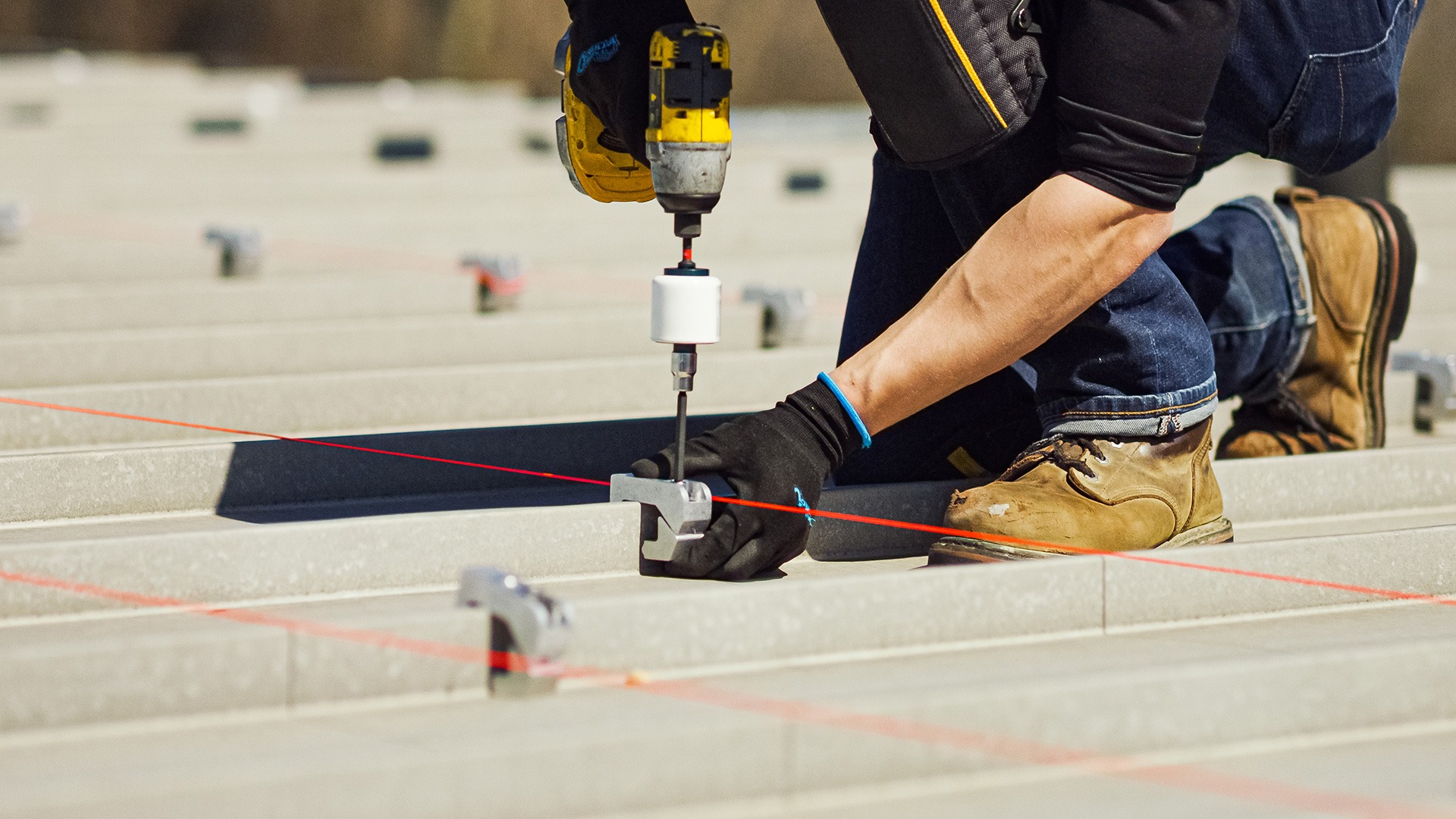
Innovation has become one of the most essential drivers of progress in the metal construction industry. As contractors contend with higher labor costs, volatile material pricing, and the lingering effects of tariffs on imported metals, there is a growing recognition that the evolution of roof attachment systems—toward greater efficiency and less installer burden—is the clearest path to controlling both labor and project costs. The products reshaping the market are not just stronger or more durable; they are more innovative, simpler, and purposefully designed to eliminate friction from the installation process.
Efficiency begins with installer-centric design
Traditional clamps and brackets were often built around engineering conventions rather than jobsite realities. Many required torque-specific set screws, multiple loose parts, or tools that added time and complexity—especially in cold or windy conditions where precision is harder to maintain.
The industry’s latest wave of innovation reverses that mindset. Manufacturers are now prioritizing systems that make the installer’s job faster, safer, and more predictable.
Using a push-pin mechanism, for example, replaces set screws entirely. Instead of applying rotational force that could damage panels or require retorquing—both of which can lead to callbacks—the push-pin delivers immediate, consistent engagement while protecting roof finishes. Combined with preassembled, ready-out-of-the-box components, the result is a clamp that shortens the learning curve, reduces installation time, and lowers the risk of error.
This kind of evolution is not just about convenience—it is about maximizing the hours crews have on the roof. When products eliminate steps, reduce tool dependency, and simplify repetitive tasks, the saved time directly translates into lower labor costs and higher productivity.
Why speed matters: Labor savings in a tight workforce
Across the metal construction landscape, contractors face a challenge that no single product can solve: the limited availability of skilled labour. With fewer hands available and more work to be completed, efficiency has become a key competitive advantage.
Modern attachment systems deliver measurable labor savings by:
- Reducing preparation time through preassembled components.
- Eliminating retorque requirements and follow-up visits.
- Providing faster engagements that require minimal or no use of tools.
- Offering universal brackets compatible with multiple roof profiles.
- Maintaining the ability to install even in freezing conditions where dexterity is limited.
Some of the newest systems on the market are installed in nearly half the time of legacy designs. Over the course of a season, those “saved minutes” can equate to hundreds of reclaimed labor hours—allowing crews to complete more projects without increasing staff. In regions hit hardest by workforce shortages, this added capacity can mean the difference between meeting timelines and falling behind.
Evolving designs without sacrificing performance
As attachment systems evolve to become more efficient, durability and long-term reliability remain central expectations. Speed alone is not enough, especially for installations facing harsh winters, heavy snow loads, or significant wind uplift.
Manufacturers have responded by pairing efficiency with high-performance design elements, such as:
- Non-penetrating attachment methods that preserve panel integrity.
- Corrosion-resistant materials engineered for long life.
- Snap-in rails and toolless ice-clip accessories.
- Self-locking or set-screw-free mechanisms that reduce maintenance.
Snow retention systems demonstrate how ease of installation can coexist with long-term strength. Meanwhile, universal screw-down brackets broaden compatibility to corrugated, exposed fasteners and asphalt roofs—reducing inventory needs for distributors and offering contractors a single, adaptable solution across multiple project types.
The throughline is clear: as products evolve to be more efficient, they simultaneously reduce labor burden and help stabilize project costs—even as material prices fluctuate.
Field-driven innovation: Solving real jobsite challenges
Perhaps the most significant driver of this evolution is the increasing collaboration between manufacturers and the people installing their products. Today’s most effective innovations are not created in isolation but through direct engagement with installers, roofers, and engineers who highlight the challenges slowing down real projects.
This feedback loop has resulted in:
- Clamps designed to install without removing gloves.
- Components that create consistent, repeatable results.
- Reduced fatigue during mass installations.
- Improved safety through fewer tool-based steps.
Many of the recent innovations—particularly the push-pin and preassembly—were direct responses to installer requests for faster, less frustrating solutions.
The future: Efficiency as standard practice
As the metal construction industry evolves, one truth has become increasingly clear: products that reduce installer burden and improve efficiency will define the next decade of rooftop attachment solutions. As materials become increasingly expensive and labor becomes harder to source, companies that innovate around simplicity, speed, and reliability will help contractors maintain profitability even in shifting economic conditions.
The evolution of clamps, brackets, and snow retention systems toward more efficient and installer-friendly designs is not just an improvement—it is becoming the new standard.
In a business where every minute matters, the most brilliant innovations are those that give time back to the people on
the roof.
Bradford A. Wasley is president of PMC Industries, Inc. and director of Total Quality. Brad is a fourth-generation manufacturer with more than 25 years of experience. AceClamp is the product line he has developed along with the PMC Industries, Inc. engineering team. Wasley can be reached at bwasley@pmcind.com