As long as people have been building buildings, scaffolding has been an important tool to elevate workers, materials and equipment.
Still elevating high-quality access for construction job sites

(Photo courtesy of BrandSafway)
The ancient Egyptians, Nubians, Greeks, Romans and Chinese all used scaffolding in their construction. This temporary platform assembled above ground level for construction, restoration, maintenance and repair of buildings provides a safe and stable working area. According to Occupational Safety and Health Administration (OSHA), 65 percent of construction projects in the United States involve the use of scaffolding by an estimated 2.3 million workers.
Few of the complex tasks of work completed in building construction can be performed at grade level (on grade) or on finished floors. Mathieu Grumberg, director of product development-North America at BrandSafway, Kennesaw, Ga., stresses that providing high-quality access to a workface, with an engineered supported scaffold solution or a large-area suspended platform, rather than, for example, a boom lift, allows a large number of craftspeople to safely and efficiently work together.
He explains to safely and efficiently perform this scope of work at required elevations demands:
• Safe ingress and egress of craftspeople to the workface from grade
• Proper fall protection
• Protection from wind and weather
• Conveyance of tools, raw materials and sources of power
• Protection of personnel and pedestrians on grade as well as on any floors below the workface, from falling objects and other hazards created by the scope of work
• A well-equipped fleet of supported and suspended scaffold and hoist products
• A solution designed to save time and money
• Properly trained personnel to engineer, erect,inspect and disassemble the access solution
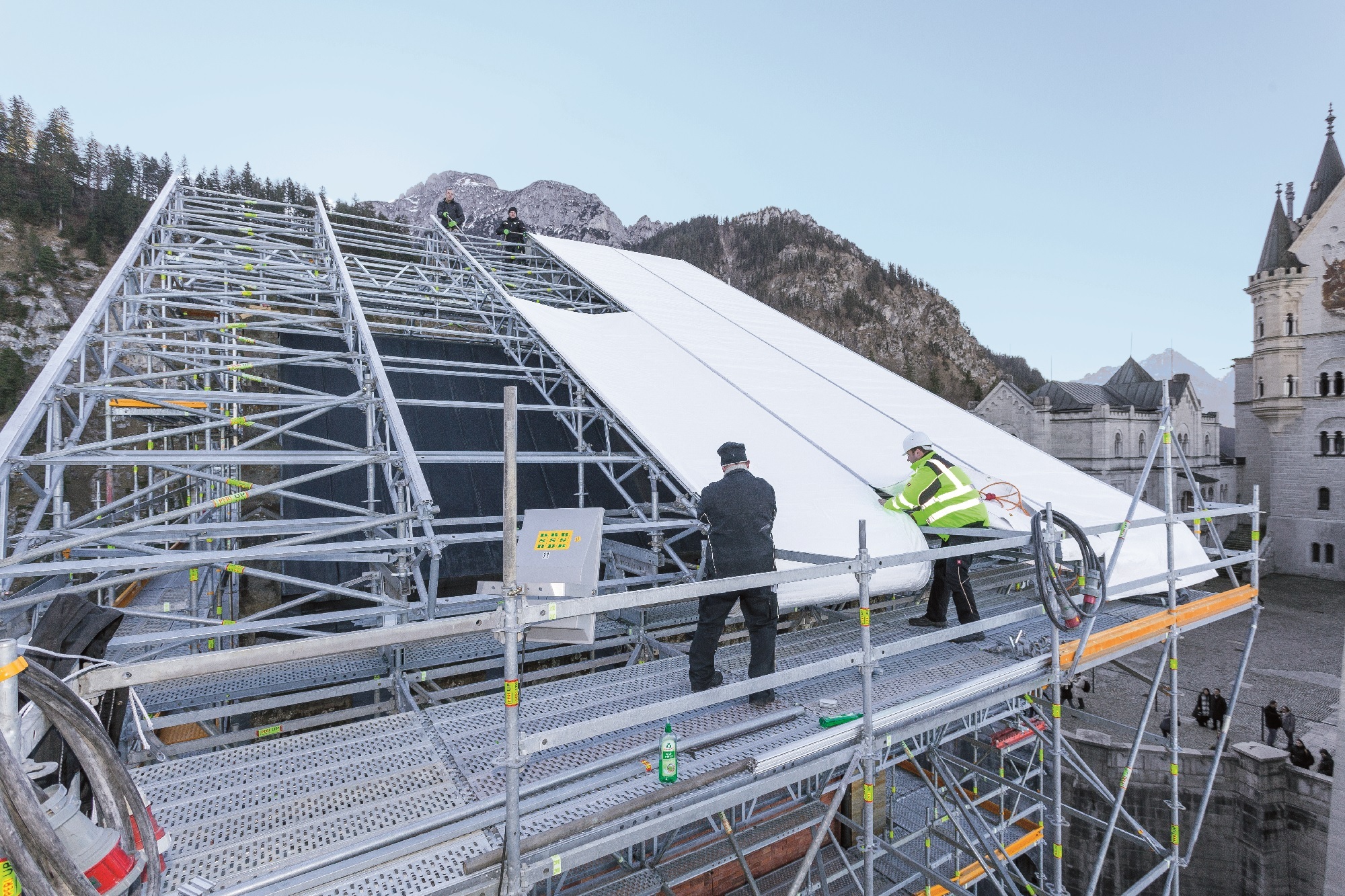
(Photo courtesy of PERI GmbH)
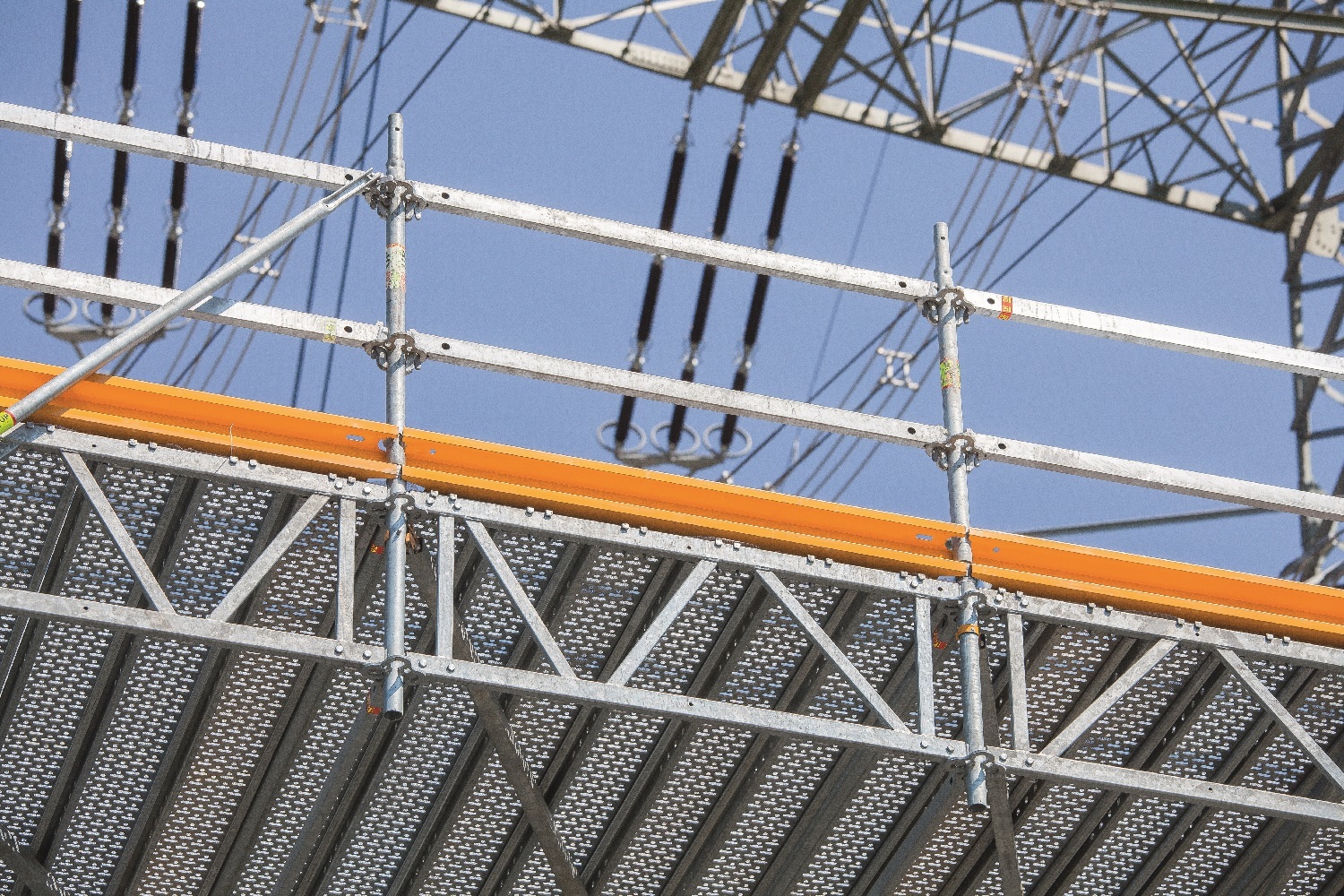
(Photo courtesy of PERI GmbH)
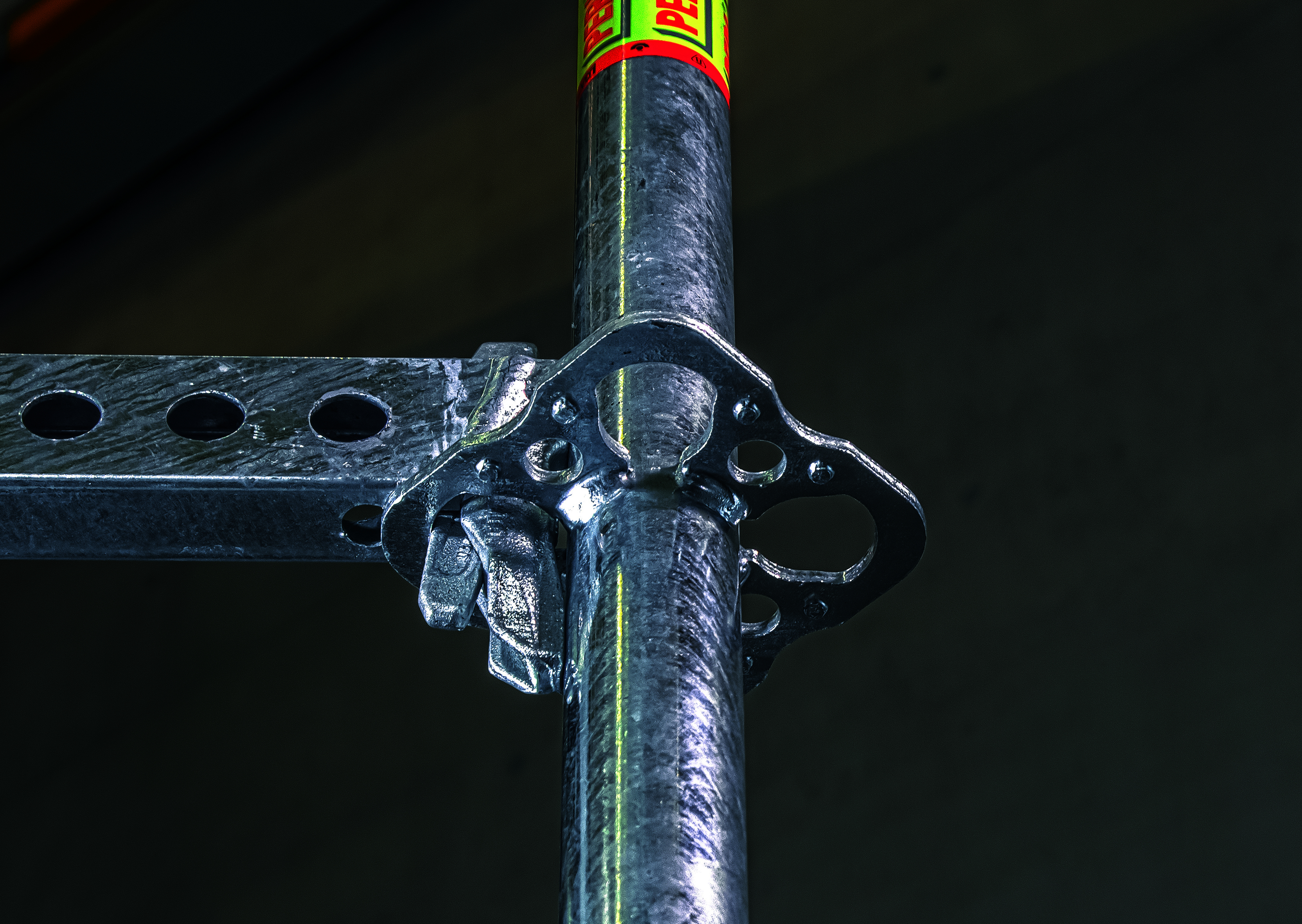
(Photo courtesy of PERI GmbH)
“Scaffolding is the backbone of the construction industry,” says Julien Riga, senior project manager at Layher Scaffolding Systems, Houston. “Scaffolding is part of the process from start to finish. It is used in shoring concrete, painting, insulating, installing windows, performing masonry, etc., while maintaining a safe and efficient environment. During the finishing process, scaffolding is also used to provide access for electricians and contractors while installing HVAC and other appliances to get the building ready for final inspection and close out.”
Scaffolding allows workers to access multiple areas of the building simultaneously. “Outriggers may be installed on the wall side of the scaffolding to allow work to be performed at comfortable heights without any obstructions between the worker and the wall,” says Craig Malterud, vice president, Advantage Scaffold & Ladders, Fridley, Minn. “Although frame scaffold is the most popular choice for access on low-rise buildings, other options are available if conditions require. Frame scaffold is the quickest to erect but systems scaffold may be used if more flexibility or load capacity are required for the scaffold. Systems scaffold has more flexibility than frame scaffold due to numerous sizes and cantilevering capabilities. Other options may be mast climbing scaffolds or crank-up masonry scaffolds.”
Scaffolding Safety
Working at elevation exposes personnel to fall hazards, the most common and most serious hazard found on a construction site. Scaffolding’s potential for tragic injuries—whether to construction workers, pedestrians or others near job sites—is one reason OSHA has established extensive and detailed safety rules regarding the assembly and use of scaffolds and the training and precautions workers need to take. Serious injury or death can result from failure to follow all applicable safety requirements of OSHA, federal, state and local regulations, along with manufacturers’ instructions before erecting, using or dismantling. According to a recent Bureau of Labor Statistics report, more than 70 percent of scaffold accident injuries are caused by:
• Scaffold support or planking giving way, either due to defective or damaged equipment or improper assembly, leading to falls and injuries to those below
• Slipping or tripping while on a scaffold due to such factors as slippery surfaces, an unsafe incline or insufficient planking, leading to falls where guardrails, a safety harness, or proper training were lacking
• Falling objects hitting either a worker on a scaffold or those below
Grumberg believes carefully engineered scaffolding and guard rail systems can be powerful, cost effective and easily applied to provide passive fall protection at elevation. According to Malterud, “All scaffolding above 10 feet in height is required to be fully guard railed to protect workers from falls and a toe board is required to protect workers below the scaffolds from falling objects. In instances where materials are placed on the scaffold platform higher than the toe board, debris netting may be installed to prevent falling objects. On each working level of the scaffold, a full guard rail must be installed including the end of a run of frames and the ends of all outriggers.” Riga contends scaffolding’s integrated fall protection components (handrails, mid-rails and toe board) could eliminate the need for personal protective equipment (PPE) in most instances. “If however, PPE is still required, the scaffolding structure can in most cases provide secure tie-off points to the users.”
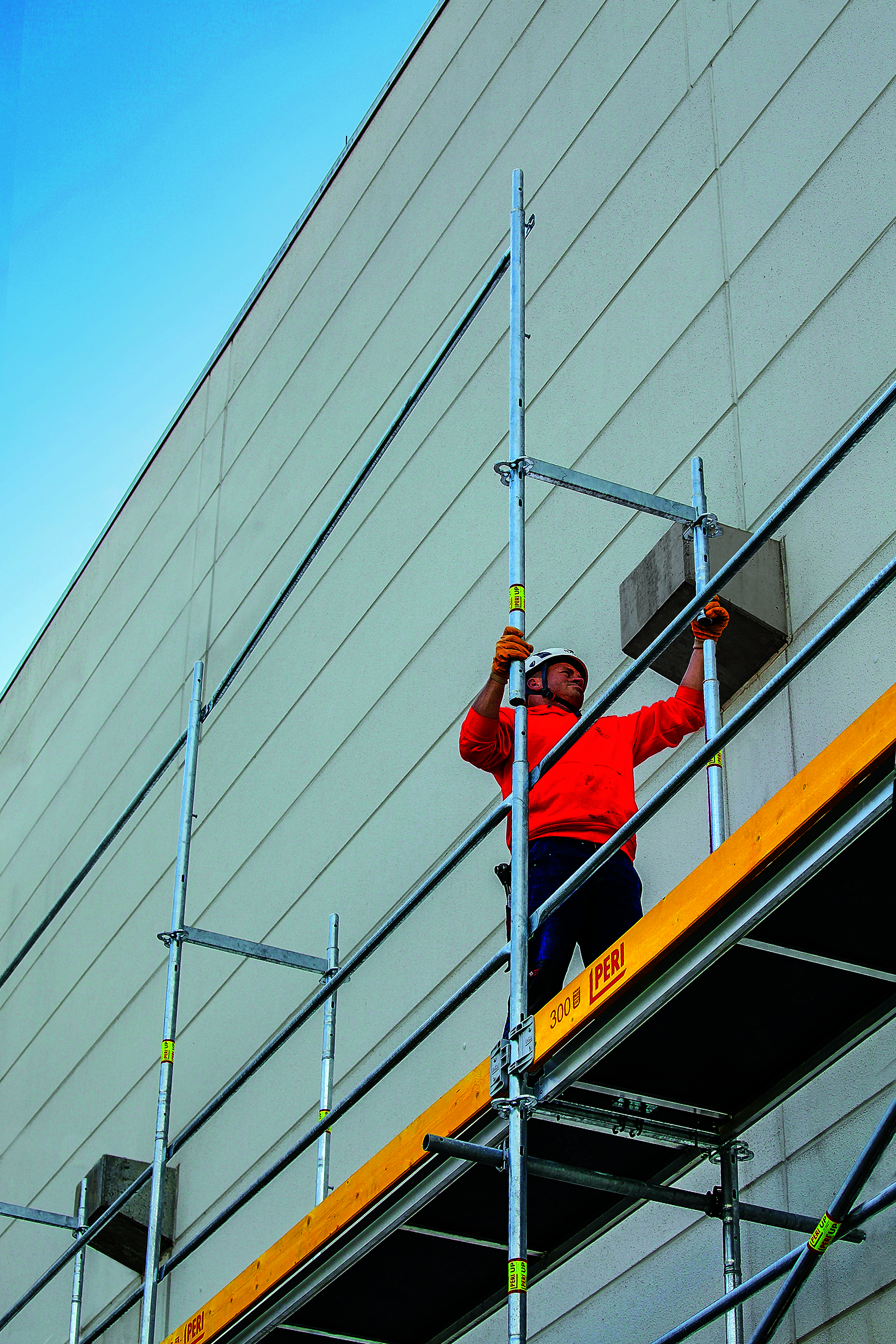
(Photo courtesy of PERI GmbH)
Other general safety scaffold tips provided by Layher Scaffolding Systems include:
• Scaffolding should be erected, moved, altered or dismantled only under the supervision and direction of a qualified person.
• Do not work on scaffolds if you feel dizzy or unsteady in anyway.
• Do not abuse or misuse the scaffold equipment.
• Always wear you a hard hat when working on, under or around a scaffold.
• Survey the job site to determine ground conditions, strength of the supporting structure, proximity of electric power lines, over-head obstructions, wind conditions and the need for overhead or weather protection. These conditions must be evaluated and adequately provided for.
• Do not erect scaffolds near electrical power lines unless proper precautions are taken.
• Post/frame spacing and sill size can be determined only after the total loads to be imposed on the scaffold and the weight of the scaffold have been calculated.
• Any part of a building or structure used to support the scaffold must be capable of supporting the load to be applied. This analysis must be done by a qualified person.
Training is an important part of scaffolding safety and will help avoid errors. “All personnel working on the scaffold must be trained in the safe usage of the scaffold … by a competent person,” stresses Malterud. “A competent person is someone with the proper training or experience in the installation and usage of scaffolds who has the authority to make changes due to recognized hazards on any job site that scaffold is being used.” Training must include the correct use of the scaffold, how to handle materials and the load capacities of the scaffold. Workers should be retrained when scaffolding, fall protection or falling object protection changes, or if additional hazards present themselves due to job-site changes.

(Photo courtesy of BrandSafway)
Avoiding Scaffolding Errors
One of the most common errors seen on today’s scaffolding structures is an insufficient number of anchors to a solid structure. “This can be prevented by having a competent person such as a professional engineer check the scaffolding plans to ensure adequate anchoring,” Riga says. “Another common error encountered in the field is the misuse of material. Scaffolding is not seen as an independent trade but as a subtrade. Because of this, there is often no formal training to continuously educate the scaffolders on industry developments, new techniques or products. Finally, a third common issue found in the field is a discontinuity between planning and building. This is mostly due to the rush that is imposed on the scaffold industry as scaffolding has not enough time to be sufficiently planned and is seen as a non-crucial part of the process.”
Grumberg contends that modern scaffold systems are carefully and purposely engineered with a minimal number of components for quick and easy assembly and compliance with all relevant regulations. However, as simple, robust and well-designed this safe access solution is, he cites the following errors commonly observed on the job site:
• Improper use or erection of scaffold by untrained personnel
• Improper removal of braces, ties and other components by erectors or scaffold users
• Installation of containment sheeting to a scaffold not designed for the additional wind loads resulting from the sheeting
• Improper mixing of components from different scaffold systems
• Use of damaged components or components that have exceeded their service life

(Photo courtesy of PERI GmbH)
Malterud cites a common error occurs when exceeding the legal height-to-base ratio, which requires a scaffold to be tied or guyed when exceeding a height of more than four times the minimum base dimension. “The scaffold must be tied to the structure when exceeding this height to prevent tipping,” he explains. “Ties require that the scaffold is tied in a manner that prevents the scaffold from tipping in all directions, which requires that the ties work in both tension and compression. Other errors include working without proper guard rails, working without fully planked scaffolds, not providing proper access to the scaffold, overloading the scaffold and riding rolling towers.”
New Scaffolding Technologies
Contractors today are under ever-increasing pressure to reduce costs, compress schedules and reduce any impact on surroundings, while also ensuring the safety of personnel. “Although built-up scaffolding has been in use for many decades, new additions to the scaffold industry come about frequently to make the scaffolding safer and easier to use,” Grumberg says. “Scaffolding and access providers and products are evolving rapidly and combining new paradigms, methodologies and technologies including motorized access and material handling.”
One of the newest additions to the scaffold industry is the advent of the mast-climbing scaffold. “Mast-climbing scaffolds typically allow a high-capacity platform to climb a single mast or pair of masts using hydraulics powered by gas-powered motors or electric motors,” Malterud says. “Some mast climbers can span 150 feet in length and climb to heights of 500 feet with a load capacity of 20,000 pounds. The platforms have guard-rail panels that include toe boards to protect workers from falls. These mast climbers allow more workers and materials to be staged on the platform with the capability of placing the platform at a comfortable working height. Multiple trades can use the same mast climbers to perform their work from the same scaffold without reconfiguring the platform to accommodate the needs of different trades reducing the redundancy of each trade providing their own access methods.”
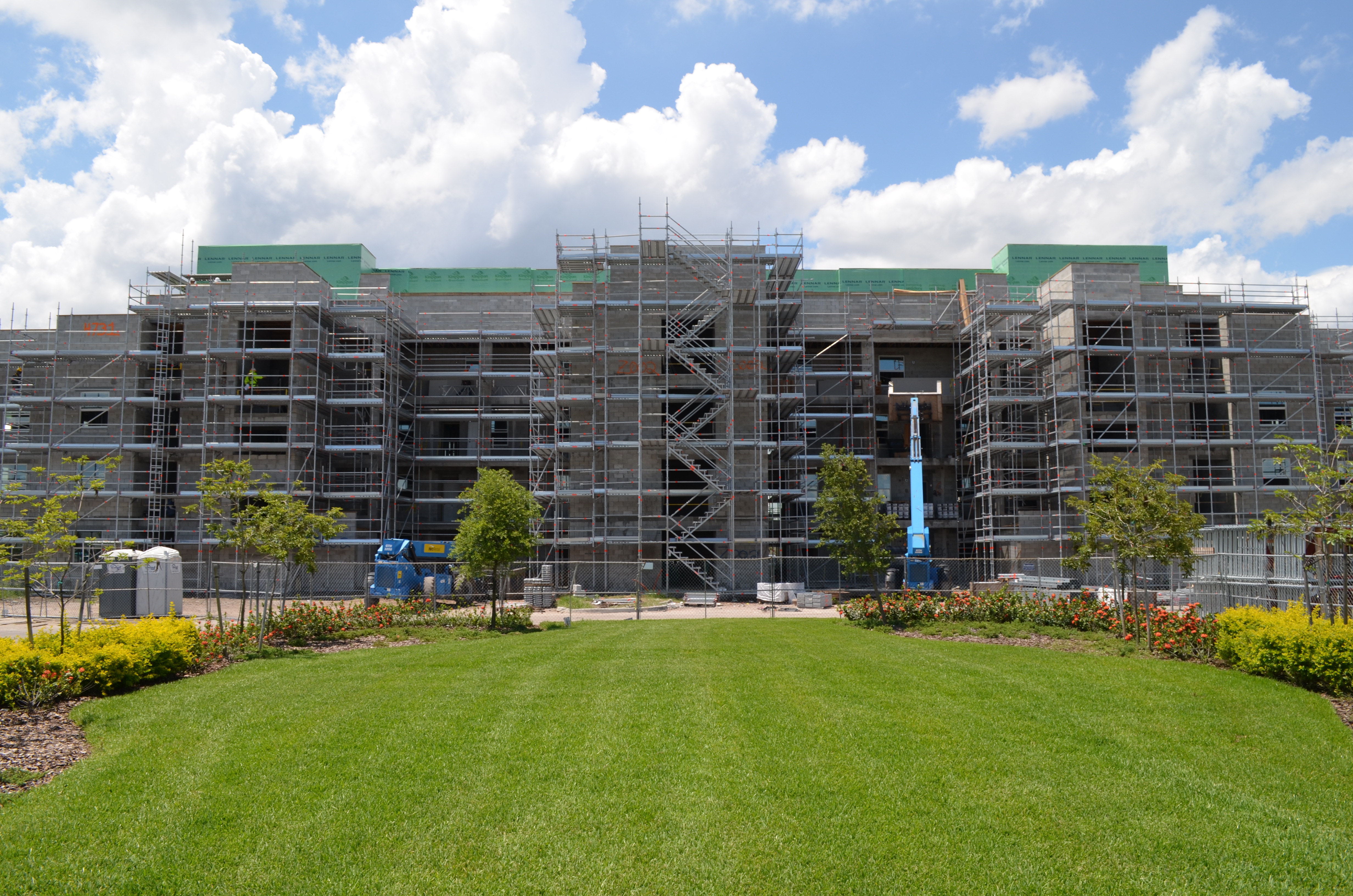
(Photo courtesy of Layher Scaffolding Systems)
Scaffolding is evolving to incorporate digital technologies. “The construction industry now uses 5-D Building Information Modeling (BIM), which in turn has been adopted by the scaffolding Industry,” Riga says. “New software powered by the scaffold manufacturers allows the import and export of 3-D files to increase communication between different trades and reduce job-site delays.”
Weissenhorn, Germany-based PERI GmbH is now providing its component models in the form of BIM libraries for other proven CAD applications. “Thanks to the new BIM CAD component library from [Augsburg, Germany-based] CADENAS, planners can now download more than 200 scaffolding components in more than 150 CAD formats at no charge and integrate the CAD data directly into the design solutions,” says Tanja Häuptle, marketing communications manager at PERI GmbH. Because of new technologies, state-of-the-art hardware and software, and BIM, Grumberg says the construction industry is beginning a “modern-day renaissance,” which includes laser scanning, thermography, drones, augmented and virtual reality, and more.