Rainscreens reduce the chance of water finding a way into the wall assembly
Improving building enclosure performance is a fundamental step in avoiding one of the leading causes of building enclosure deterioration: moisture. With driving rain typically being the largest source of moisture for above-grade building enclosures, reducing or eliminating rain penetration and absorption plays a key role in moisture control. A rainscreen is designed to limit the amount of water that could potentially come into contact with the primary building envelope’s moisture barrier.
It reduces the chance of water finding a way into the wall assembly by defending the wall assembly against the five forces that drive rain into buildings: kinetic energy, gravity, capillary action, surface tension and pressure gradients. A rainscreen should be viewed as a building envelope support mechanism, whose primary function is not to provide barrier protection against water penetration like that of a weather barrier.
Shedding water
The central principle of rainwater control is to shed water by layering materials in such a way that water is directed downwards and outwards out of the building. Rainscreens also shed water at the outer face; however, it anticipates some degree of water intrusion by including internal drainage provisions. The rainscreen is exterior cladding that sits away from a building’s outside wall’s weather-resistant barrier, creating an air cavity directly behind the cladding that helps to protect the building’s important weather-resistant barrier. This allows any moisture that may pass by the cladding to easily drain away from the building.
However, drainage alone does not remove all water that penetrates the cladding. Rainwater that is absorbed by materials or surfaces can only be resolved by evaporation. Due to changes in energy codes, an increase in airtightness and thermal control (insulation, white roofs, radiant barriers) has reduced the energy flow across the enclosure available to dry this remaining moisture. This lack of drying capacity has increased the probability of moisture-related enclosure failures. As insulation levels, airtightness, and materials change, how materials are assembled in enclosures needs to be considered as well.
A single-component solution
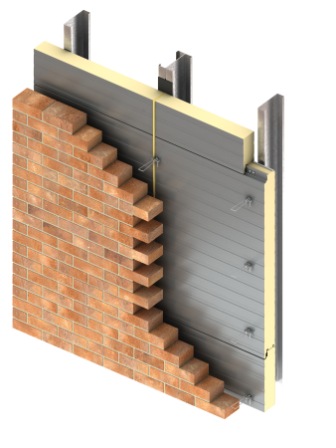
A unique solution to moisturemanagement and energy efficiency would bea single-component insulated metal panel (IMP) wall system, as an alternative to other traditional, multi-component cladding systems. Off-site factory manufactured assemblies combine the thermal energy efficiency of IMPs with the ability to supports a full range of exterior cladding options for any desired aesthetic.
A single-component IMP wall system can act as a control wall, with the addition of an attached rainscreen. The control is the moisture/vapor barrier, air barrier, and is also a backer wall to the rainscreen. By backer wall I mean the control has its own weather barrier as the exterior skin of the panel in addition to the rainscreen. Once the building is enclosed, a number of options are available for cladding material, including brick, tile, aluminum composite material (ACM) and metal composite material
(MCM).
With most single-component IMP wall systems being quick to install, this ensures air and watertightness as soon as installation is completed. Single-sourced solutions also provide consistency throughout the install process with the need for less coordination among different phases and trades. All of these advantages mean there are no concerns about potential water intrusion while the rainscreen is being installed. The rainscreen installation can actually be scheduled at a later date since the overall building envelope has been completed with the singlecomponent IMP.
Not having to worry about a high-performance building envelope, there is also flexibility for unique design freedom for the rainscreen. Traditional materials such as brick, stone, granite or tile can still be used to create a rainscreen. But incorporating a single- component IMP into the wall assembly opens up a myriad of aesthetic and design opportunities. Rainscreens with multifaceted looks, compilations of different materials and different patterns can now be created. Combining different colored single-component IMPs and a rainscreen spaced apart can generate stunning, contrasting looks.
Rainscreens have and will continue to play an important role in the overall performance of building structures. Combining a rainscreen with a single-component building envelope solution opens up a whole new world in building performance and design flexibility.
Paul R. Bertram Jr., FCSI, CDT, LEED AP, is director of environment and sustainability for Kingspan
Insulated Panels, Deland, Fla. To learn more, visit www.kingspanpanels.us.