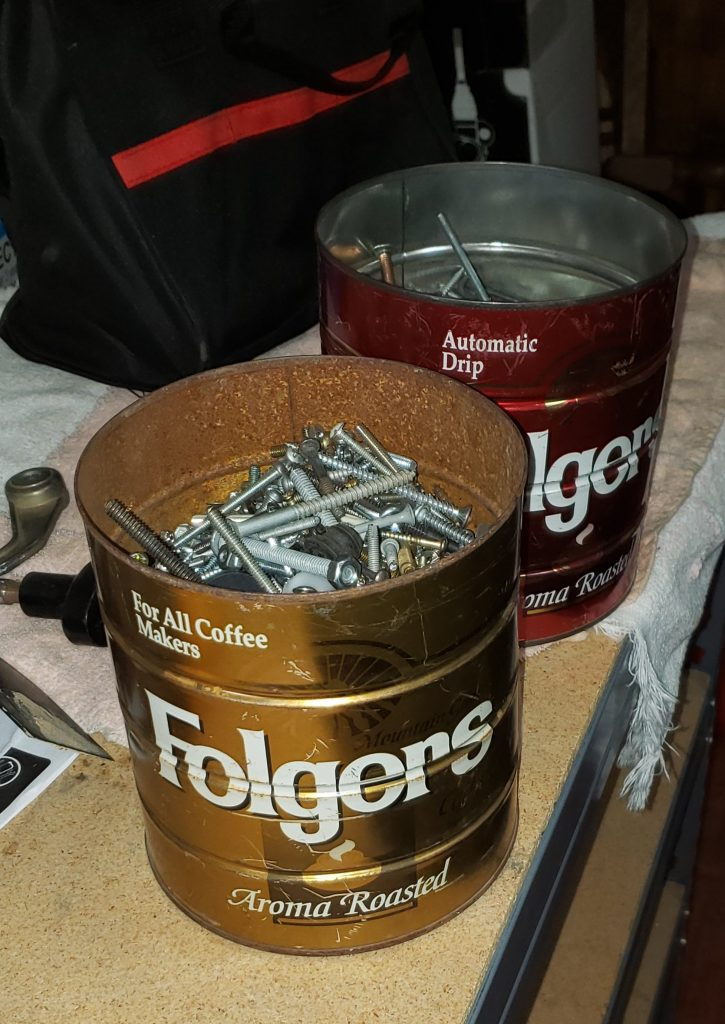
Growing up, my dad had about a half dozen coffee cans full of old nuts, bolts, screws and other random metal things. The collection consisted of the extras from every car project, every trip to the hardware store, every new piece of furniture; he’d even pick up poor little metal orphans off the street. I remember helping him on projects when he’d hold up a bolt and say, “find a nut that fits this.”
Safety comes when everyone working participates in identifying how work will be done

Hours of endless searching would ensue until I found that one perfect nut. I hated those cans.
Over the holidays I noticed those old cans are still in his shed.
Seeing them got me thinking about all the nuts we deal with in the safety field. And I don’t mean all those crazy people who run around construction sites and tell everyone to obey them because OSHA says so. I’m talking about the parts and pieces of our safety programs. In my experience, one of the most important of those pieces is one of the simplest, most innocuous and seemingly well-intentioned pieces that nearly every company already employs in one way or another: the Job Hazard Analysis (JHA).
Organizations call them by many names. Some are labeled a “Pre-Task Plan” or “Standard Operating Procedure.” Maybe it’s a “Task Risk Analysis” where you work. Whatever your organization calls it, it’s there to help workers mitigate risk.
Or is it? If you looked at it from the perspective of the nuts-and-bolts analogy, could you say for sure that you found the right nut and the right bolt from your coffee can?
Let’s use the example of a JHA that comes in the form of a pre-job checklist. It’s something your employees complete every morning before they get to work. The supervisor dutifully reads down the list, and the crew nods along as he checks YES or NO next to each line. I’m sure you’ve all seen the “call-and-response” ritual.
“Any fall hazards?” “Nope.”
“Everyone got their proper PPE?” “Yep.”
“Any open excavations?” “Nope.”
The list goes on until the last mark is checked then it’s passed around for everyone to sign. Because signing stuff makes you safer …
Believe it or not, that exercise is designed to protect the legal interest of the company, not the lives of its workers. On rare occasions, you might find an outstanding supervisor or two who makes a point to go beyond the checklist, but paper never saved a life.
Meaningful safety isn’t born when a worker signs their name on a card. It comes when everyone working participates in identifying how work will be done and what precautions must be put in place to ensure the result we seek. The checklist can stay, but use it as a prompt for active communication. That conversation should go like this:
What is our job today? Are we installing a pump? Great. How is that done?
What do we need to get it done? Do you need parts? What size wrenches are required? Do we have all of the materials needed to put it together?
Who’s doing what? Assign specific roles. For simpler tasks, this may seem dumb since everyone should already know what they’re doing. Maybe. But calling it out will keep people from wandering around without purpose, doing stuff to stay busy and walking all over each other.
How could someone get hurt during this job? Brainstorm. The crew should talk about areas where extra coordination and communication is needed as well as considerations for other people the area.
How do we make sure that doesn’t happen? Discuss the measures they will take to account for the risk they just brainstormed about.
That’s it. Engage workers in the process. When you do that, you’ve just taken the first steps toward building safety in rather than allowing it to just be something extra.
You may not have noticed, but only two of the questions I asked had a safety specific connotation. By talking about things like tools, tasks and strategy, people will begin to get the idea that safety isn’t just first and then on to the real work. They will begin to think of the safety elements as real steps in the process. It’s a simple shift in thinking, but an important one.
Jason Maldonado has worked as a safety and health professional for 17 years in a variety of industries. He is the owner and lead contributor of RelentlessSafety.com, as well as an accomplished author and speaker. His first book, “A Practical Guide to the Safety Profession: The Relentless Pursuit,” is available now.