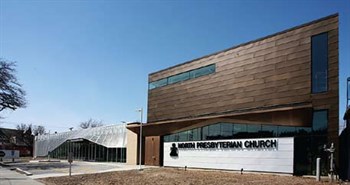
 Lutheran Metropolitan Ministries (LMM) of Cleveland, Ohio, has a new home due to a unique retrofit of an existing warehouse. Known as the Richard Sering Center, the project features an updated exterior appearance by using expanded metal screens from McNichols Co. Inc., Tampa, Fla., to protect solar shading, as well as anodized aluminum panels from Firestone Metal Products Inc., Anoka, Minn.
Cleveland-based studioTECHNE | architects was hired to provide new offices for the growing social service agency, which serves and advocates with youth at-risk, people involved in the criminal justice system, at-risk adults, people with disabilities and the homeless. LMM’s current facility provided a method of service where providers rarely worked together and clients’ needs were being overlooking in the process. “We worked with them to gain an in-depth understanding of the services they provided; and to understand the needed movements of clients and service providers to develop a new and more efficient work flow that respected the fragile nature of their at risk clients, and ensured the case workers provided coordinated support to these families and individuals,” explains Marc Ciccarelli, principal at studioTECHNE.
In addition to accommodating its extensive program, LMM had a series of requirements for the new facility’s location. Along with needing the new facility to be in their service area and on an active bus line, the organization wanted to renovate a structure instead of building a new one. After an extensive search and test fitting several buildings, the decision was made to use the former Jerry Lorie Fashions manufacturing facility located on the corner of Superior and 45th Street. While vacant for a number of years, the building still had sewing tables and other items from its past strewn about. Existing mechanical, electrical and plumbing systems were all removed, and the warehouse’s first bay was removed to create a front drop-off, mandated by the openness to the street and accessibility requirements. Wood beams were saved for reuse, while the remaining building components were salvaged.
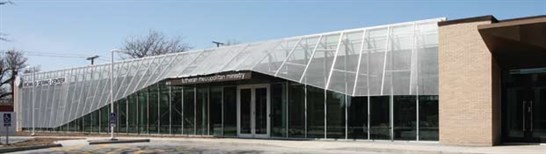 LMM requested that the building’s internal activity be visible to the street, and the south façade as transparent as possible. “The building design focused around establishing a safe comfortable environment washed in abundant daylight,” says Ciccarelli. “Materials were chosen for their simplicity and ease of long-term maintenance. Failing exterior systems were covered with bronzed anodized aluminum panels, brick masonry was tuckpointed and repaired, and the front curtainwall system is shaded with a dramatic expanded aluminum sunshade. Interior finishes included staining existing concrete surfaces, clear finished and painted MDF wall panels, and reclaimed barn siding and sewing table tops that became stair treads and countertops throughout.”
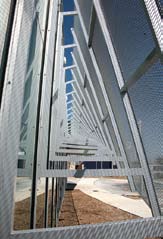
Ciccarelli explains that daylight was introduced to the building in two direct ways. The façade on the building’s south side, facing Superior Avenue, was replaced with a glass curtainwall system from E.R. Flynn Co., Cleveland, and an expanded aluminum sunshade made up of 2,016 square feet of McNICHOLS’ standard non-flattened 1/8-inch aluminum expanded metal with an open area of 68 percent over 1 1/2- by 3- by 1/8-inch aluminum tube. Additionally, 68 skylights from Solatube International, Vista, Calif., allow the interior to be light without the use of artificial light on most days of the year.
 For the building’s two-story portion, Firestone Metal Products supplied 4,000 square feet of its Una-Clad Flat Lock wall panels in a Dark Bronze anodized aluminum finish. “The bronze anodized aluminum provides the building with maintenance-free cladding,” says Ciccarelli. “The dark color was chosen to de-emphasize the two-story mass and focus attention on the one-story glass façade and entry. Further, the patina of the anodized panels changes throughout the day, providing warmth and visual interest.”
“The placement of offices, work areas and gathering spaces is all directed at providing the most efficient service model in an open comfortable atmosphere,” Ciccarelli adds. “Features include meeting nooks, a full-service commercial kitchen that provides meals for homeless shelters, a changing room for bicyclists complete with showers, a donor wall fabricated to our design by
[Cleveland-based] A Piece of Cleveland made from the timbers removed during demolition.”
The building is expected to receive LEED Silver certification.
Richard Sering Center, Cleveland, Ohio
Owner: Lutheran Metropolitan Ministries
General contractor: Thomarios Inc.
Architect: studioTECHNE | architects, Cleveland
Structural engineer: Ebersole Structural Engineers, Brecksville, Ohio
Mechanical/electrical engineer: WHS Engineering, Cleveland
Roofing contractor: T+F Systems, Cleveland
Curtainwall/storefront: E.R. Flynn, Cleveland,
(216) 391-4141, Circle #XX
Expanded metal mesh: McNichols Co. Inc., Tampa, Fla., www.mcnichols.com, Circle #XX
Metal wall panels: Firestone Metal Products Inc., Anoka, Minn., www.firestonemetal.com, Circle #XX
Ornamental metal: Fabrication Group LLC, Cleveland, www.fabricationgroup.com, Circle #XX
Skylights: Solatube International, Vista, Calif., www.solatube.com, Circle #XX
Upcycling: A Piece of Cleveland, Cleveland, www.apieceofcleveland.com, Circle #XX