When realizing that snow retention is a critical component of your metal roof, your first question is what type to use.
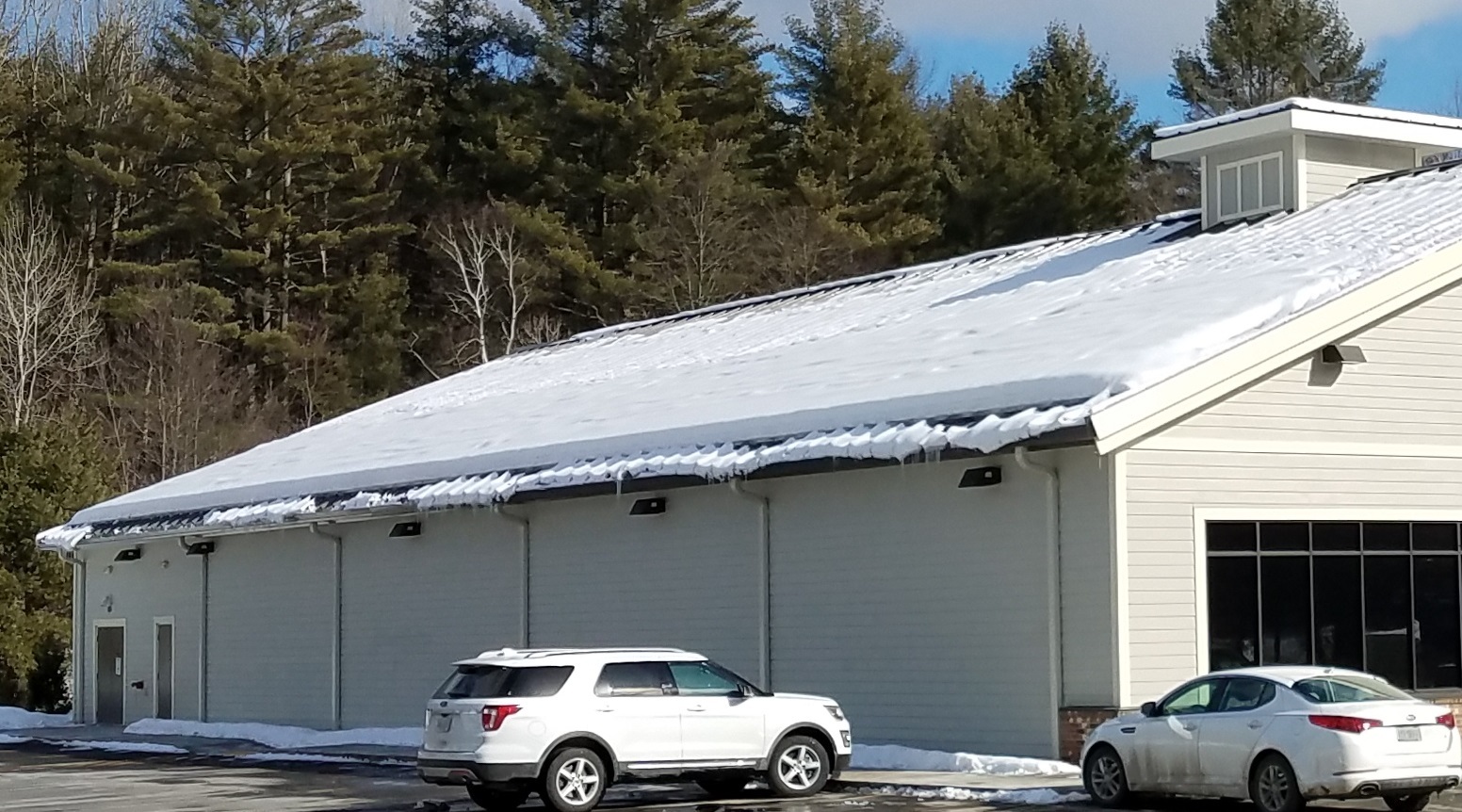
The correct snow retention system can alleviate snow sliding and ice accumulation on unprotected metal roofs

This decision will be based on what type of roof panel you have or perhaps as simple as what type of look you want. There are many configurations of snow guards on the market but individual/pad style snow guards and continuous rail type snow guards, such as DYNA-GUARD, are the two most commonly used in the U.S.
Pad and Rail
Both can be installed on through fastened panels or standing seam panels. Individual snow guards will either adhere to the roof panel via adhesive/sealant or fasteners that penetrate through the roof panel into the structural substrate.
These pad-style snow guards are typically polycarbonate, and do not usually offer the same strength characteristics of a continuous rail system. Continuous rail-type snow guards will attach to either a mount that is through fastened into a structural member, for corrugated or through fastened panels, or via clamps that will attach to the seam of a standing seam panel, using non-penetrating setscrews. Either of these two methods will then use a continuous rail/extrusion that attaches to either the mount or clamp, and will also have a SNO-DAM or a flag that hangs down and rests in the center of the flat of the panel, which will keep snow and ice from sliding under your snow guards.
Rail-type snow guards are commonly manufactured from aircraft quality, high-tensile aluminum and use stainless steel hardware for attaching. Both individual and rail-type snow guards give you the option to color match your roof panel. Preferred systems will use flat stock panel that has been cut down to slide in the face of your rail/extrusion. This will ensure roofline aesthetics for years to come as you won’t have to worry about your snow guards fading at a different rate than your roof panels.
Other things to consider are whether or not the system has been independently tested and if the system can be designed/engineered for your specific roof. Generically speaking, most continuous rail-type snow retention will be installed in a single row within a few feet of the eave line while individual/pad-style snow guards will be installed in a grid or staggered pattern. In certain circumstances, multiple rows will be required to properly retain the accumulating snow no matter which system is used.
Rail-type systems are more likely to use a single row due to the greater holding power versus glue-down pad style. Long panel lengths combined with steep roof slopes are two factors that play into calculating whether or not multiple rows are needed. Other factors to consider are: designed roof snow loads as well as the roof panel base material, width and configuration. Consult the snow guard manufacturer for engineering/calculations for each individual roof.
Correct Installation
Proper installation of whichever style snow retention you choose is imperative. Since individual or pad-style snow guards rely on adhesive/sealant for attachment optimum weather conditions as well as a clean panel surface is vital for installation. These adhesives/sealants are recommended to be installed at temperatures above 40 F for application and require seven to 14 days to fully cure. Continuous rail-type snow guards can be installed in virtually any weather condition.
Choosing the correct clamp for your roof panel configuration is essential. Also, clamp setscrew torque is a critical component in the strength of a continuous rail system. Using a calibrated torque wrench to tension the setscrews properly is a necessity, remembering to alternate tightening the setscrews repeatedly until they all hold the required tension during installation. Manufacturers should be able to provide clamp/panel specific torque values. Consult with the manufacturer prior to installing for recommended materials, tools and installation procedures.
Snow sliding and ice accumulation on unprotected metal roofs can cause issues such as property damage as well as potential physical injury. Using the properly engineered/tested snow retention system can alleviate these dangers.
Jerod Webber is sales manager at Dynamic Fastener, Raytown, Mo. To learn more, visit www.dynamicfastener.com.