Planning momentum in March 2026 was powered almost entirely by data center projects, said Sarah Martin, associate director of forecasting at Dodge Construction Network.
“For some categories, this reflects a natural reset after the outsized growth in late 2025. But for others, elevated macroeconomic risks are likely beginning to feed into planning decisions,” she said.
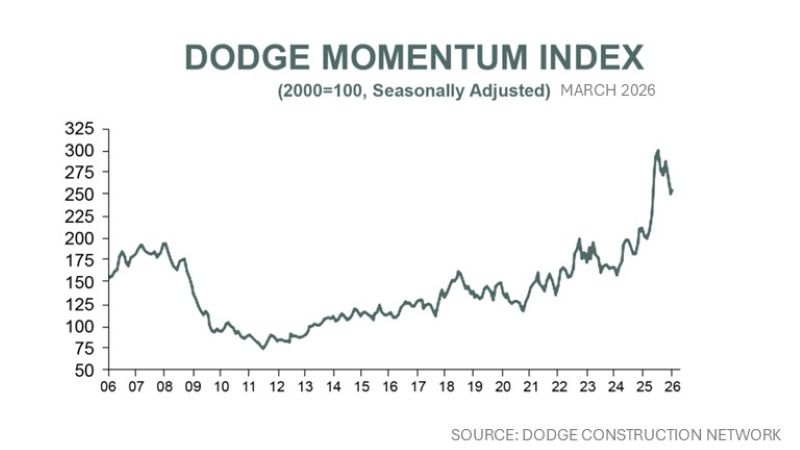
Martin was referring to the recently published Dodge Momentum Index (DMI), which increased 1.8% in March to 250.5 (2000=100) from the downwardly revised February reading of 246.2. Over the month, commercial planning grew by 7.0%, while institutional planning momentum declined by 8.8%.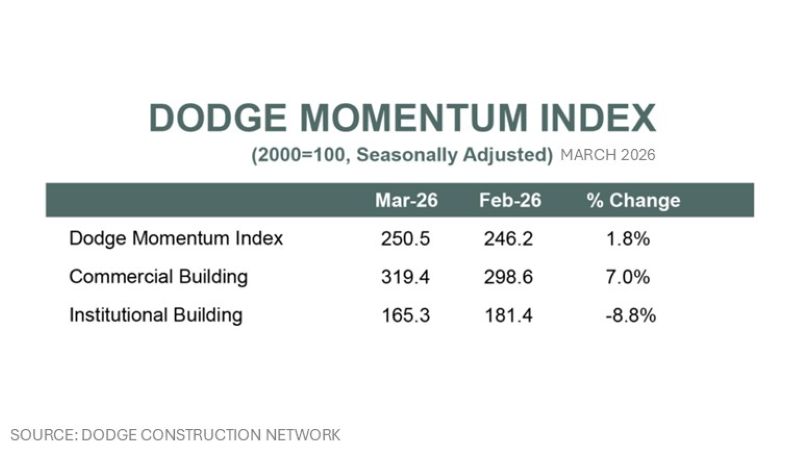 On the commercial side, momentum slowed across all sectors except data centers. Institutional planning saw widespread weakness, with only education and public buildings showing moderate gains.
Despite recent declines, the DMI remains elevated. Year-over-year, the DMI is up 25.8% when compared to March 2025. The commercial segment is up 28.5% (-12.7% when excluding data centers), and the institutional segment is up 19.6% over the same period.
A total of 54 projects valued at $100 million or more entered planning throughout February. The largest of those included 17 individual buildings, each valued at $500 million, for the Amazon Data Center Campus in Hamlet, N.C.
Similarly, 10 individual buildings—each valued at $250 million—entered planning for the Microsoft Data Center DSM50 in Dallas, Iowa.
The largest institutional projects were the $245-million MCLJ Outpatient Pavilion in San Diego, Calif., the $183-million Orlando Health Viera Hospital (Phase 1B) in Viera West, Fla., and the $175-million Bachelor Enlisted Quarters renovation project at Camp Pendleton North in San Diego, Calif.
Published by Dodge Construction Network, the DMI is a monthly measure based on the 3-month moving value of nonresidential building projects going into planning, which has been shown to lead construction spending for nonresidential buildings by a full year to 18 months.