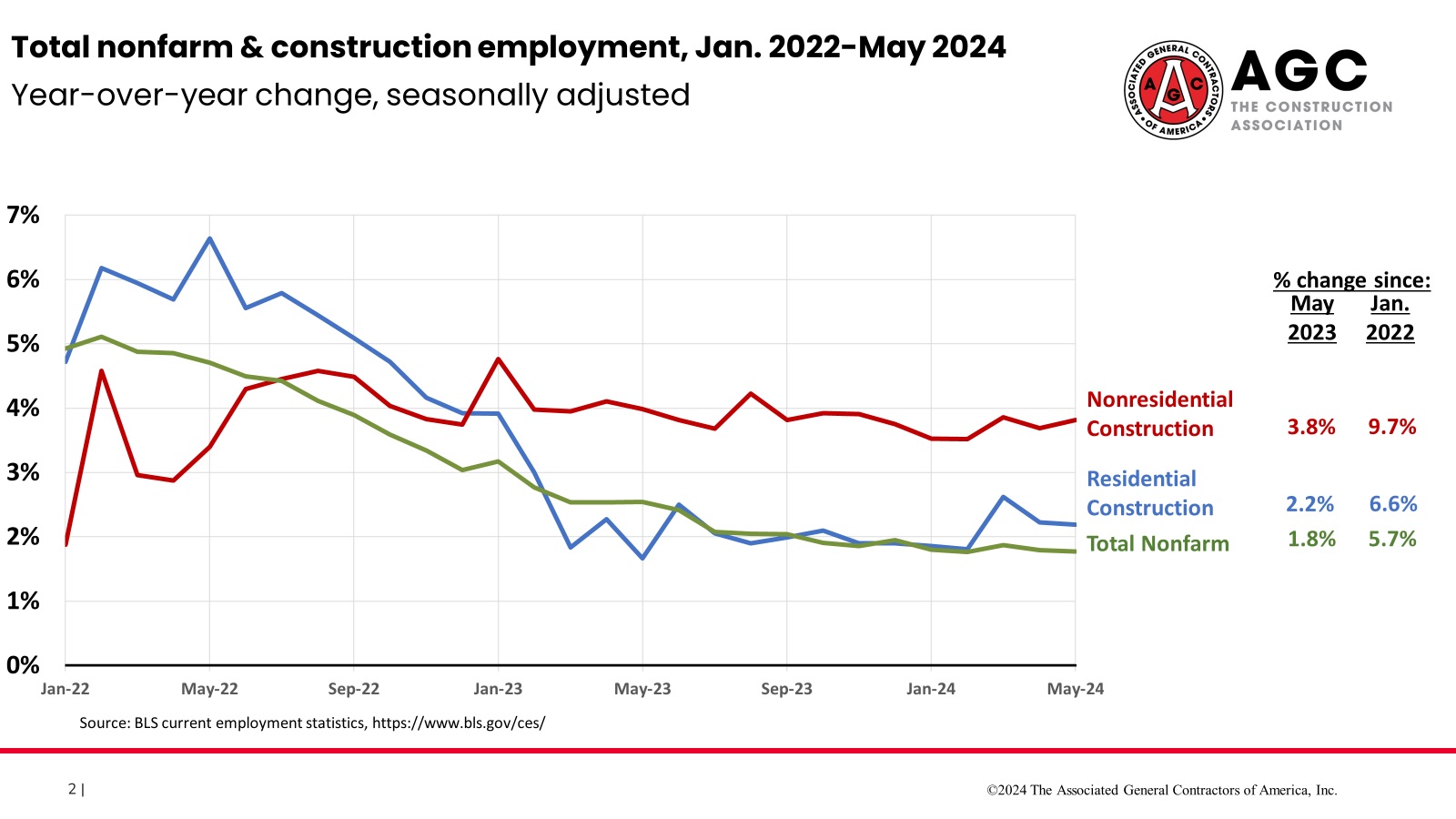
Construction employment, seasonally adjusted, totaled 8,228,000 in May, a gain of 21,000 from April and 251,000 (3.8 percent) year-over-year, according to Associated General Contractors of America’s (AGC) analysis of data the U.S. Bureau of Labor Statistics (BLS) posted.
The year-over-year growth rate outpaced the 1.8 percent increase in total nonfarm payroll employment. Residential construction employment (at residential building and specialty contractors) rose by 3,500 in May and 71,900 (2.2 percent) since last year.
Nonresidential construction employment (at building, specialty trade, and heavy and civil engineering construction firms) increased by 17,100 for the month and 179,000 (3.9 percent) year-over-year. Seasonally adjusted average hourly earnings (AHE) for production and nonsupervisory employees in construction (i.e. most craft and office workers) rose 4.3 percent since last year to $35.45 per hour.
The “premium” for nonsupervisory construction workers was 18.2 percent over the private sector average of $29.99 but remains considerably below the average premium between 2000 and 2019 of 21.5 percent. The number of unemployed job seekers with construction experience totaled 406,000, not seasonally adjusted, an increase of 51,000 (14 percent) from May 2023.
Construction spending (not adjusted for inflation) totaled $2.10 trillion in April at a seasonally adjusted annual rate, down 0.1 percent from the upwardly revised March rate but up 10 percent year-over-year, the Census Bureau reported on June 3, as declines in public and private nonresidential and multifamily construction outweighed growth in manufacturing projects.
Private residential construction inched up 0.1 percent for the month and 8 percent since last year. Single-family homebuilding rose for the 12th consecutive month, by 0.1 percent; multifamily construction spending declined 0.3 percent; and owner-occupied improvements rose 0.3 percent. Private nonresidential construction spending dipped 0.1 percent for the month but climbed 8.3 percent year-over-year. The largest private nonresidential segment—manufacturing construction—rose 0.9 percent for the month (with computer/electronic/electrical up 2.8 percent, chemical and pharmaceutical down 0.6 percent, and transportation equipment up 6.4 percent).
Commercial construction fell 1.1 percent (comprising warehouse, down 1.4 percent; retail, down 1 percent; and farm, unchanged). Power and energy construction ticked up 0.1 percent. Private office and data center construction rose 0.4 percent. Public construction spending decreased 0.3 percent for the month but rose 19 percent year-over-year. The largest public segment, highway and street construction, declined 0.5 percent for the month, education spending slipped 0.2 percent; and outlays for transportation facilities increased 0.5 percent.
There were 351,000 job openings in construction, not seasonally adjusted, at the end of April, a decline of 23,000 (-11 percent) year-over-year, BLS reported on June 4. Hires for the full month totaled 434,000, a drop of 30,000 (-6.5 percent). Layoffs totaled 119,000, a drop of 51,000 (-30 percent). While declining openings and hires may imply cooling demand, the steep drop in layoffs indicates contractors expect to need current workers in the near future. Many firms still report difficulty filling positions.