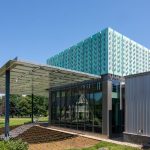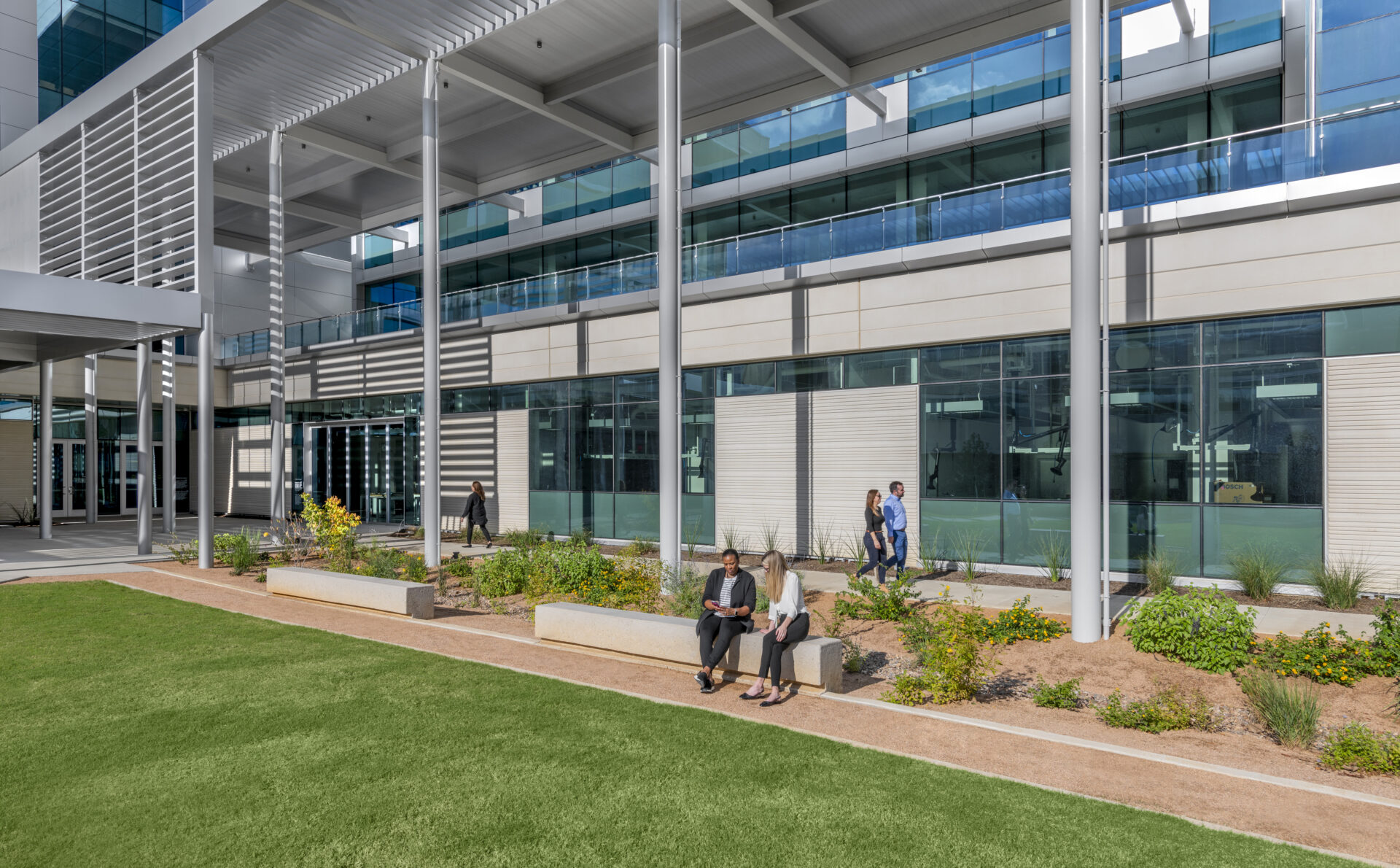
The Texas Instruments Biomedical Engineering and Sciences Building (BMES) catalyzes a unique partnership between UT Southwestern Medical Center and The University of Texas at Dallas, bringing their biomedical engineering programs together to foster innovative solutions for unmet medical needs. The five-story research facility connects engineers and scientists with access to physicians and patients on UTSW’s East Campus with the aim of improving technologies to advance patient care. Designed to accommodate future research needs and technologies, the L-shaped lab chassis features open labs and a flexible systems framework that can easily change over time. The labs are coupled with directly adjacent office spaces for quick access and a generous collaboration area as the connecting knuckle between the two lab bars on each floor. The L-shaped form encloses a landscaped courtyard that serves as an outdoor amenity and flexible event space while creating a greater sense of place for the east campus.
Although the BMES building was the fourth building on the East Campus, the campus lacked a sense of place with minimal continuity between buildings. The design team enveloped the iconic structure with a system of pedestrian-scaled canopies to build physical and experiential connections between buildings. At the facility’s main entry, a cantilevered canopy projects outward, welcoming visitors to the front door while reaching over to connect to the neighboring research building. The canopy then wraps the building, forming the perimeter edge of a new landscaped courtyard before stepping up to create a two-story pedestrian walkway and shade trellis over a level 2 roof terrace. The canopies are multi-faceted in their function and utility. They provide beneficial cover and shade for the building while crafting a human-scale arrival experience that connects occupants to the outdoor environment and the broader campus. Existing campus materials included metal elements accenting a primary palette of precast concrete and glass.
The design for the BMES building builds off the existing palette, utilizing metal more extensively. Metal’s lightweight and high
strength-to-weight ratio made it an obvious choice for the cantilevered canopies and integrated curtainwall shade elements. The material’s versatility is unparalleled and is on full display in everything from structure to finish material. The canopy system is constructed entirely of aluminum and steel and includes an integrated drainage system. Aluminum was also an important choice for the interior ceilings, where single panels run the entire width of the corridor. Lightweight aluminum panels installed via a torsion spring system provide maintenance personnel with easy handling and access to the service plenum above. The panels also include a custom perforation pattern that adds visual movement down the corridors while aiding acoustics.
Owner: UT Southwestern Medical Center/University of Texas at Dallas, utsouthwestern.edu/utdallas.edu
Architect: SmithGroup, Washington, D.C., smithgroup.com
Metal installer – MCM panels: Armetco, Justin, Texas, armetco.com
Metal installer – metal ceilings: Lasco, Austin, Texas, lascoadi.com
Metal installer – canopies: Avadek, Webster, Texas, avadek.com
General contractor: Whiting-Turner Construction Company, whiting-turner.com