

When designing a home in the Mojave Desert, blistering sun and gusting winds top the list of challenges. Shade and sustainable design come at a premium, and creating it inexpensively is no easy task.
Faced with the challenge, Los Angeles-based architect Walter Scott Perry, AIA, found an answer in a lightweight perforated aluminum panel. Perry’s firm, Ecotechdesign, and 44 West Construction Inc., Topanga, Calif., completed the project in early 2011. The custom-built, 2,400-square-foot home includes the owner’s private photography studio.
The unique part is the object used as the core building material-ISO corrugated metal cargo shipping containers, which he partially wrapped in the perforated metal panels from Tampa, Fla.- based McNICHOLS Co. The panels serve as an exoskeleton and sunshade to control heat. Because they diffuse light, the metal panels reduce solar and wind impact by 50 percent.
Purchased from a Long Beach, Calif., dock, the six cargo containers were converted off site into modular units complete with windows, plumbing fixtures, wiring, kitchen and finishes, ready for onsite hook up. Transported four hours on a flatbed truck, the containers were installed in 15 minutes each, and covered with the perforated metal panels using a system Perry calls a “kit-of-parts.”
Besides complementing the modern look of his container design, the metal panels, like the containers, were easy to transport and handle, says Perry. “And the installation requires only simple everyday construction tools.”
Natural Ventilation
Perry used McNICHOLS Designer Perforated Aluminum Metal with 3/16-inch round holes on a 1/4-inch staggered pattern in 16-gauge, which was cut into 4- by 8-foot and 4- by 4-foot panels. The material covers 1,800 square feet over the two roofs and the south and west facing exterior walls of the living quarters.
Each panel was secured with stainless steel bolts and washers onto Unistrut T1001, 12-gauge galvanized steel framing members bolted together on 4-foot centers. The framing sits 8 inches off the exterior wall and 4 to 6 inches above the roof. Unistrut framing is by Atkore International Inc., Harvey, Ill.
“The idea was to create a home that is passively cooled using natural ventilation,” says Perry. “The extra 8-inch space between the skin and the exterior wall allows air to circulate around the home, create more efficient cooling, as well as facilitate cleaning and maintenance.”
“Another advantage of the perforated metal is its partial transparency which changes during the day, based on the suns relative position,” he says. “During the late afternoon, it becomes more reflective due to the lower sun angle, thereby reducing glare. In the morning, it’s more transparent from the inside, thereby enhancing the views out over the desert landscape”
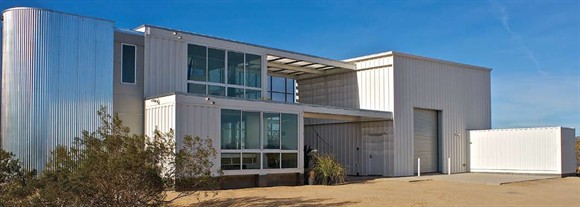
The residence sits on a 2.5-acre rural lot in Joshua Tree, Calif., at the foot of Shadow Mountain, roughly 40 miles east of Palm Springs. The 900 square feet of living area consists of five cargo containers, two placed on top of three to create two levels that include the kitchen, living room and half bath on the first floor and bedroom and full bath on the second floor.
The stairwell is a U-shaped structure covered with corrugated metal siding, complementing the steel wall panels of the photography studio to the west, which is a 21-foot-high pre-engineered steel building from Butler Manufacturing, Kansas City, Mo. The sixth cargo container literally plugged into the studio where it is used for equipment and material storage.
Installation Made Easy
Perry said the planning team first intended to use the perforated aluminum as a shade canopy to create the 500-square-foot outdoor living space for people to gather and socialize without being subjected to excessive heat and wind. The idea quickly evolved into creating an exoskeleton covering the two roofs and the south and west exterior walls, an approach that proved economically and environmentally beneficial.
The system accommodates the photovoltaic, hot water solar panels and green roof modules that are bolted directly through the perforated metal onto the Unistrut sub-framing. Perry says he was able to install the exoskeleton system, including sub-framing, metal panels and labor, at a cost of $10 to $12 per square foot. According to Eric Engheben, owner of 44 West Construction, the completed home was built for $150 per square foot.
The cargo containers, which measure 20 feet long by 8 feet wide by 8 1/2 feet high, were cut and opened up in strategic locations to conform to Perry’s open floor plan.
“It was a true collaboration between builder and architect, which is the main ingredient for a successful project,” says Engheben. “Using the perforated metal, for example, changed the whole appearance of the structure. Not only does it add an architectural element, it helps prevent heat gain.”
With the container units painted a highly reflective cool white on the sides to match the “cool roof” with an SRI=0.75, and combined with the metal shade canopy and other energy saving features, the construction exceeds California’s Title 24 energy requirements for code approval, says Perry. The container wall and roof insulation systems exceed code by 50 percent.
Other energy saving features include a roof membrane of single-ply TPO, a 10,000-gallon water storage tank, 3,000-gallon cistern, water harvesting and grey water system, and interior walls of plywood from a sustainable source monitored by the Forestry Stewardship Council.
In addition, natural daylight and ventilation are used throughout the containers with large operable windows and sliding glass doors; the photo studio uses dimmable Velux Sun Tunnels from Greenwood, S.C.-based VELUX America Inc., to control daylight levels and heat buildup throughout the day. The home has a mini-split heat pump system for air conditioning and heating with a 17 SEER rating.
The perforated metal skin makes this home architecturally unique, says Perry, as it integrates the various hybrid building components, creating a sophisticated and contemporary industrial aesthetic. While the perforation already decreases the home’s solar exposure by 50 percent, Perry says he is considering adding different panel opacities on the roof, which could achieve up to 90 percent shading, while still allowing for drainage and ventilation.
Mary Estes is principal of Estes and Co., Tampa.
Private Residence, Joshua Tree, Calif.
General contractor: 44 West Construction Inc., Topanga, Calif.
Architect: Ecotechdesign, Los Angeles
Perforated metal panels: McNICHOLS Co., Tampa, Fla., www.mcnichols.com
Metal framing system: Atkore International Inc., Harvey, Ill., www.unitstrut.us,
Metal building: Butler Manufacturing, Kansas City, Mo., www.butlermfg.com,
Skylight: VELUX America Inc., Greenwood, S.C., www.veluxusa.com