High-performance and net-zero buildings have been a major topic of discussion at everything from the American Institute of Architects‘ National Convention to the U.S. Green Building Council‘s Greenbuild International Conference and Expo to the metal construction industry’s own convention, METALCON.
“Everyone is well aware that our planet is facing some serious energy and pollution issues,” says Brian Court, AIA, LEED AP, at The Miller Hull Partnership LLP, Seattle. “Buildings in America are responsible for approximately half of our total energy consumption, two-thirds of our electricity use and are responsible for roughly half of all of the country’s CO2 emissions. There is a real opportunity for architects and engineers to help mitigate some of the most pressing global issues. We see all buildings in the future performing at very high levels as it is clear to us that the days of cheap energy are numbered.”
“We don’t just want to create buildings that look good,” says John M. Swift Jr., PE, CEM, LEED, Cannon Design, Boston. “We want to create buildings that work well for the people who use them, that are healthy, and are places where people can learn and live.”
Renee Loveland at Portland-based Gerding Edlen Development agrees, saying: “We have a strong commitment to sustainable development and high-performance buildings. We see it as not only the right thing to do, but good business and good for the local community. Our goal is to make lasting contributions in the built environment and to create vibrant, 18-hour live/work/play communities where people can thrive.”
“For us, high-performance buildings mean we’re not only focusing on energy and water efficiency, better indoor air quality and sustainable finishes, but also amenities and features that help foster community among those who live and work in our buildings,” Loveland continues.
Building Strategies
The process of building buildings and the process of operating buildings have a significant impact on the environment, both from an air quality and pollution point of view, Swift says. “We like to try and minimize the damage that the building and operating of the buildings we design that they do to the local and global environment.”
Loveland recommends following an integrated design process, where the owner, architects, engineers, contractors, city planning officials, utility representatives and others are working closely together from the beginning of the project. “This ensures that the contractors understand the design intent and provide cost-effective solutions to achieve the desired objectives.”
Focusing on efficiency across all disciplines is key, notes Loveland. “The façade will impact the effectiveness/performance of your HVAC systems, etc.,” she adds. “Making sure you have a wellinsulated façade and high-performance mechanical equipment is very important, but ideally you minimize the amount of heating and cooling required through good site design/solar orientation, exterior shading on the south façade, and as much passive ventilation as possible.”
Energy Modeling
Energy modeling is the practice of using computer- based programs to predict the energy performance of an entire building or the systems within a building. “Energy modeling allows us to test a myriad of performance strategies and come up with the combination that achieves the highest levels of performance,” Court explains. “Daylight simulation software allows us to optimize building massing and fenestration patterns to maximize natural daylighting. From a design perspective, one of the biggest weaknesses with buildings today is air infiltration. If we can detail a building properly and specify windows and doors that seal very well we can dramatically reduce energy losses.”
Cannon Design uses energy modeling in three different ways, says Swift. The macro-conceptual model takes the whole building and allows architects and engineers to input very conceptual systems and concepts when looking at the initial massing strategies for a building design. The second is a micromodel, which looks at options for systems in the schematic and design development phase. Lastly, the whole building energy model does the final prediction of how the building will operate.
“The simulation tools that we have now help us articulate the decisions that are being considered from both a systems perspective and from a massing and envelope perspective,” explains Swift. “And so using those simulation programs- whether its looking at energy modeling or daylight simulation or solar radiation simulation-seeing how the building is going to be impacted by the sun and the wind, and from prevailing winds and rain and such, and integrating concepts into how the building will be designed that use those forces positively wherever possible and minimize the negative impact of them.”
By metering new buildings, designers and engineers can do a post-occupancy evaluation on how a building is actually performing. “Setting buildings up with metering capabilities so you can get post-occupancy evaluation on how the building energy is actually being used compared to how you forecasted it and modeled it, is very helpful, because some of our assumptions end up being pretty accurate and some don’t,” Swift says. “Sometimes the building is operated in a completely different way than we expected, or a system doesn’t work exactly how we intended it to. So we get feedback on that and it helps us improve how we implement those type of concepts on future projects.”
Moving Forward
“I think [construction] is headed more towards the whole concept of a living building, where buildings actually no longer do damage,” says Swift. “I don’t think you’re ever going to have every building in the world that is going to be designed to [the Living Buildings Challenge] standards, but I think a lot more buildings will be designed with those ideas in mind. And the buildings that are built with be built and operated in a way that there is a much lower environmental impact.”
“The Living Building Challenge is the most far-reaching measure of true sustainability for buildings that we have today,” says Court. “It is holistic and forward thinking and performance based. The goals are simple and straightforward.”
“We continue to innovative with respect to tenant amenities and services and push the envelope on energy and water efficient strategies,” Loveland says. “We believe high-performance buildings of the future need to also generate more power than they consume and treat more waste than they generate. By focusing on infrastructure at a district or neighborhood scale, we can overcome some of the cost barriers around the most innovative technologies for energy generation and wastewater treatment. The way in which we plan and develop our communities needs to change, and we see that beginning with the notion of ‘ecodistricts,’ which has really taken hold here in Portland.
Bullitt Center, Seattle 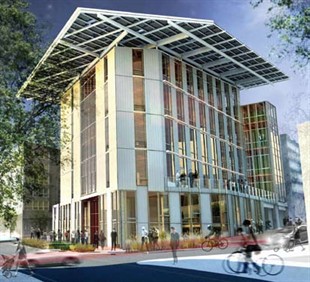
Located in Seattle, the Bullitt Center will be one of the most ambitious green buildings in North America. In addition to providing office and commercial space for leaders in the green building industry, the mixed-use building will serve as the future headquarters of the Bullitt Foundation. Construction on the project is underway with completion anticipated for late summer 2012. Designed by The Miller Hull Partnership, the project will adhere to the guidelines for the Living Building Challenge, which requires that a buildings performance be verified after one year of occupancy.
The Bullitt Center is projected to use 82 percent less energy per square foot than the typical baseline office building in Seattle. “To achieve this level of efficiency, we have made use of geothermal wells that allow us to use the earth as a heat sink in summer and a heat source in winter,” explains Court, project architect. Additionally, all windows will be triple pane and fully automated to optimize natural ventilation strategies. Fully automated exterior shades will track the sun and deploy as needed to virtually eliminate solar heat gain, when its not wanted. Energy use in the building will be monitored on an outlet by outlet basis to better understand and monitor plug loads, and occupancy sensors will all but eliminate phantom loads.
Rainwater collection is designed to provide for 100 percent of the buildings water needs by using a 50,000-gallon cistern located in the basement and carbon filters and UV light disinfection that will treat all water to potable standards. “Codes in Washington currently do not allow drinking rainwater in commercial buildings, but the building is designed for the day when this proven method of chemical-free water treatment will be acceptable,” Court says.
All waste will be treated on site, with composting units in the basement that will treat all solid waste and a constructed wetland on the roof that will treat all grey water.
Photovoltaic panels on the roof will provide 100 percent of the building’s annual energy requirements. “We are using metal siding on the project due to its inherent durability, low maintenance and recyclability,” explains Court. “Aluminum is being used for the buildings’ curtainwall, photovoltaic array racking system and exterior solar controls due to its high strength, low weight and recyclability.”
Manitoba Hydro Place, Winnipeg, Manitoba, Canada 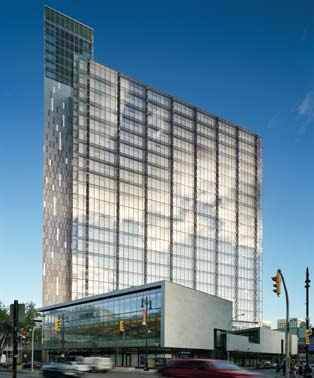
The corporate headquarters for Canadian energy company, Manitoba Hydro, created one of the most energy-efficient large-scale buildings in the world, while establishing a model for cold-climate integrated building design. Targeted for LEED Platinum, the approximately 700,000-square-foot, 22-story high-rise office building provides 100 percent fresh air, 24 hours a day, 365 days a year.
Manitoba Hydro Place consumes only 88 kWh/m2 per year, making it 66 percent more efficient than the Model National Energy Code of Canada for Buildings. It is the only Canadian recipient of the AIA’s 2010 COTE Top Ten Award.
Kuwabara Payne McKenna Blumberg Architects, Toronto, was the design architect, along with Smith Carter Architects and Engineers, Winnipeg, the architect of record, and Prairie Architects Inc., Winnipeg, the advocate architect. Transsolar, Stuttgart, Germany, was the energy and climate engineer for the project.
Forming a capital ‘A’, the building is composed of two 18-story twin office towers that rest on a stepped, three-story, street-scaled podium. The towers converge at the north and splay open to the south for maximum exposure to the abundant sunlight and southerly winds unique to Winnipeg’s climate.
The building features three distinct facades- an ashlar masonry rainscreen cladding in both limestone and black granite, a triple-glazed high performance unitized curtainwall and a thicker double façade located on the east and west façades, explains John Peterson, associate at KPMB. “Thermal performance was key to the selection of all three of these types of facades, but it was the nature of the double façade as an activator for the natural ventilation that really was the origin for its inclusion on the project.”
The east and west double façades are comprised of an exterior double-glazed high-performance curtainwall with automated vents at 27-foot intervals, an interior single-glazed storefront glazing system with manually operated hopper vents, a thermally active concrete slab and automated louver shades, Peterson explains. “The cavity created by the two glazed assemblies spans the length of each façade, but does not connect between floors as do conventional European double facades.”
The exterior automated vents are tied to the building’s systems management system and weather stations on the podium and tower roofs, and are programmed to open when exterior temperatures exceed 41 F. The louver shades are also tied to the management system and are programmed to optimize light penetration while blocking heat gain into the office space. This heat is trapped within the double façade cavity and is vented out naturally through the exterior vents. “The thermally active slab is used to prevent the façade cavity from dropping below 41 F in winter while also offering the potential of gathering heat in the summer and storing it in the geothermal field below the building,” says Peterson. “Each season has its own operational scenarios for these elements, with the ultimate goal being to allow occupants access to natural ventilation for a greater amount of the year.”
The facades have the potential to become active participants in the building’s ventilation, Peterson says. “The heat that is captured in the cavity can be used to create a passive thermal buffer between the interior and the harsh extremes of a Winnipeg winter.”
The building’s extensive geothermal field of 280 wells and its use of high-efficiency condensing boilers help to provide the heating and cooling for the building with minimal energy requirements. “Additionally a comprehensive heat recovery system helps to keep heat in the building once it is carried along with the exhaust ventilation air,” Peterson explains. “This recovered heat cycles back up to the atrium air intakes to help preheat the air entering the building.
Path to Net Zero
Kingspan Insulated Panels Inc., Deland, Fla., updated its Path to NetZero tool for the building industry that simulates the process of achieving high-performance and net-zero energy buildings. The revised app includes the addition of two Canadian cities-Calgary and Toronto-giving users a choice of six cities. The original version of the app included Baltimore, Boston, Minneapolis and Anchorage. In addition to a city, users select a building type-school, office or warehouse- and a baseline building-EIFS, split-face block, tilt-up or single skin with batt insulation- designed to ASHRAE 90.1.2004. Users then choose a Kingspan insulated roof and wall system and compare savings. Benchmarks for the tool are aligned with the Department of Energy Commercial Building Initiative and the U.S. Green Building Council LEED 2009/3.0 requirements. The Path to NetZero tool is accessible through interactive mobile applications available on the web, as well as via free apps for the iPad, iPhone, iPod Touch and Android mobile devices.
Visit the Path to NetZero website at www.pathtonetzero.com for more information and to download the free app.
AIA 2030 Commitment Reporting Tool
The American Institute of Architects recently updated its 2030 Commitment Reporting Tool, which helps architecture firms track the predicted energy use of its complete design portfolio. Based on user feedback from firms, the updates include additional building types, additional code equivalents, a clearer distinction between new construction/renovations and interiors work, along with a mixed-use calculator.
The Excel-based reporting tool requires the user to enter project use type from a drop down menu, gross square footage, a few yes/no questions and predicted energy use intensity. Based on that information, for modeled projects the tool automatically calculates the national average site EUI for that project type and the project’s percent reduction from the national average EUI toward meeting the firm’s 2030 goal for the current year, which is currently at 60 percent. For non-modeled projects, users enter in the design standard or code and similarly the sheet calculates the project’s contribution toward the firm’s 2030 commitment.
The Excel tool generates three easy-todecipher graphs that aggregate the individually listed active projects within the Excel sheet. The graphs represent the report that firms forward to the AIA, and show a snapshot of the firm portfolio including the percentage of GSF of active projects meeting the current reduction goal, the percentage of GSF being modeled and percentage of GSF for which the firm will gather actual energy performance.
Firms are asked to track all active design projects for the reporting year, not just ones that are seeking green building certification and the reports developed through the tool are meant to provide a year-to-year look of a firm’s work. Firms of all sizes and building type expertise will use the same tool and report in the same manner.
For more information and to download the reporting tool, visit
www.aia.org/about/ initiatives/AIAB079458