Jobsite rollforming and in-plant rollforming both have a place in the metal construction industry. The right choice depends on the application, panel profile, target customer, available labor, and production volume required.
And to help guide you toward the choice that is right for you, Metal Construction News spoke with Bill Griffin, president of Metal Rollforming Systems, who tells us that it’s not about one method being universally better than the other. Every tool has a job, and certain jobs require specialized tools.
“Ultimately, your customer’s needs will dictate which tool you use to best meet those needs,” Bill says.
When jobsite rollforming makes sense
Jobsite rollforming is most useful when logistics make transporting finished panels difficult or impractical. A common threshold is panel length. A strong case can be made for jobsite rollforming once panels exceed roughly 53 feet, because transportation may require additional permits, flagging, signage, or other oversized-load considerations.
Long panels are one of the clearest applications for onsite forming. Remote projects can also benefit, especially where access is challenging or where delivering finished panels creates additional handling risk. Smaller custom roofing jobs may also be well suited for onsite production because a contractor can remain flexible without investing in the overhead of a full plant operation.
For a residential roofing contractor or small shop, onsite rollforming can be a practical and cost-effective entry point. It allows a company to service customers at a lower facility cost, less inventory, and a smaller operational footprint.
Advantage of in-plant production
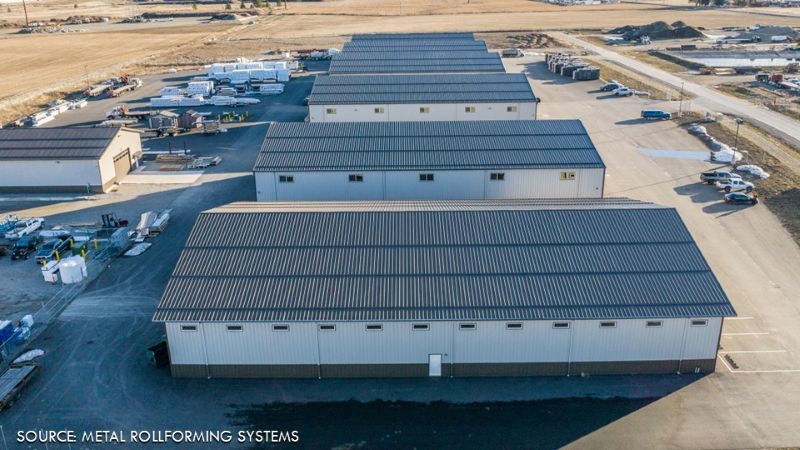
In most higher-volume applications, in-plant rollforming remains the stronger option. A plant environment provides better environmental control, higher production speeds, better access to coil inventory, and more consistent quality control.
The speed difference alone is significant. An in-plant line may run 150 to 200 lineal feet per minute, while an onsite machine may run closer to 30 to 50 lineal feet per minute. That difference affects labor, scheduling, throughput, and the ability to support larger customers.
In many cases, logistics also favor plant production. A delivery truck carrying plant-formed panels can deliver 40,000 pounds or more of finished product. A truck-and-trailer setup for onsite rollforming may be limited to roughly 10,000 pounds of coil and equipment. Once a company begins targeting agricultural, commercial, or other higher-volume markets, the efficiencies of in-plant production become more important.
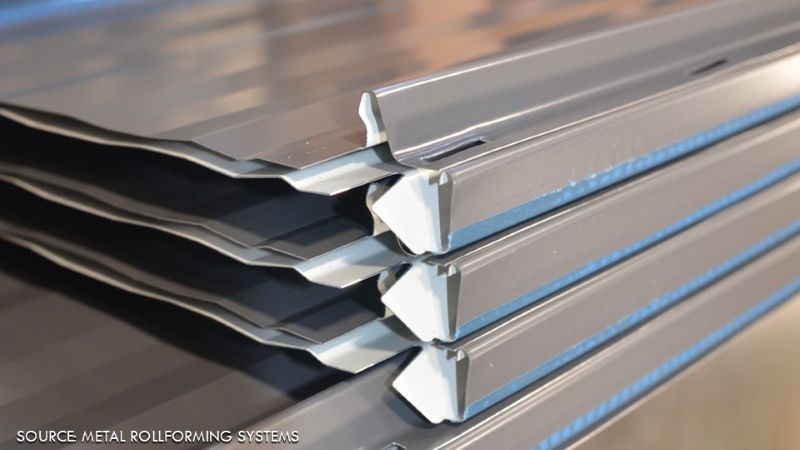
Through-fastened panels, which still represent the bulk of the metal roofing and siding industry, are also better suited to in-plant production. The shop-versus-jobsite comparison is most relevant with concealed-fastener profiles, such as snap-lock and standing seam. Through-fastened profiles are efficient to produce, stack, package, transport, and deliver in volume from a plant.
The growth path from onsite to in-plant
For many companies, the move from onsite rollforming to in-plant production is not a single leap but a phased process. It may start with the desire to form your own trim on a CNC brake, then progress to slitting, and soon you reach the point where you have the space, inventory, customer base, and staff to support the leap.
“That transition point is different for every company, but is usually driven by volume, customer mix, labor efficiency, and the desire to serve broader markets,” Bill notes.
A contractor focused on residential work may operate successfully with a small shop and portable machines. A company pursuing agricultural, commercial, or distribution work will usually need the speed, inventory, and consistency of an in-plant operation.
Transport damage vs. field variability
One of the most common arguments in favor of jobsite rollforming is in-plant product damage during transport, and this is a serious consideration. Finished snap-lock and standing seam panels require careful packaging. Manufacturers should use protective tape or film on vulnerable edges where rubbing can occur, along with bundle crates or other packaging methods to protect the panels during loading, transit, and unloading.
Those precautions do add time and cost, but they are often nominal compared with the overall economics of the job.
Onsite rollforming eliminates some transportation risks but introduces new quality-control challenges.
Field conditions are harder to control than a plant environment. The ground may not be level. The weather may change. Coil handling can be more difficult. Dust, mud, water, and wind can all affect the process.
The field operator may also be under pressure to produce panels while working around other trades and site constraints. Additionally, he may not fully understand machine setup, adjustment, coil handling, and troubleshooting, resulting in poor-quality product.
While not impossible, it is much more difficult to make high-quality product in the field.
Labor and operator skill
Whether a machine is operating in the plant or on a jobsite, it needs a competent operator. This is becoming a larger issue as manufacturers and contractors continue to struggle finding and retaining skilled employees.
The productivity difference between the two methods matters. If an in-plant line can produce several times the output of a portable jobsite machine, the labor efficiency can be substantial. It may not translate perfectly one-to-one, but it does reduce the number of skilled operators required to produce the same amount of material.
With jobsite rollforming, the operator’s job also extends beyond making panels. They may need to haul the machine, transport coil, set up the trailer, stage material, manage site conditions, run the panels, troubleshoot problems, and pack everything back up. In an eight-hour day, the machine’s actual runtime may only be a few hours.
Transportation can also create staffing challenges. Once a truck-and-trailer setup begins hauling meaningful amounts of coil and equipment, the requirements for someone with a commercial driver’s license (CDL) may become an issue.
“That means a contractor may need someone who is not only a competent machine operator, but also properly licensed to transport the equipment and material,” Bill points out.
Weather, equipment life, and machine design
As mentioned earlier, weather can be a challenge for onsite production. Manufacturing cannot always stop because rain moves in, but transporting equipment and coil while exposed to the elements is never ideal. No amount of tarping or weatherproofing can completely eliminate the risk of water penetration. If moisture works its way into coil, it can create paint issues and potential warranty concerns.
Equipment life is another consideration. Portable machines must balance durability, weight, mobility, and setup requirements. They are exposed to road vibration, dirt, weather, and jobsite conditions. In-plant lines can be built heavier, more precise, and more robust because they are not being transported.
Several factors matter for contractors choosing a portable machine, starting with weight and potential CDL requirements. You also want versatility, interchangeable cartridges, notching options, and factory support.
The priorities are somewhat different for in-plant equipment. Most machines sold today are pre-cut rather than older, post-cut technology (which has largely gone by the wayside). Pre-cut is cleaner and much more versatile. For in-plant production, look for pre-cut capability, speed, and future expansion options.
You decide the best tool for the job
“In the end, shop versus jobsite rollforming is not a debate with a single answer. It is about matching the equipment and production model to the customer, market, and work being performed,” Bill advises.
It really hinges on the contractor’s business model. A residential contractor serving smaller custom jobs may be well served by onsite flexibility. A company looking to grow into agricultural, commercial, or higher-volume production will likely need the speed, control, inventory, and consistency of an in-plant operation.
Because both onsite and in-plant rollforming equipment can have a long service life, you’ll be entering into a long-term relationship with whichever manufacturer you choose … so do your homework and choose wisely.