Perhaps previously you didn’t need to stick your neck out to keep your head above water. In years past, there was plenty of work to go around-maybe not “easy money” but pretty straight forward. And you and your crew got to be downright experts at building standard straight walls and buildings. Besides, building all that crazy, wacky, whopper-jawed
(should we also say “neat-looking” stuff?) is so hard … hard to figure, hard to construct, hard to bid and scary hard to make a profit on.
New Curvable Products Provide The Solution
Now, with the full array of curveable framing products, you can tackle those jobs with confidence. Using these new innovations, it is so much easier to build those mega-curved projects that you can submit your bids without feeling like your “shot-in-the-dark” bid is going to ricochet to bite you in the end! Curved tracks are available from several manufacturers and come in special order shapes or as hand-shapeable tracks, such as Flex-C Trac from Oklahoma City-based Flex-Ability Concepts, so you can grab it off the shelf and build any curve you might need. There’s also a version, Flex-C Arch, that bends in the other direction, making it a breeze to frame arches. You can also turn Flex-C Arch on its side and
instantly frame short, 2 1/2 inches to 11 1/2 inches tall, serpentine soffits and light coves with ease. These tracks come in nearly every gauge and width. Flex-C Products now have a Hammer-Lock feature which you can strike with a hammer on concrete and it instantly locks the curve in that shape.
Also, the new, hand-curveable lines make it so much easier to make those curves look just like what the customer wants-beautiful
(or weird, depending on their architectural goal). Regardless, you’ll be able to hold your head high as you hold out your hand for payment!
Covering Your New Curves
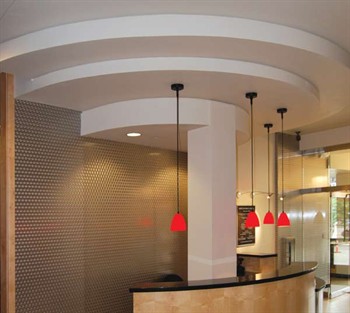
There are countless products with which to cover your curves, but the most common interior finish is gypsum board. Several drywall companies now sell a high-flex version of their gyp board. They are usually 1/4-inch-thick, 4- by 8-foot sheets and cost somewhat more than standard 1/4-inch board. But by using these, you won’t have to wet it anymore unless you’re building very tight, usually less than 30-inch, radius curves. Just use two layers and stagger the joints as you normally would.
Once you’ve firmly grasped these basic curves, you may get the opportunity to really show your stuff and frame some strange, tapered or otherwise incredibly shaped structures. Architects know these curvable framing options are available and are coming up with some amazing designs. If the weird design is conical, then you simply need to make the top and bottom plate curve at their different shapes and add studs. The main hiccup will be the inefficient use of gyp board as you run off the ends of the curved cone with your straight-edged panels.
If your framing structure is curved in both planes, you’ll need to use your curveable track as studs. Once you get it framed, this is where it really gets tricky. You’ll need to either cover it with strips of drywall or metal lath and plaster. But don’t worry, once you set your mind to it, it is still just like building any other structure.
Be Happy and Be Profitable
So, as you step out into the curvy, asymmetrical, unorthodox world of framing curves, do your homework by learning the amazing capabilities of the new hand-curveable products, and revel in your newly improved building talents. After all, why not enjoy what you do for a living, and do it profitably?
A Few Final Tips
Here are several suggestions I make to subcontractors using curvable tracks:
- Don’t skimp on the quantity of studs in curved framing. A closer stud layout assures the gypsum board has the needed support so that it won’t crack or bend unevenly.
- Suppose you need to frame a curve that is too large or difficult to lay out, such as 400-foot radius or an ellipse, we can mail to you a 10-foot-long full-scale printout to use as a template
(nominal fee.) - There are a number of curvable corner beads to follow your curves and give tapers an easy edge to float to.
- Applying decorative trim to the wall can be very easy or very tedious and expensive. Rubber base or flat trims are easily curved. However, a cove or crown trim where the profile view is asymmetrical or leaning out can be a challenge. In these cases, you’ll need to purchase one of the brands of synthetic or wood pre-curved trims. These can be expensive but necessary.
Frank Wheeler is the owner of Oklahoma City-based Flex-Ability Concepts, and inventor of Flex-C Trac. For more information, visit
www.flexabilityconcepts.com.