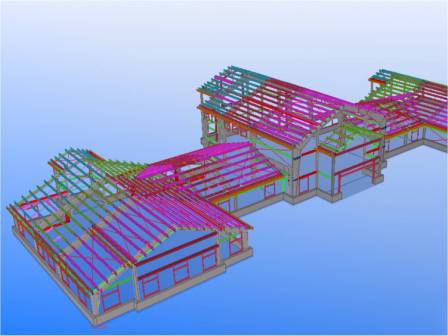
BIM brings increased productivity and lower costs to metal buildings
Construction has become increasingly complex, with tighter schedules and budgets. The use of Building Information Modeling
(BIM) software on-site and in the office helps streamline workflow, maintains more accurate information and keeps construction projects moving forward more predictably.
BIM is one of the newest technologies to hit the construction industry and it is imperative for builders and installers to constantly adapt to the ever-changing technologies that further enhance the erection of metal buildings.
BIM is the process of generating and managing building data and its various components throughout the building’s life cycle by using 3-D, real-time, dynamic building modeling software to increase productivity in building design and construction. Unlike past 3-D innovations in the building industry, BIM is more than a conceptual modeling tool. BIM encompasses building geometry, spatial relationships, geographic information, quantities and properties of building components. When the modeling software is used by manufacturers and principals involved in a building project, the resulting BIM is usable for fabrication. It involves ground-up reality rather than top-down theory.
 |
Digital prototype
The BIM process produces a digital prototype of your project, allowing you to build it virtually before building it in reality. A BIM project is not “drawn” in the traditional sense; rather it’s “built” digitally as a database in BIM software. Instead of having to look at hundreds or thousands of separate drawings, schedules, specs and cut sheets for all the information on a particular element, all the pertinent information is built into the object in the BIM.
Compared to conventional structures, custom engineered steel buildings offer many clear advantages. They incorporate value engineering that includes aesthetics, utility, timeliness, overall cost and many more attributes. By developing each project in BIM, the value of building with metals is enhanced even more.
Owner’s manuals of the future
Building owner’s manuals of the future will go digital with BIM as the most important component. One of the most valuable benefits of BIM technology is the ability to provide a digital owner’s manual rather than thousands of pages of blueprints. The building owner gets a digital copy of the completed project model that can be used for decades of operation and maintenance. Considering that 85 percent of the cost of a building over 30 years is in maintenance and operation, having a digital copy of the completed project that includes all information related to the building eases the task of on-going maintenance.
The digital manuals will have maintenance recommendations, HVAC equipment, lighting, plumbing, security systems and site information. This is why many government agencies require building contractors to use BIM for public construction. This information can effectively be stored on a computer, tablet or external hard drive, saving untold trees in the process.
 |
Why use BIM?
Virtually all Eufaula, Ala.-based American Buildings Co. (ABC) projects are detailed in BIM. ABC is pairing its proven track record of quality and service with the future of 3-D modeling to give builders, general contractors, engineers and architects an edge over competitors in the market. Providing customers with a modeling system that can display an exact replica of their building leads to confidence and peace of mind for the life cycle of the project.
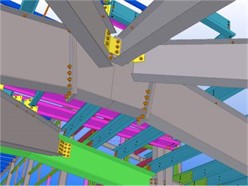
The benefits of BIM to builders are considerable. During the pre-construction phase it allows for a quick way to determine cost and schedule feasibility with various configurations to find the best value. The quality of the design is greatly improved and the visualization aspect allows key decisions to be made earlier in the process. As the model incorporates all of the trades, it compels early coordination that detects clashes of the various systems that can save up to 10 percent of the construction cost due to reduced changes in the field.
BIM is the choice of leading builders, architects, fabricators, erectors, engineers, designers, manufacturers and owners because it leads to increased productivity, provides comprehensive life cycle management and enables communication across project team members, which can significantly reduce change order costs.
Wes Brooker is the marketing manager at American Buildings Co., Eufaula, Ala. To learn more, go to www.americanbuildings.com.