My company erects pre-engineered buildings. Internally, we focus on erecting quality buildings and developing quality teams. Apprenticeship is the tool we use to ensure we achieve both goals. Those of you wno know me, or have heard me speak, know I am the self-proclaimed guru of apprenticeship. Why should you care about apprenticeship? What’s in it for you?
If you are an employee, you gain a recognized, transferable skill. You have a career path and are not just a construction worker. You probably also have better job security and safer work conditions.
If you are the erector (also known as the sponsor of the apprenticeship program), you have a stable workforce, “plug-and-play” training, a competitive advantage and are able to differentiate yourself from competition based on your qualifications, certifications and training.
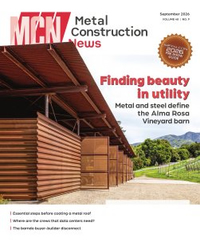
The third leg of the stool is the manufacturer/ supplier, and this is where it really gets exciting. Today’s building manufacturers and suppliers are doing incredible things. Glance through this magazine and all you see is cutting-edge use of materials and techniques. Obviously, the green revolution is driving some of this, but overall there is true innovation, including continuous development of new and better systems, methods, materials, etc.
So what does this have to do with apprenticeship?
Apprenticeship provides the assurance that your buildings are going up properly and that erectors are trained to your standards. More importantly, it provides opportunities for speaking, demonstrations and training. Erectors focused on training and development are constantly seeking tools to assist with their training and development. And frankly we look to you to not only provide these tools but also to ensure we are keeping up with all the new developments and techniques.
This past January, I had the distinct honor of speaking before a National Erectors Advisory Council organized by the Houston-based NCI Group. NCI had invited representatives from more than 25 companies to meet with their people to discuss meaty topics such as optimization of installations, improved deliveries, etc. What an incredible opportunity for the erector and the engineer to brainstorm. Modest design improvements can and will have economies for the erector as well as the manufacturer. This was a definite win-win for all involved.
I submit the companies that are capable of contributing at this level. Whether they realize it or not, whether they have formalized it or not, they are practicing the ideals of apprenticeship. They are finely tuned to the ideals of continuous improvement, efficiency, safety and training.
The local chapters of the Metal Building Contractors & Erectors Association (MBCEA) provide a similar forum. Art Hance, Hance Construction, Washington, N.J., is the president of our chapter, the Mid-Atlantic Division (MAD). His immediate goals are to strengthen the chapter’s financial position to ensure long-term subsidized training for members; develop strategic partnerships with other organizations in order to expand training opportunities; and to promote the goals of MBCEA.
Hance’s long-term involvement with Butler Manufacturing and current position on the Butler Advisory Council provides a valuable link between us erectors and the manufacturers of the buildings we erect. My company works very closely with Hance’s team to identify ways we can better order buildings, improve shipping and delivery, clarify drawings and streamline the erection process so that we are all more efficient and safe at our work. By taking this information back to the manufacturers we all benefit-manufacturer, general contractor and erector, but most importantly, the owner!
Last year, I presented the MBI Apprenticeship Program to the Metal Building Manufacturers Association (MBMA). Part of that discussion centered on the role of “The Quality and Craftsmanship DVD Training Series” (soon to be available online). Developed by the Metal Buildings Institute for the MBCEA, this series is widely considered the premier training tool for industry. These 12 modules offer a tremendous opportunity for any company interested in educating their workforce, but I would like to see 10 more modules, including modules dedicated to some of the new roofing and siding applications, new materials, new fasteners, etc. This is a tremendous opportunity for the manufacturers to partner with the MBI to further develop the series or to provide independent modules on their own.
At the end of the day, a trained workforce benefits everyone. It is never too late to learn something new. So what about it-got any training tools you want to share with the Metal Buildings Institute, the educational arm of the Metal Building Contractors and Erectors Association?
Gary T. Smith is president of Thomas Phoenix International Inc., Eastampton, N.J. He serves as chairman of the Apprenticeship Committee for the Metal Buildings Institute, the educational arm of the Metal Building Contractors and Erectors Association. To learn more, visit MBI at www.metal-buildings-institute.org or call (800) 866-6722.