Building owners and erectors must make many decisions regarding the best course of action for their particular business. As the percentage of metal continues to increase in many commercial, industrial, agricultural and even residential buildings, the choice of the best fastener to use to secure roof and wall cladding is often not at the top of the list.
There may be an assumption that there are strict industry standards to which fastener manufacturers and suppliers adhere, which should make this decision much easier. There are standards which manufacturers adhere to regarding heading, threading, heat treatment and plating. There are ASTM and IFI (Industrial Fastener Institute) performance specifications in terms of strength characteristics, test protocols for wind resistance, seismic design and fire protection for the finished structure. However, the finished fastener product may not always be what it seems.
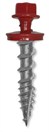
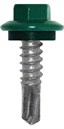
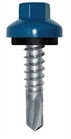
The majority of fasteners used on today’s metal-clad buildings are manufactured from carbon steel wire. After heading, thread-rolling and pointing, the fastener is heat treated to allow it to self-drill and tap into various thicknesses of steel or even wood substrates. A high-quality self-drilling screw will have a point angle and point length that will drill a metal panel and framing member immediately once the power tool is turned on. A self-drilling screw is nothing more than a drill bit on the end of a tapping thread.
Since the properties of carbon steel allow it to develop red rust corrosion if not properly protected, the next operation is to apply either an electro-zinc or mechanical zinc plating to the fastener. The properties of zinc provide protection of the fastener. The thicker the zinc, the more protection there is. Mechanical zinc can be deposited in thicknesses greater than electrozinc and provide more corrosion protection. It also eliminates the potential for hydrogen embrittlement, a result of the heat-treating process that hardens the screw to allow it to self-drill through metal. Since the electro-zinc is thinner, post-treatments have been developed that are applied over it. These can be spray applied to cover the head and washer or in a dip-spin process to cover the entire screw.
To match the building panel color, a wetpaint or powder-coat paint system is applied to the fastener. Powder coating provides a hard shell barrier coating and provides more corrosion resistance than wet-paint. A bonded washer or cupped head with an EPDM rubber washer will provide maximum leak prevention if installed to a proper depth.
A quality power tool and clean socket is critical to a successful installation. A priority should be given to the RPM speed and the clutching mechanism within the tool, and a depth sensing nosepiece. Impact drivers have a detrimental effect on fastener paint and plating. They also can affect the structural integrity of the installation by stripping the fastener from the substrate.
In a perfect world, with the ever-improving technology in coatings and paint systems for metal panels, 304 Stainless Steel would be used to prevent all fastener corrosion potential. However, this material is more expensive than carbon steel and cannot be heat-treated to selfdrill through metal (although the technology is advancing so that someday this will be a feasible alternative. SEALTITE is introducing a 304 SS metal to wood self-drilling screw in the fourth quarter of 2012). Present alternatives include a ZAMAC 5 zinc-aluminum alloy molded head and 304 Stainless Steel caps assembled to a carbon steel screw. Both provide long-life protection of the head and washer to equal that of the painted metal panel, although the screw shank is still carbon steel.
At a minimum, a building owner should begin his research with pairing his metal panel warranty with the fastener that is supplied with it. If the fastener does not carry a warranty equal to the panel warranty, he should demand that from his metal or fastener supplier. In summary, while research on the proper fastener to use on a project may be down on the priority list, a fastener failure will catapult its importance quickly to the top. Demand a fastener that performs and provides protection for the life of the building.
David Quehl is the marketing manager, and
Tom Hulsey is the director of technical services at Tyler, Texas-based SEALTITE Building Fasteners. To learn more go to www.sealtite.com.