It's been said that if a metal roof is perfectly installed, there is no need for sealants. Perhaps therein lies some truth, but perfection is elusive, especially under field conditions. All roofs will leak at some point, but metal roofs are particularly challenging. Metal has a high coefficient of expansion, so it moves more extensively with temperature swings. To complicate matters further, metal roofs feature flashings and other details that also move along different directions. Further, sometimes mechanical seamers do not work correctly. They can get out of adjustment, causing as many as half the seams on a finished roof to be deficient. The result: avenues for water. Fortunately, there are products that can remedy the situation effectively.
Sealants and tapes are effective for repairing metal roofs leaks

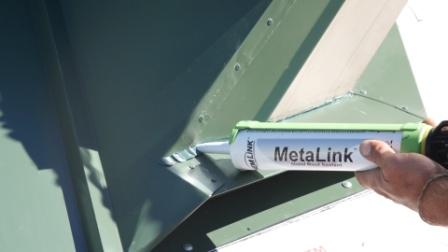
Two classes of products are designed for repairing metal roof leaks: sealants and tape. Sealants are ideal for the gaps formed by mechanical fastener heads and other penetrations. Most metal roofs have fasteners and, over time, these will back out from expansion/contraction cycles. Missing heads, loose heads, heads with the washer gone are typical. The correct approach to repairing these leaks is to remove the screws, put in a new washer and fastener, and then dab a high-quality sealant over each head.
Sealants and Tapes
For metal roofs, a high-solids polyether or silicone sealant is best. Many of these are pigmented to match popular roof colors so they blend in and form a solid seal. Both of these polymer types have excellent adhesion to metal, including coated metal such as Kynar 500 PVDF, and both are ultraviolet (UV) stable and have excellent weathering and physical properties. Silicone is a little bit better in high temperature zones, especially if a dark, UV-absorbing color is involved.
Roof tapes are also highly effective and efficient to use in repair situations. On a lower slope metal roof, like a 4:1 pitch typically found on large commercial warehouses, leaks form along seams and gaps. A high-quality, watertight roof tape with 30-mil thickness can be easily installed with one worker holding the edge of a 50-foot roll of 4- or 6-inch tape, and another worker walking the roll along the seam or gap, pulling off the backing as the tape is applied.
For this application, the tape should have a polyester scrim for the best flexibility, so it can go over a lot of different shapes and even make 180-degree turns. Proper preparation is critical. The area to be taped should be mechanically brushed to remove dirt and oil residue from the atmosphere. A cleaner such as rubbing alcohol should then be applied to remove post-brushing residue. Once the tape is in place, it should be set with a roller. The pressure activates the adhesive in the tape. The final quality control step is to examine the outside edges to ensure there are no voids or loose spots. This type of roof tape requires a coating.
Gutters and Water
Tape is also ideal for repairing gutters, in joints, corners and places where the gutter has not been cut the precise length and the joint is too big. The key first step is to thoroughly clean the gutter since this is a sink for all the dirt and grime that comes off the roof. The procedure is the same, but a different type of tape is better suited here. Whereas the more flexible roof tape is designed for laps and seams, a thicker tape with a coating is better for the gutter. This is because it eliminates the hassle of having to apply a coating to the tape after it has been installed in the confined area of the gutter.
Another situation for big commercial roofs is ponding water caused by heavy equipment. In warmer climates such as Texas and across the South, there is a lot of air conditioning (AC) equipment. Weight and vibration cause problems. AC units have condensate lines that are supposed to run to the gutter or drain. They can leak, clog or even get disconnected, thus ponding water.
Roof tapes can be painted over to match roof color. Some contractors are going to more expensive coatings, such as two-part urethanes, which are applied over the tape. Some are coating the entire roof to form a monolithic continuous seal offering warranties for up to 20 years. Most will give a 15-year warranty on the tape repair and five years on the labor.
Jeff Piotrowicz is product manager at Chem Link Construction & Maintenance Products, Schoolcraft, Mich. To learn more, call (269) 679-4440 (x204), email jpiotrowicz@chemlink.com or visit www.chemlink.com.