When using open web steel joists, pay attention to the joist camber next to adjacent framing and walls
The Steel Joist Institute publishes, in its specifications, a camber table that is a requirement for steel joist manufacturing. This camber table was adopted years ago when steel joists in flat roof systems experienced difficulties due to ponding. The camber table was introduced in the 1953 long-span specification to provide a water-shedding effect toward the column lines and to avoid live load deflection creating a low spot (ponding) in the roof.
For short-span joists up to and including the 1964 catalog, the following paragraph appeared addressing camber: “The requirement and amount of vertical camber, if any, shall be optional with the manufacturer. In no case will joists be manufactured with negative camber.” In 1965, the catalog included the first camber chart for short-spans. Modified in 1973 and again in 2005, the short-span camber commentary remains in effect today in the 2010, 43rd Edition, Section 4.6. In the 2010 DLH specification, with the expansion of the DLH spans to 240 feet, the SJI, Section 103.6, reduced the camber to Span/300 for those joists that exceed 100 feet.
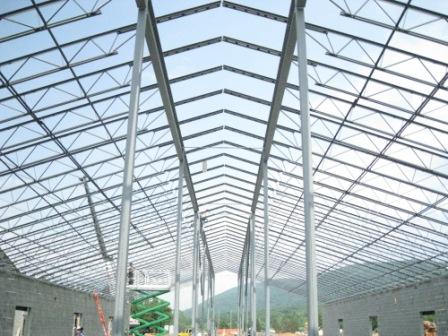 |
The SJI camber is based on an arc radius of 3,627 feet for joists up to a 100-foot span. The specification states: “Joists shall have approximate camber in accordance with the following,” and: “The specifying professional shall give consideration to coordinating joist camber with adjacent framing.” For a 100-foot joist, the required camber is 4 1/4 inches at the center. Depending on the dead load deflection, that may be reduced. However, when erecting steel joists and deck, most of the camber will remain.
If not taken into consideration, the difference in the joist camber with adjacent framing can create situations where the deck spanning from the steel joists to the adjacent framing or wall angle support will be above its desired bearing point. When using long joist extensions, the camber will tend to cause a deflected shape toward the end of the extension. In buildings where joists in longer bays frame up against joists in shorter bays, the difference in the camber can be significant. If the center bay of a building increases from 100 to 240 feet, the camber difference between adjacent joists can be 5 1 /4 inches.
The joist manufacturer has a standard camber built into their rigging tables and specifying special camber requires a change in the camber settings. A few camber changes on a lot of joists are more cost effective than a lot of camber changes on a few joists. While it could be more advantageous to specify special joist camber in certain conditions, it may be better to consider adjusting the adjacent framing in the structure.
Here are a couple of things to consider:
• For extreme roof slopes greater than 1:12, the specifying professional may consider joists with no camber.
• Look at end walls and adjacent framing where situations might require special camber in the joists. The more of those situations you can limit, the better.
• Special profiles, such as bowstring, gable, arch and scissors joists, should never be cambered.
• Never specify negative camber.
• Consider dead load deflection and how that affects the joist camber.
• Never specify standard joists to be cambered for dead load deflection, unless the joists are being used in a composite floor system. CJ series joists require a dead load deflection camber to keep the slab at a consistent depth, and that camber is part of the CJ series design parameter checklist.
• Consider the shape of the roof and make sure the water path is clear and unobstructed. Camber was introduced in steel joists to avoid ponding. Be certain the camber does not create a ponding situation.
• The longer the joists, the more likely you will have a camber issue. Consider joists over 60 feet (1 1/2-inch camber) to be the span where joist camber can become an issue.
It is important to note that the joist manufacturer cannot change the standard joist camber. It is the responsibility of the specifying professional to consider the impact of joist camber on the building structure. If camber situations arise, consult the joist manufacturer for suggestions and make an informed, cost-effective decision.
Carl Pugh is the engineering manager at New Millennium Building Systems in Salem, Va. To learn more, go to www.newmill.com.