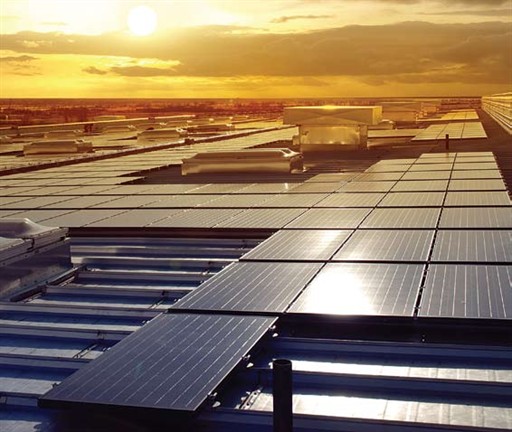
Photovoltaics, or PV, is a solar-powered technology using solar cells to convert sunlight into electrical energy. Building integrated PV systems integrate solar cells into a building envelope, such as a roof or a façade. The PV generates direct current electricity either stored in batteries for future use, or delivered to an inverter that converts it to alternating current that can be used by the building occupants or delivered to the utility grid.
Metal roofs are a good match for solar PV because they are very durable and have lifetimes that meet or exceed the 25- to 30-year expected life of the solar PV system. “Financial incentives at the federal, state and/or local level coupled with high electric rates make solar PV investments attractive for the building owner or solar investor,” says Rob Roche, vice president of business development, United Solar Ovonic LLC, Auburn Hills, Mich. “Solar investors seeking an attractive [return on investment] will fund rooftop solar PV projects and sell the electricity produced to the building owner at an attractive rate over 15 to 20 years typically in what’s known as a power purchase agreement, or PPA. The owner wins by enjoying predictable lower energy costs. The investor wins by earning a reasonable return on their investment. And of course the zero-emissions energy over the operating life reduces greenhouse gases and pollution.”
In terms of metal construction, PV produces clean electricity on the most reliable, economical, trouble-free and sustainable roof platform available to any building owner. In terms of construction, PV is geared around building performance. “There are numerous advantages to PV on metal. The electricity is produced at the source of load, reducing transmission costs,” says Robert Kiessling, general manager, Metanna LLC, South Bend, Ind. “PV on metal reduces the ownership cost of the PV system because of decreased roof maintenance when compared to PV on a conventional roof. PV on metal can be designed to cool the building or transfer the thermal energy to solar thermal energy production.”
Crystalline versus laminate
Two types of PV systems can be placed onto a metal roof: glass-framed crystalline arrays and flexible thin film laminates. These two technologies offer different advantages depending on the application. “For uneven surfaces like a corrugated metal roof, PV arrays made of crystalline silicone in metal frames are mounted to the roof,” says Alan E. Burnett, PE, associate, Gale Associates Inc., Mountain View, Calif. “The frames need watertight connections to the roof and need to resist loading exerted on a roof by the arrays, such as wind. It is important that these PV systems do not comprise the watertightness of the roofs and obstruct drainage.
“For smooth-surfaced metal roofs-e.g., standing seam metal roofs-the PVs are typically PV laminates made of a thin film of amorphous silicon deposited onto a metal foil. The PV laminate adheres directly to the metal roof surface and are manufactured to fit between the standing seams. Wiring is embedded in the PV laminate back sides.”
Array location is sometimes a determining factor when choosing which PV system to use. “Thin film encapsulated in glass is seen mostly in ground-mounted applications,” says Rob Haddock, director,
Metal Roof Advisory Group Ltd., Colorado Springs, Colo. “But often because of the weight of two panes of glass, modules are a bit heavy for roof mounting.”
Thin film composites are used for groundmount applications because while they are less efficient, they can also be less expensive, which is important for large solar farms. In rooftop situations, there is always limited space. “You can put a less efficient solar technology up there, but you’re going to run out of space,” says Keith Lipps, vice president of sales and marketing, Metal Roof Innovations Ltd., Colorado Springs. “You want to produce as much energy as you can from that limited amount of space. Because thin film laminate technology is less efficient than crystalline technology, that means on the same amount of space you’re going to produce a lot less power with thin film than you would with crystalline. Since your objective is to produce the most amount of power you can with a space confinement, crystalline is usually the preferred choice on rooftops. On ground-mounted arrays, space is abundant and weight is not an issue, so thin film modules can make a lot of sense.”
Attaching PV onto metal
The attachment method of solar PV to a roof is influenced by the roof itself. When attaching PV onto a conventional, nonmetal commercial roof, the solar panels require a frame, a sacrificial sheet, and penetrations and/or ballast. However, “on a metal roof, the PV products are directly attached to the standing seam with a very reliable, inexpensive attachment device or they are directly adhered to a flat metal surface with the proper finish,” says Kiessling. “The seam type and the panel profile are important application considerations in either technology.”
When compared to conventional flat roof installation, installing PV modules on a metal roof is less expensive, faster and simpler. It requires no penetrations, no ballast and no racking. “Installing photovoltaics on a metal roof is a ‘piece of cake,'” says Haddock. “It’s the other roof types that are challenging. Metal roofs, especially standing seam metal roofs start off with a perfect platform for solar photovoltaics. The standing seam provides a mounting potential that’s waiting to be had. It’s noninvasive to the roof. With our S-5! technology, you don’t have to penetrate the roof and you don’t have to buy extensive mounting systems, which are two things you have to do with other roof types. S-5! is a clamping system that attaches to a roof’s standing seam with unprecedented holding strength and is thoroughly tested for holding strength. So, the attachment can be engineered to resist applied loads for any roof or array. Roof warranties are left in tact; and with a 35-year range service life of crystalline modules, metal is the only commercial roof type that will outlive the PV system.”
Burnett suggests that for optimum PV installation, the following factors must be considered:
• Large, open roof areas are better for PV electricity generation. Cut-up areas and areas congested with penetrations and mechanical units will reduce PV performance.
• Metal roofs with flat areas (standing seams) provide a better substrate than corrugated metal roofs.
• For steep slope roofs, the roof plane should have a roof slope to optimize PV electrical generation. Roofs with southern exposure receive more sunlight and will produce more electrical power.
• For PV arrays connected to the roof, the roof structure will need to resist the additional loads induced by the new PV system. Framing modifications may be needed.
• To keep the building occupants and contents watertight, the new PV system should not comprise the main purpose of a roof.
The use of combining photovoltaic arrays with standing seam metal roofing is growing. “Solar was a bright spot in the U.S. economy during 2010 as the fastest growing energy sector, in part due to the fact that PV module prices in the soft market seen in 2009 continue to decrease significantly,” says Jerry Heininger, environmental products coordinator, Englert Inc., Perth Amboy, N.J. “The U.S. share of the global PV market is set to increase from 5 percent in 2010 to 14 percent in 2015. And according to Solarbuzz, the U.S. will be the fastest growing major country market over the period 2010-2015.”