Insulating metal building systems poses several challenges. Over the years, the use of reflective insulation has continued to increase, as more people recognize and understand its value in metal building systems.
An effective insulation system must reduce heat transfer and minimize energy usage and costs. It should also prevent interior condensation and provide thermal breaks. The insulation must be durable, capable of withstanding years of exposure, and maintain its performance and physical properties over time. Finally, the insulation system must be efficient, affordable, cost-effective, and easy to install.
Metal buildings are, by nature, very thermally inefficient. A natural property of metal is its high thermal conductivity. This means that virtually all heat energy received by metal is efficiently transferred with almost no thermal resistance. As a result, maintaining desired temperatures in metal buildings is typically difficult, ongoing, and expensive.
Reducing summer interior heat gain is especially challenging. The sun’s rays can bring the metal exterior to extremely high temperatures. As a result, the metal cladding essentially becomes a radiator, delivering this heat to the inside of the building. Without proper thermal insulation, a metal building’s interior can easily become hotter than the outside air in the summer. Controlling heat loss in cold seasons is equally challenging.
Controlling heat gain and loss
Reflective insulation offers the best defense against the radiant heat transfer that commonly occurs in metal building systems. The key is the aluminized surfaces, which provide a thermal reflectivity of 95-96 percent. This high reflectivity (and low emissivity) results in a surface that interrupts and redirects the flow of radiating heat energy.
In metal building systems, most of the heat gain/loss is the result of radiant heat transfer. Traditional fiber/mass insulation reduces heat transfer via conduction and convection but has almost no effect on radiant transfer. Reflective insulation is, by far, the most effective defense against radiant heat gain and loss in metal buildings.
Preventing interior condensation
A secondary benefit of this thermal performance is reduced interior condensation. In metal buildings, this occurs when water vapor in the air condenses on the ceiling surface. This happens when the air temperature rises until it matches the dew point temperature of the ceiling itself. Since reflective insulation dramatically reduces interior heat gain, the conditions for condensation to form no longer exist.
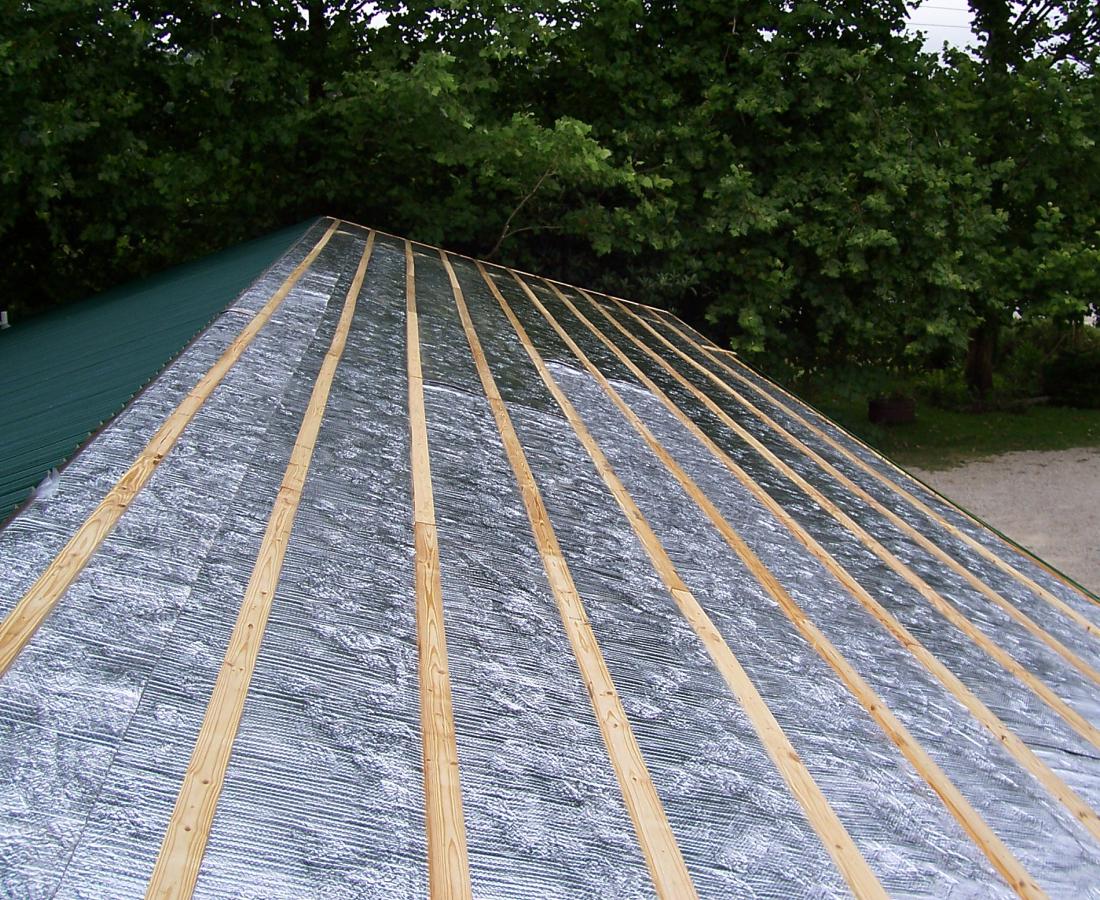
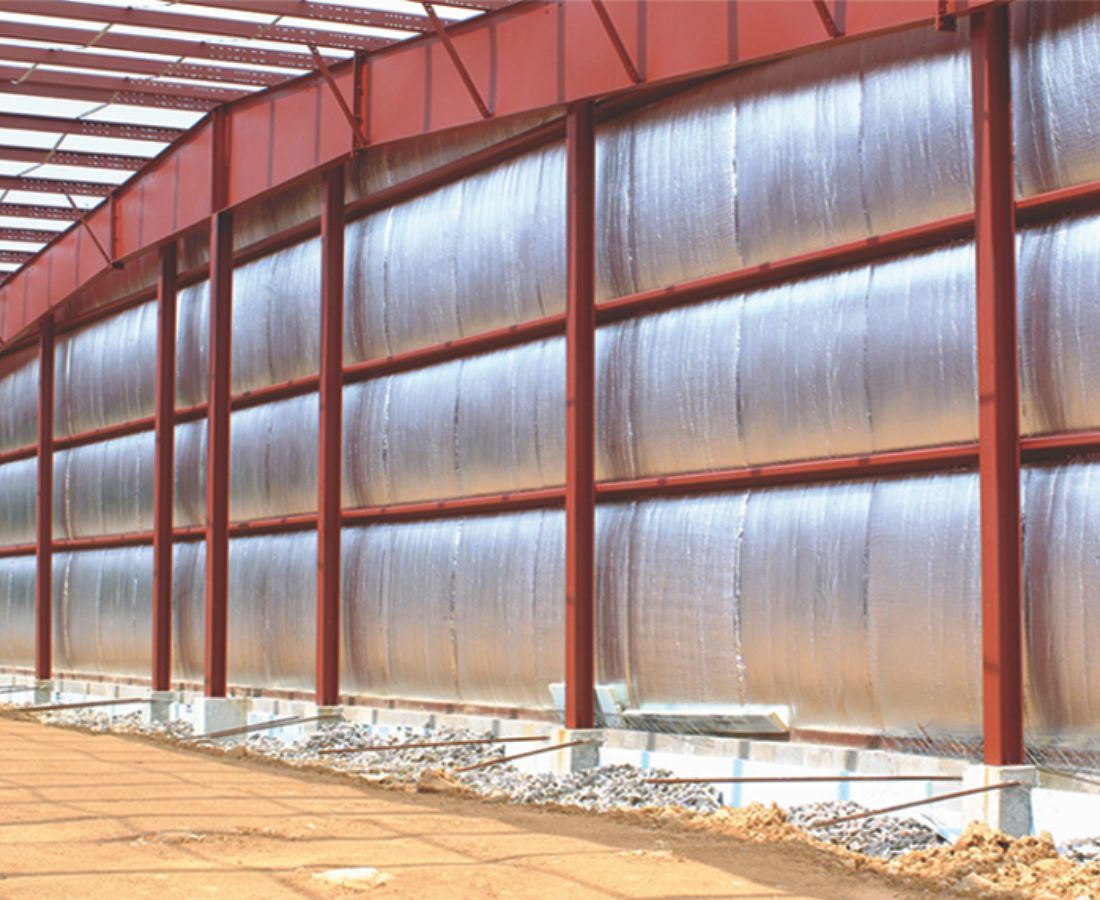
Reflective insulation typically consists of highly reflective aluminized film laminated to a substrate, which provides rigidity, flexibility, strength, and an effective thermal break. Among the most common substrates are single or double layers of high-strength polyethylene bubble film. The reflective surface can be on both sides or with a white-facing material on one side.
Installation of reflective insulation systems:
- Draped over the purlins: When installed with an airspace between the insulation and the exterior metal, insulation with two reflective sides can achieve an R-10. Insulation with one reflective side and one white-facing side can achieve an R-value of 6.
- Attached to the inside of the purlins: This method provides increased thermal performance, due to the larger enclosed airspace between the reflective insulation and the metal exterior. This method also covers the purlins, further reducing the risk of interior condensation. The enclosed airspace between the purlins can also be filled with fiber/mass insulation to meet higher R-value requirements.
To achieve maximum performance, the insulation must always be properly installed according to the manufacturer’s specifications.
Below is an overview of the many reasons reflective insulation is a wise choice for metal building applications:
- Superior thermal performance against radiant heat transfer, the primary mode of heat gain/loss in any metal building system.
- Reduce energy usage and lower heating/cooling costs.
- Prevents interior condensation.
- Lightweight and easy to cut and install.
- Easy to handle, no harmful fibers, and no itch.
- Will not harbor mold or mildew.
- Highly durable and tear-resistant.
- Will not lose thermal performance over time.
- It can be installed over existing fiber insulation to improve thermal performance and enhance interior appearance.
- It can easily be used to retrofit existing metal buildings.
- Bright interior surfaces can reduce lighting requirements up to 35 percent.
- Class 1/A Fire Rating (ASTM E84-09 and ASTM C2599).
- Passes National Fire Protection Association (NFPA) 286 Full Room Burn Test.
- Passes ASTM G-155 (Long-term weatherization/oxidation).
Reflective insulation materials should always be tested under the ASTM 1224, Standard Specifications for Reflective Insulation for Building Applications.
Kelly Myers has 31 years of experience in the reflective insulation and radiant barrier industry, including 19 years managing sales of rFOIL Insulation Products in the United States and Central America. Kelly has vast experience and knowledge of the principles of reflective insulation/radiant barriers, and a keen ability to educate others about the technology, performance, and applications for these products. Kelly has led seminars and presentations to a wide variety of groups, including architects, municipal agencies, code officials, universities, and industry trade conventions. He has written educational materials for the American Institute of Architects (AIA) and has been a certified AIA continuing education instructor. Kelly is a member of several industry associations, including the Reflective Insulation Manufacturers Association (RIMA), where he currently serves as chairman of RIMA’s Verification Committee.