Metal building contractors and others do most of their business constructing new buildings, but often renovations play a significant part in their businesses. Usually, the renovation is a metal roof retrofit, and often that’s because of a failing roof. In the renovation categories—maintenance and repair, improvement and major replacement—roof retrofits fit in the category of either major replacement or maintenance and repair.
Building owners remodel metal buildings for dozens of reasons, and can face unique obstacles when they do

What about the improvement segment, though? Bryan Hargett is director of project management for Paramount Metal Systems, Little Rock, Ark., and he says of this kind of work, “It’s a small part of our business. Five percent, maybe. Ten would be a stretch.” While it is only a portion, Hargett identifies a unique element of this work. “It’s been my experience that the guys tend to appreciate the renovation work. If you’re just giving a building a facelift, they see what it looked like before, and when they finish and back away, they have a sense of pride and ownership. They made it really nice from what it was.”
Renovation Versus New
T.B.T. Construction Services Inc., Columbia Station, Ohio, does considerably more renovation work than Paramount. CEO Jerrod Turner says, “There’s a whole lot of opportunities out there in the renovation market. The renovation is closely related to the new construction work, and for us, it’s helping the customer get more floor space or more usable production area.”
For companies doing both renovation and new construction work, the motivation is the same: help building owners solve problems. It may be to expand operations, or a new tenant may have different needs, but the question at the heart of any renovation is if the solution to the owner’s problems is best solved by renovation or new construction.
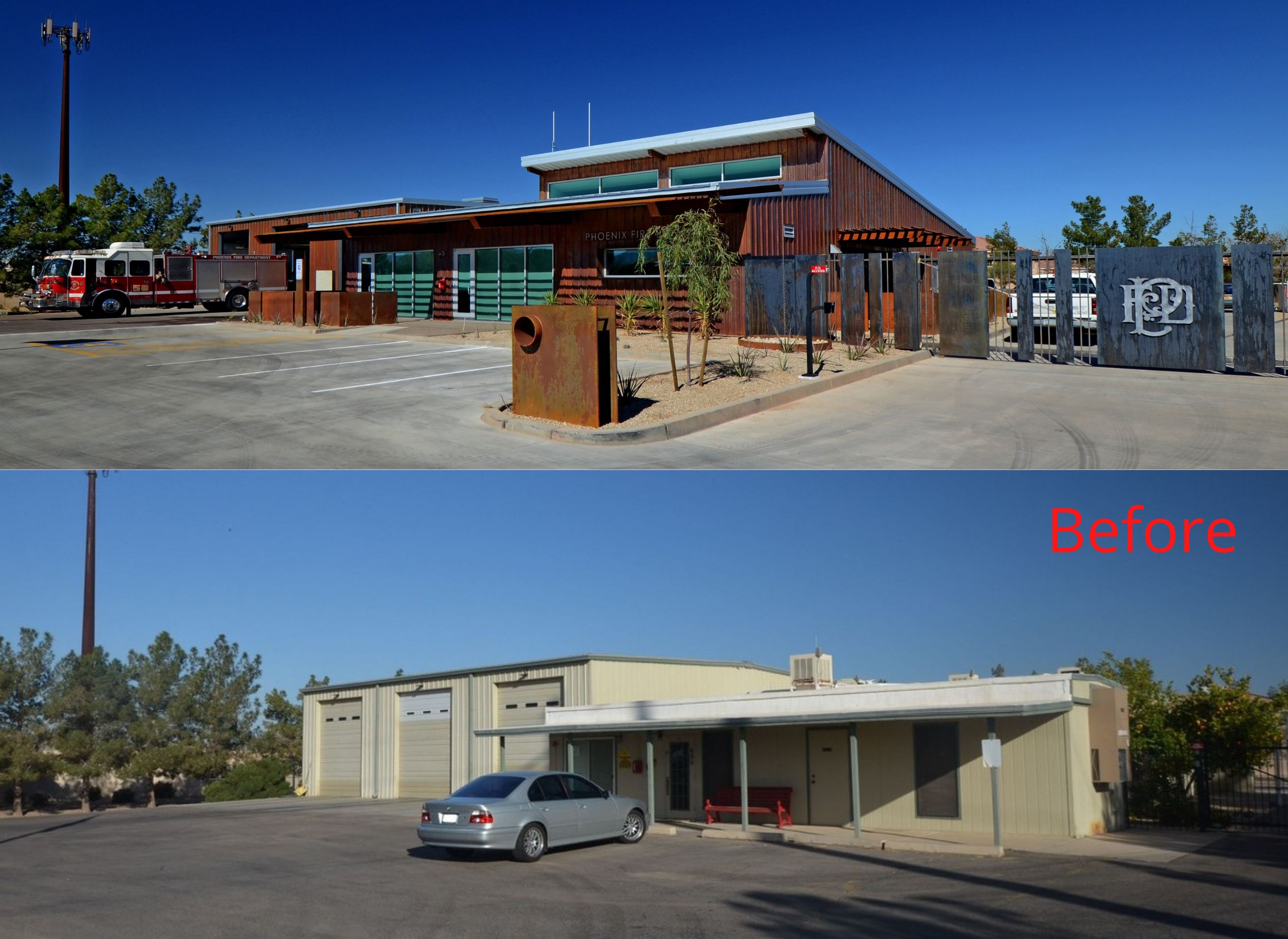
Phoenix Fire Station No. 58
The existing building at Fire Station No. 58 was in considerable disrepair and had reached the end of its useful life. Following a design by LEA Architects, Phoenix, contractors clad the existing bays with metal panels and built an additional building supplied by Bunger Steel, Phoenix.
The wall panels were purlin bearing rib (PBR) metal panels in weathering steel that were supplied by Bunger Steel. The roof was a Galvalume concealed fastener system from MBCI, Houston.
The result is a one-story, three-bay, eight-dorm-room station with a mixture of flat and pitched roofs over a metal frame and skin body that houses an engine, a tanker (tender) and a brush truck.
A limited budget constrained the project and was a leading motivator to use a metal building system because of its cost effectiveness, structural strength and durability, and aesthetic value. Budget issues also drove the need to retain the existing apparatus bays, which were also covered in PBR panels.
The weathering steel panels tie to the agricultural context of the surrounding community and the natural desert environment. Custom architectural details were designed to integrate with the pre-engineered metal building structural system including a weathering steel angle shade trellis and gutter system that defines and protects the south facing entry. The simple gable roof forms inherent to a traditional metal building are offset to create a south facing clerestory that brings natural daylight into the interior of the fire station.
The metal panels used in the project require no future painting or refinishing. The rich earth colored weathering metal wall panels tie the building to the site and offer contrast to the lighter colored Galvalume metal roof. The deep shadow of the metal PBR panels and mechanically seamed roof system introduces both scale and texture to the project.
For Tom Gunsinger, president, Bel-Con Design-Builders Ltd., Belleville, Ontario, Canada, the decision is primarily economic but there are nuances. “Often the decision is owner driven by location and/or budget,” he says. “If the location is important to the client’s business, it may be their best or only option to renovate as other properties may not be available to construct a new facility. Typically, if a client can find an existing building that works for their business then it will have a less initial capital cost and quicker turn around for occupancy than purchasing land, getting approvals and building a new building. The other side of the coin is that a new build will typically have lower energy/operating costs as well as little to no maintenance costs for the first few years.”
Given those conditions and the current economic slowdown, it would seem to make sense that renovation projects may be on the rise over the next few years. Traditionally, during construction downturns, contractors have turned to the renovation market to expand their services and building owners— unwilling to take on greater capital risks—have fueled that need. “I’m not a hundred percent familiar with the real estate market right now,” says Turner, “but I think there will probably be more renovation work than new construction because it’s a lot more cost effective to repurpose or find a way to get more utilization out of your existing facility than to move and put up a whole new building somewhere.”
Building Characteristics Drive Renovation Needs
The simplest, most basic question to ask when considering any renovation is, can the building meet the new requirements? You can’t turn a pumpkin into a gilded carriage and buildings that are in too much disrepair may be better to scrape off and replace than renovate. And buildings that require wholesale repurposing and reconfiguring may need so much investment that it just doesn’t make sense.
“Often renovation occurs at the time the building changes hands,” says Gunsinger. “A new owner has new requirements and needs a new end-use. Or, alternatively, the existing owner is looking for a refresh, expansion or reorganization of their existing facility.”
Reskinning the Simmons Bank Arena
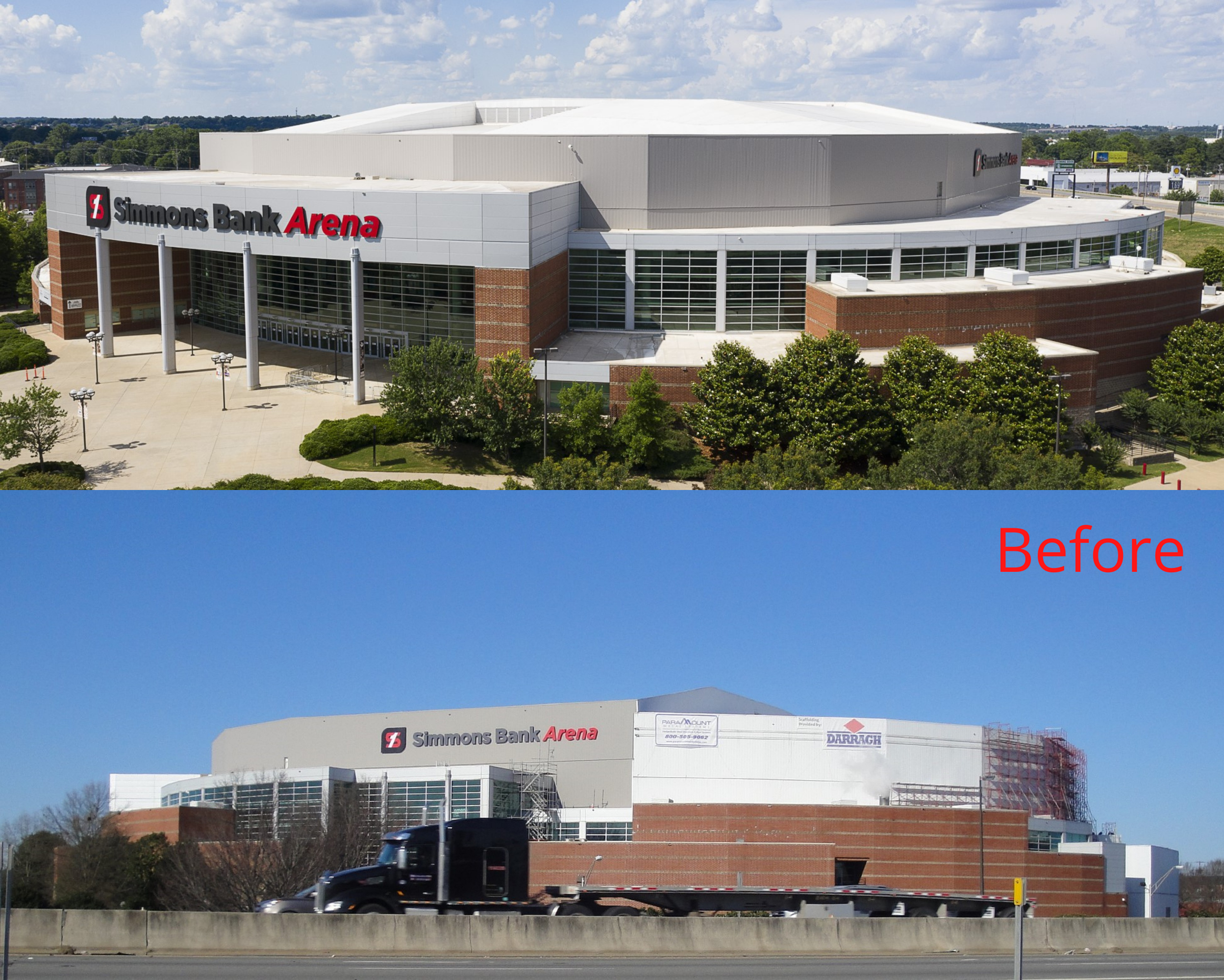
The Simmons Bank Arena, North Little Rock, Ark., was originally completed in October 1999 with a fixed seating capacity of 18,000 and 28,000 square feet of open floor space. Over time, the exterior had deteriorated, and the building had become an eyesore. Time and elements had taken their toll on the white façade, and it needed a facelift.
Paramount Metal Systems took on the project. “We don’t GC a lot of projects,” Bryan Hargett, director of project management for the Little Rock-based company, “but we decided to do this one since it just had really one scope of work in it. It just really went well. I don’t think we had one glitch the whole way, which is unusual for a construction project.”
The majority of work was installing new paneling, leaving the existing panels in place. The only material removed was some insulated metal panels. “It was an area that had numerous signs attached,” Hargett says, “and we changed those out so it would have a nice fresh appearance, background for the signage.”
The work went quickly, and, according to Hargett, went faster than if it had been a new building. “The existing roof gave the crew a platform to hang scaffolding and stage materials. A structural engineer reviewed the loads because the roof-loaded scaffolding and siding materials carried a lot of weight. Had to bring in structural engineer review. Had a lot of weight. Roof loaded scaffolding and siding materials.”
Crews began the work in November 2019 and completed it in the beginning of March. That change was “simply an aesthetic boost for the entire community,” Hargett says.
At Varco Pruden Buildings, Memphis, Tenn., they work with contractors looking to do renovations and support that effort. As retrofit sales manager for VP, Bill Kanke sees a lot of this work. “As a team, we collaborate to evaluate the needs of the project balanced with the condition of the building, along with new state and local codes to provide a renovation solution,” he says.
There are types of projects that contractors tend to see regularly, and they can vary by the company. “Older big-box stores that are being converted into climate-controlled self storage are the most of what we see,” says Paramount’s Hargett. “We also do quite a few mezzanines. For example, the developer wants to turn a Walmart into a storage facility. We put a mezzanine in, do all the red iron, structural studs and put the deck down so they can pour the floor for the mezzanine.”
That’s not all Paramount sees, and T.B.T.’s Turner agrees, saying, “Every project is unique.” Even so, his company gets certain kinds of projects. “A lot of what we’ve been getting into is overhead door resizing, moving and installing walls. A company’s services may be expanding or, on the maintenance side, there’s a lot of damage in these shipping facilities. So, we get in there and do a lot of repair and maintenance and actually fix the steel from where trucks have hit them.”
Turner joins Gunsinger in pointing out that the time of ownership or occupant change is when a lot of renovations happen. “A lot of them are repurposing a building,” he says. “The occupant changes or their needs change. On one project we opened a wall to another building to increase the size and added 54 overhead doors.”
Changing needs can be simple, such as a company needs more warehouse space, but they can be kind of esoteric. Turner recounts the work his company did on a church, which was growing in membership. “The church needed to increase occupancy category of the building, so all the mainframes had to have steel added to reinforce them. We doubled the roof structure and doubled purlins, just to repurpose and reutilize that existing structure.”
Trends
That makeover followed a trend that Gunsinger has identified of “converting spaces to more modern looks, inside and out, but other than that reason the most often reason for these types of renovations is related to repurposing the building. For example, one of our recent projects was to convert a wholesale vehicle parts facility into a new office space.”
In his position, Kanke sees a lot of metal building system renovations. He’s identified three trends among those that have been submitted lately.
Focus on energy efficiency: “The changes in the energy code are driving a need for wall systems with lower U-values to increase the energy efficiency of the building.”
Building flexibility through adaptive re-use to save time and budget: “As community needs change, including those related to health and safety and improving infrastructure, building flexibly is becoming more of the expectation to stay marketplace competitive.”
Modernization and refresh: “The location can be right, but a building may still need a refresh for aesthetics or maintenance reasons. Updates that help increase property values and appeal include new exterior façades, new roofs, a more modern entrance and installing popular design elements. The possibilities are endless.”
Obstacles
In other words, Kanke says there are no restrictions on what kind of renovation can be done to a metal building system. There can be obstacles, though, and they can run the gamut to difficulties upgrading the building to new code requirements, matching profiles on older buildings and meeting other regulations.
Denmar Mechanical/Hamilton-Smith
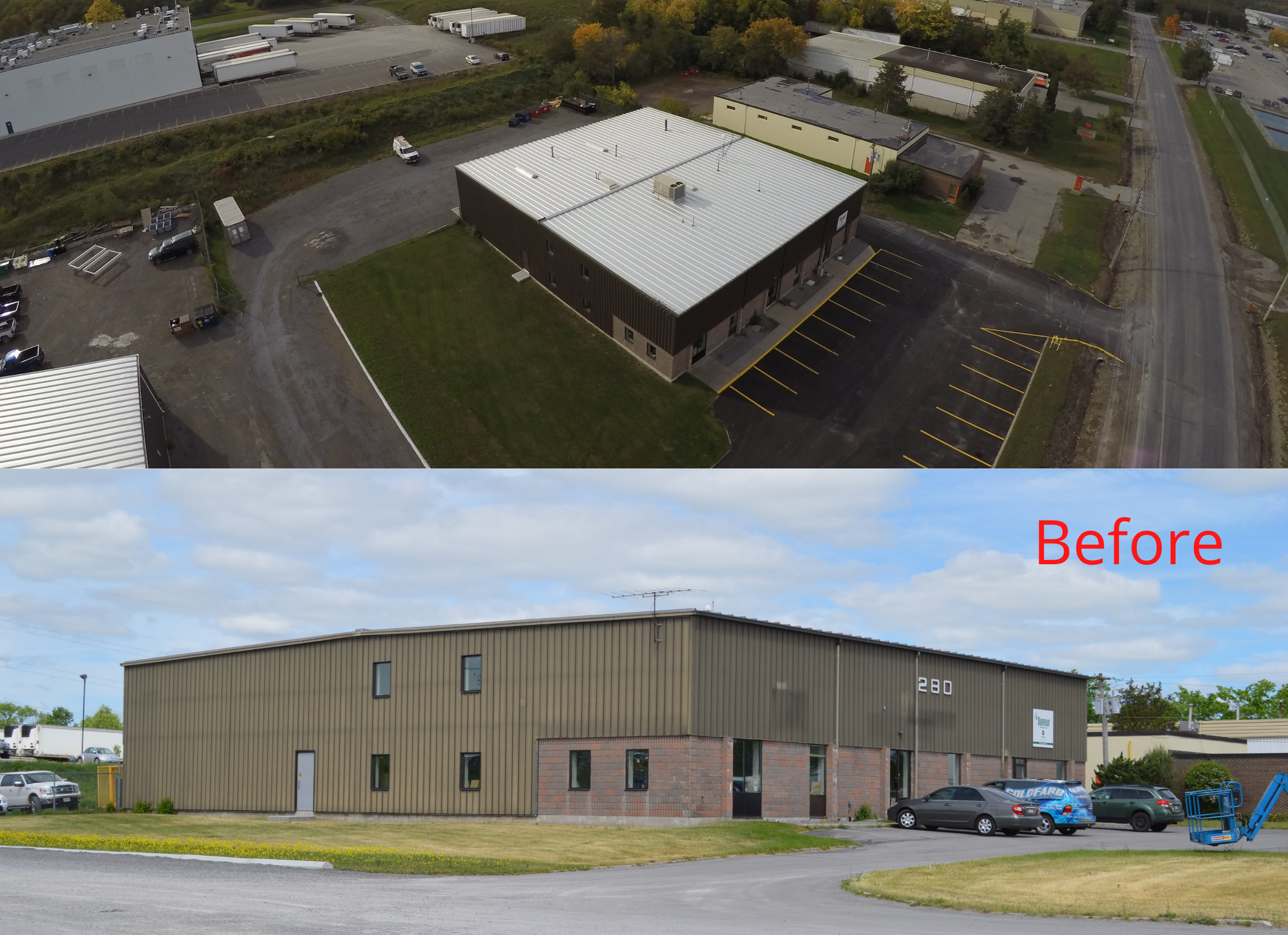
Denmar Mechanical/Hamilton-Smith purchased an early 1980s Butler building to renovate for their new expanded Belleville, Ontario, location as well as incorporating a rental unit. This building had its original roof and siding in place when purchased.
The roof was showing rust and had minor leaks, but the owner decided that this was an opportune time to update the 35-year-old roof and improve the insulation at the same time. Butler’s High-Profile Metal-Over-Metal MR-24 standing seam roof system was utilized, which added 12 inches of fiberglass insulation over the existing roof. The client also decided to add three Butler SunLite Strips to provide natural light into the shop/warehouse area.
The exterior siding was also showing its age and was updated with a high-quality professional paint job that left the siding looking as good as new. The interior office renovations were extensive and included construction of a second-floor private office area behind a main floor open structure office area. The new space also included storage, lunch and training rooms. The main floor front office is very nicely finished with timbers, wood and stone and features a large open balcony.
Of the obstacles, Turner says, “Codes and loads are the biggest thing. The new energy codes and building wind codes and structural snow loading are what you want to think about at the forefront of the project, so you don’t get into all the pricing and find out it’s not a feasible thing to do.
“Updating codes is on a project by project basis. Every one of them is different, but usually you only need to update the new structure to the new codes. A lot of times, the older codes, the energy and insulation stuff can be sort of grandfathered in because of the usage of the building or if it’s just considered a storage building and not a manufacturing building, they have different requirements on the energy side.”
Contractors can turn to their building manufacturers for help in navigating new codes. “When looking at loading and code requirements,” says Kanke, “this can be dependent on the age of the building and whether original design documents are available. Changing load requirements is a primary consideration on any project, but especially when related to a building renovation. We recommend that a local engineer familiar with the respective building codes evaluate the existing structure to see if it can accommodate the new loads. Varco Pruden licensed engineers are always ready to work with local building officials, project architects and local engineers to make sure any project we are partner on complies with all relevant building codes.”
Turner points to a very specific issue related to codes that affects his marketplace of Northern Ohio. “The biggest structural issue I’m always concerned about is snow loading,” he says, “because any time you have a structure that’s going in or near an existing structure and if you have anything above another structure, you have to worry about reinforcing the existing building if your new building is taller than it. It’s always easier to keep your new structure a little lower than the existing one. In most cases, that way you can just design for the imposed snow load from the existing structure to the new structure.”
The consequences of not addressing this issue can be dire. “You have to ensure whatever you’re putting up is going to be safe,” Turner says, “and you’re not going to cause any future structural failures by attaching to the building or putting imposed snow loading on it that it’s not design for.”
A lot of the work Paramount Metal Systems gets is reskinning metal buildings, which has both energy and structural components to it that needs to be addressed during the planning. “If you go to reskin these buildings, if the existing skin is intact, it acts as structural component,” Hargett says. “When you put another layer on top of that, you just increase the strength of the building and you save the owner money in the long run. On a pre-engineered metal building, on an older building we see the heat over the years causes the insulation to stick to the siding, so if you go to remove you tear the insulation, reducing the R-value. In that situation, we recommend reskinning the pre-engineered building.”
To address load issues, Gunsinger says, “One of the most challenging obstacles is finding the original design information for the existing building so that the loads and capabilities are known to allow any structural changes that the owner is looking to achieve.”
But not all the obstacles are related to energy and traditional building codes. One specific aspect of the codes can be troublesome. “Perhaps the most common challenge is making provisions for barrier-free accessibility as required by new codes,” Gunsinger says. “The other requirements we run into that require additional planning and thought are adding floors inside of the existing building shell and improving the energy efficiency of an older building.”
When asked what the obstacles are to completing a successful renovation, Kanke says, “It all depends on what the end-use client wants. Components, such as panel and trim, continue to evolve as new technologies emerge, and panel profiles change over time as well as color selections. Trying to match profiles and colors can be a challenge depending on the age and manufacturer of the existing building; however, with new technology and innovation we can access a variety of seamless solutions.”
Trim Profiles
On the aesthetic side of things, metal building contractors can struggle matching profiles on older buildings. “It’s always a little bit of a challenge to make siding profiles look similar enough when you’re putting an addition on or you’re making repairs to a building,” Turner says. “The metal building industry is kind of unique. There are so many different manufacturers with so many different profiles. Trying to track down where to find siding profiles, if they still exist, can be difficult. There are a lot of extinct profiles that are no longer made and can’t be found anymore. Our bread and butter is Butler Manufacturing buildings so we can usually get those profiles. On some of the really old buildings, it can be hard to identify the manufacturer, but after you’ve been doing it for a while you start to recognize similar patterns in trim profiles that you can get a good guess at what family of buildings it is.”
In instances where it’s difficult to identify the original profile or the original profile is no longer made, Turner has a couple of tricks up his sleeve. “We provide a lot of profiles to the customer,” he says. “Sometimes you demo some existing panels to make it match or potentially reskin the whole thing.”
And sometimes matching profiles doesn’t matter. Turner says, “The owner may not be that concerned with the matching profiles. If it’s not a high-trafficked public area, most of the time the building owner isn’t going to be concerned with matching siding profiles. As long as it’s a similar color or they can repaint the existing building, they’re usually good with it.”