A curtainwall is a vertical enclosure connected to a building’s exterior to protect it.
Originated in medieval times as a defensive structure to protect castles, today they are high-performance systems that keep out rain and wind while helping stabilize the building. Curtainwalls reduce movement and sway caused by wind and seismic movement.
They transfer horizontal loads to the main build for design and aesthetic purposes. Aluminum is relatively lighter than steel and is less susceptible to brittle fractures. Besides glass, other curtainwall infills include stone veneer, metal panels, louvers and operable vents.agummerson_403x269.jpg)
“When glass is used as the curtainwall, a great advantage is that natural light can penetrate deep within the building which is key for the wellbeing of both plants and people,” says Joanne Craft, designer at Ambius in Burnaby, British Columbia, Canada, a design and plant services company for interior business environments.
“Curtainwall and framing can play a role in reducing carbon footprint and play a part in thermal control of a building, especially when interior live plants are part of the design concept. Aluminum in-filled glass will offer an abundance of daylighting whereby plants would thrive and this is where shading, thermal control of a building can assist in reducing carbon footprint. Not only is the curtainwall visually pleasing to the eye, it is a good example of how architectural design works ‘within the space.'” Additionally, curtainwalls can act as a fire stop, slowing or preventing the spread of fire between building floors. Curtainwall systems range from manufacturer’s stock catalog systems to specialized custom walls. Custom walls become cost competitive with standard systems as wall area increases. Curtainwalls can be classified by their method of fabrication and installation.
Stick systems
“Stick” curtainwall systems are shipped in pieces for field-fabrication and/or field assembly. “These systems can be furnished by manufacturers as ‘stock lengths’ to be cut, machined, assembled and sealed in the field, or ‘knocked down’ parts pre-machined in the factory for field assembly and field sealing only,” says Steve Fronek, PE, LEED Green Associate and vice president of technical services, Wausau Window and Wall Systems in Wausau, Wis. “All stick curtainwalls are field-glazed. Typical performance of a stick system is 8 to 10 psf for water resistance test pressure and less than 0.06 cfm per square foot at 6.24 psf for air infiltration.”
“I-beam” walls are similar to stick systems in typical performance. Named for their I- or Hshaped, structural, vertical back members, they are set into openings in the field, with horizontals then clipped to verticals. After glazing, extruded aluminum interior trim is cut and snapped into place at vision areas. Since unexposed spandrel areas receive no interior trim, savings in material and finish (painting or anodizing) can result, partially offset by added field labor. Of course, maintaining vapor retardant continuity at interior trim joints can be challenging if any positive building pressure is present.
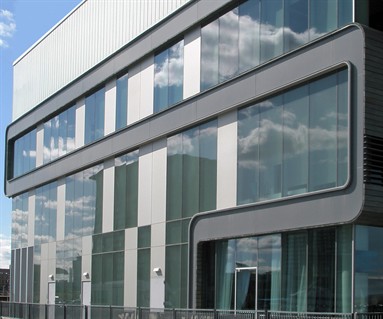
“Many stick curtainwalls are called ‘pressure walls’ because exterior extruded aluminum plates are screw-applied to compress glass infill between interior and exterior bedding gaskets,” Fronek says. “A snap-on cover or ‘beauty cap’ is then used to conceal the pressure plate fasteners at the exterior, with joints accommodating thermal expansion. ‘Compartmentalization’ of each lite is strongly recommended to isolate glazing pockets. Typical pressure wall performance is 10 to 15 psf for water resistance test pressure and less than 0.06 cfm per square foot at 6.24 psf for air infiltration.”
Field-assembled or field-glazed curtainwall performance is only as good as field conditions allow, and limited by variables such as weather, access, and job-site dirt and dust. Many critical seals are necessary, even in systems that are designed to drain or “weep” rain penetration from the system back to the exterior.
Unitize sized
Unitized curtainwalls are assembled and glazed in factories, then shipped to the job site in units that are typically one lite wide by one floor tall. Most unitized curtainwall systems are installed in a sequential manner around each floor level, moving from the bottom to the top of the building.
“Only one unit-to-unit splice-usually a translucent, silicone sheet or patch-needs to be field-sealed,” Fronek says. “Only one anchor per mullion needs to be attached to the face of the floor slab. The units are hung from the floor above on the pre-set anchors. Interlocking, unitized curtainwall frame members are weather-stripped to seal to one another, both horizontally and vertically. This accommodates thermal expansion and contraction, inter-story differential movement, concrete creep, column foreshortening and/or seismic movement. Typical performance of a unitized curtainwall is 12 to 15 psf for water resistance test pressure and less than 0.06 cfm per square foot at 6.24 psf for air infiltration.”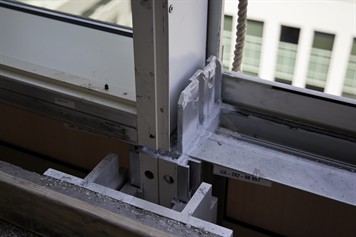
Window wall and storefronts
Window wall curtainwalls span from the top of one floor slab to the underside of the slab above it. Window wall systems employ large, side-stacking window units, contained in head-and-sill receptors, known as “starters,” that accommodate movement and drainage, but still require field-appliedperimeter sealants. Slab edge covers can be fabricated from aluminum extrusions, sheet, panels and even glass.
Window walls easily accept operable windows and unlike curtainwalls, can usually be installed in any sequence. “Storefronts” are non-load-bearing glazed systems that occur on the ground floor, which often include commercial, aluminum entrances. They are installed between floor slabs, or between a floor slab and building structure above it. Storefront systems usually are field fabricated and field glazed, employing exterior glazing stops. Provision for anchorage is made at perimeter conditions.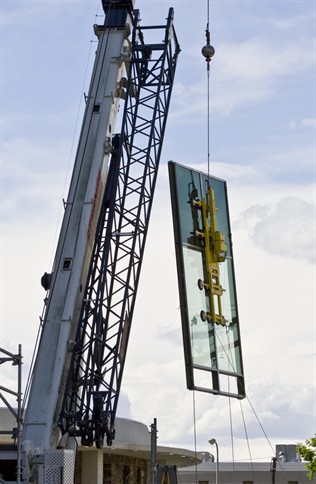
“Sometimes specified as a lower-cost alternative to curtainwall systems for low-rise buildings, performance requirements for storefronts are generally less stringent than curtainwalls,” Fronek says. “Typical performance of a storefront system is 6 to 8 psf for static water resistance test pressure and less than 0.06 cfm per square foot at 1.57psf for air infiltration. Along with generally lower performance requirements, storefront materials also may require more frequent maintenance than curtainwalls due to both its construction and its installation in high-use applications.”
Anchorage and connection
Because of the many diverse combinations of curtainwall loads, tolerances, movements and substrates, curtainwall anchorage must be designed to each individual project’s requirements. However, there are basic anchor types and design principles applicable for various conditions. Curtainwall anchor systems must carry the curtainwall’s dead load weight. The weight is transferred from horizontal framing members to vertical mullions, then down to anchor points, where it is transferred to the building structure. Dead loads also can be picked up at intermediate floor slabs. Dead loads always act vertically, whereas wind loads primarily act normal to the plane of the wall, moving in both inward (i.e. positive) and outward (i.e. negative) directions.
“Curtainwall systems have anchors typically attached to a floor slab,” says Mic Patterson, LEED AP (BD+C), and director of strategic development at the Advanced Technology Studio of Enclos in Los Angeles. “With a steel structure they may be attached to columns or floor beams, but most of the time it is the floor beams. Typically, we are dealing with a reinforced concrete slab, and the anchors are attached to the top or face of the slab, depending on the anchor design. Sometimes that is facilitated by an embed plate, which has to be cast in when the floor slabs are poured. In other cases the anchor assembly is secured to the slab after it has been poured using specialized hardware designed for this purpose.”
In one type of standard anchorage method, double-angle mullion anchors straddle both sides of the vertical mullion and are secured with a through-bolt and pipe spacer. The spacer allows for thermal and side-to-side building movement of mullions, even when anchor bolts are securely tightened. Typically, the double angles are attached to the face of the slab using embedded weld plates, channel-shaped embeds, or expansion bolts drilled into the floor slab. If embeds are used, the curtainwall manufacturer should supply the layout drawings to help avoid excess coordination time and costly errors.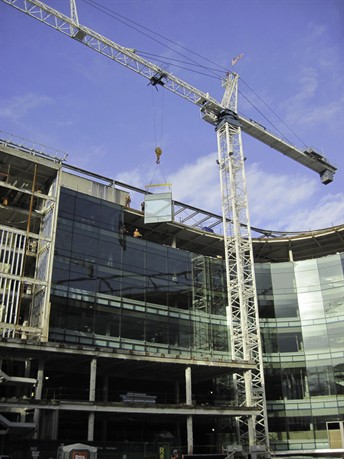
One of the most economical ways to anchor curtainwalls is through using manufacturer specific, custom-designed, three-way adjustable anchors. These anchors allow for in/out, up/down and side-to-side adjustment during installation and feature a jack bolt for fine, vertical adjustment. The jack bolt stops the movement of a saddle plate attached to the side of the mullion, allowing the hoist to unhook and pick another unit while the curtainwall is being set to its final position. This saves field labor by using hoist travel time for concurrent, fine adjustments. Jack bolt anchors can be pre-set to the top-of-slab or the edge-of-slab.
Also, “when planning to field-drill into floor slabs or other concrete structures, consider where the rebar or post-tensioning cables are to be located,” Fronek says. “This requires close coordination between architectural and structural disciplines during design and installation. Since a building will move during the daily temperature and use cycle, care must be taken in the design of the wall and its anchorage to accommodate the full range of movements. The construction process is not one of perfection. If the anchorage cannot accommodate specified building tolerances, time and money is lost. In design, do not expect perfect visual alignment. As an example, a 0.5-inch reveal that varies +/- 0.5 inch would likely look awful, but a 1.5-inch reveal that varies the same +/- 0.5-inch is more visually forgiving.”
SidebarStep-by-step curtainwall installation
1. Unloading and distribution
2. Protection during storage
3. Removal and disposal of packaging
4. Rigging and hoisting
5. Substrate inspection and preparation
6. Anchorage
7. Setting and positional adjustment
8. Glazing
9. Sealing and interface tie-ins
10. Final hardware adjustment
11. Inspection and testing
Sidebar
Curbing curtainwall water leakage
One of the most reliable ways to protect against water leakage through aluminum windows and curtainwalls is to apply the “rainscreen” principle in their design, so that pressure equalization can be provided. Pressure equalization ensures the pressure on both sides of a rainscreen is essentially the same. Because of this, little rainwater will be drawn through the rainscreen by pressure differences.
“Curtainwalls typically have an outer pressure-equalized chamber that is unsealed, allowing some moisture penetration into the chamber,” says Mic Patterson, LEED AP (BD+C), and director of strategic development at the Advanced Technology Studio of Enclos in Los Angeles. “The systems are designed so that this moisture will drain to the exterior, and the pressure equalization prevents pressure differences that could interfere with this drainage. A water and air barrier within the systems creates a dry inner cavity.”
The rainscreen principle is a concept requiring a tight seal at a dry area within the wall system, then pressure equalization from this point outward with that of the outside air. This is done by placing slots or openings in the outer face, and additionally, placing a screen over such openings to prevent the entrance or blockage effect of rainwater.
“Generally, it is relatively easy and routine to design a curtainwall system that will overcome the entrance of water by gravity, surface tension, capillary action and kinetic energy,” says Steve Fronek, P.E., LEED Green Associate and vice president of technical services, Wausau Window and Wall Systems in Wausau, Wis. “Cover plates, battens, splines, internal baffles, drips, a discontinuity or gap in a joint greater than the width of the capillary path, and properly-applied caulking will all help accomplish this. The most damaging types of water infiltration, however, are those caused by wind action, air currents and pressure differences. Air currents that differ over the wall surface can be induced by wind, or by convection within the wall cavity, and can carry water from one area to another. The major force, however, in relation to window leakage is pressure difference.”