Proper electrical grounding increases power quality and decreases potential damage
Thirty years ago, it would have taken an active imagination to believe that there would be a computer at every desk and a cell phone charger in every outlet. With technology booming and our individual electricity intake rising in correlation, it’s no surprise that the electrical grounding system of most buildings should be upgraded accordingly to satisfy our appetite for electricity. With all daily operations relying on power quality and reliability, a secure grounding system is the foundation for the consistency of the electricity throughout the structure.
This power deviation can quietly decrease the life span of a computer and, in extreme cases, compromise the device entirely with one severe deviation (surge).
Often times more important than the physical effect on the equipment, is the loss of productivity resulting from computer equipment failure and downtime. In fact, it has been estimated that the total cost to U.S. businesses of this lost productivity is a staggering $15 billion to $30 billion per year. Many business owners do not calculate the cost of their annual losses due to power quality (or even erroneously attribute power quality glitches to software or hardware causes).
When determining power quality, the average voltage and therefore current flow rarely takes into account the extreme outliers in power fluctuation, i.e., lightning strikes and surges. A single deviation, such as a well-placed lightning strike, is all it would take to cause irrecoverable damage to a poorly grounded facility. On the other hand, a well-grounded facility can avoid this threat by creating paths of least resistance for strong electrical currents to be guided away from the building’s electrical infrastructure.
Broadcast communication towers, data centers, emergency call centers and hospitals are all examples of facilities where power outages simply are not an option and power quality should be a high priority. Constantly providing valuable information and services for countless people, these buildings must have grounding systems that can withstand anything.
“With important structures like these, a failure in the grounding system could prove much more costly than the equipment at stake,” says David Brender, national program manager for the New York Citybased Copper Development Association (CDA).
He adds that it is important for contractors and facility managers to realize that it is necessary to surpass minimum grounding system requirements to ensure the public’s safety and eliminate potential damage.
According to NFPA 780, metal must be 3/16-inch-thick or thicker to take a direct lightning strike and conduct it to a grounding system. Most metal construction will melt through where the lightning makes contact so a metal building or roof area is generally protected in the same way as a non-metallic building.
“Electrical grounding is often overlooked and not tested for extreme cases such as lightning strikes,” says Brender. “Outdated systems must be brought up to code or beyond and maintained before it’s too late. Most facilities meet the bare minimum requirements, but to help ensure protection in extreme cases we recommend that you go above and beyond code minimums.”
“The Motorola R 56 and NFPA 780 standards provide a good foundation for codes regarding communication towers and mandatory lightning protection in facilities, but they still only represent the bare minimum requirements,” adds Brender. “All facilities should evaluate their current electrical grounding systems and improve them to the point where power quality should not be an issue (or, at least, much less of an issue).”
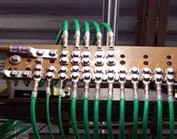
In many cases, simply installing enhanced electrical systems and improving existing grounding systems will go a long way in preventing the problem. Copper is the grounding material of choice because of its inherent conductivity properties and high resistance to corrosion. Copper wiring, radials and phase conductors provide superior protection for any grounding system and are simple to protect during installation.
CDA offers the following steps that may prevent most power quality problems from occurring:
• Use double-size neutral conductors or separate neutrals for each phase.
• Specify a separate, insulated full-size grounding conductor, rather than relying on the conduit alone.
• Use an isolated grounding conductor for sensitive equipment.
• Segregate sensitive loads on separate branch circuits, fed from a separate panel board, fed from separate feeders (and even separate transformers if possible).
• Run a separate branch circuit for every four to six duplex outlets.
• Use an outside copper ground ring and multiple ground rods as part of the grounding electrode to achieve lowest practical resistance to ground. Measure ground resistance.
• Use harmonic-rated circuit breakers, panel boards and transformers.
• Use surge and lightning protection.
• Oversize phase conductors to minimize voltage drop. (This will save energy too, and may even pay for itself through lower I2R losses.)
• Choose materials based on superior connectability. Poor quality connections are a major consideration. This is where all-copper wiring excels over other materials.
• Remember that code minimums can be exceeded, but should not be violated
Ned Brush is an energy efficiency consultant with BBF & Associates, New Harbor, Maine. For more information about copper grounding systems, visit www.copper.org