Many people assume there is little difference between walk door types when discussing their energy efficiency in post-frame or red iron metal buildings. The thinking is that most doors are very similar in construction, gauges, and cores, so there is no need to look at performance or testing results.
But because of energy costs and climate objectives, greater emphasis is now being placed on thermal performance. This makes sense … every building owner or homeowner should be concerned with the insulating properties of the building envelope.
Those who look at each category in finer detail will find ways to source better-performing products—and walk doors are no different.
The starting point would be the door panel itself. Common exterior doors use a styrene core with an R-value ranging from 4 to 6. Better doors will have a poured-in-place polyurethane core; because it is a liquid at the time of application, this core fills all the door cavities and typically more than doubles the R-value to about 12 to 13.
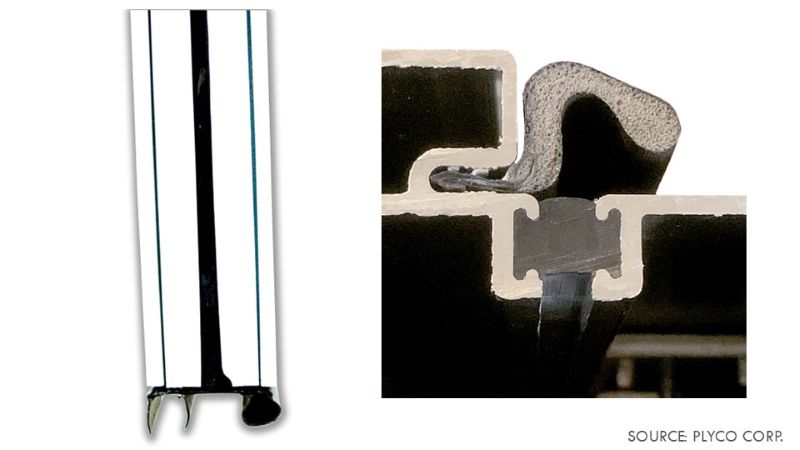
But the core is only part of the story. The weather seal, threshold/sweep, and overall fit in the frame also play a big role in the amount of air or water infiltration. The thermal performance of the complete door system can be evaluated according to ANSI/NFRC 100, which provides a good indication of real-world thermal performance.1 (Make sure your supplier can provide results from third-party tests rather than in-house engineering calculations.)
Knowing the door system’s NFRC 100 U-factor helps you quantify the impact of using high-performance windows and doors. That performance data can be used in the Department of Energy’s REScheck and COMcheck when evaluating residential and commercial building envelopes.
For example, under ASHRAE 90.1, the prescriptive U-factor for walls is 0.050 and 0.68 for doors in Climate Zone 5.2 While there are several other variables to consider, an aluminum thermal-break barrier door system will yield a strong U-factor for a door opening, and possibly reduce the R-value required for the wall around it.
Figuring out the energy efficiency of doors can be a bit complicated. Testing and performance level minimums are a good starting point to ensure basic requirements are met. Meanwhile, advanced door systems—especially those with a thermal break door and frame—will deliver the necessary U-factor for meeting energy efficiency and climate goals.
Tom Granitz is the vice president of sales and marketing at Plyco Corp., a supplier of metal doors, windows, horse stall systems, ventilation products, reflective insulation, fasteners, and closures. Email tgranitz@plyco.com.
Notes
1. ANSI/NFRC 100, Procedure for determining fenestration product U-factors.
2. ASHRAE 90.1, Energy standard for sites and buildings except low-rise residential buildings.