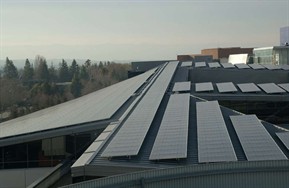
A standing seam metal roof (SSMR) is the most highly favored photovoltaic (PV) mounting platform for both practical and economic reasons. The methods of mounting the array and the longevity of the completed system are factors that enable metal to surpass any other roof type. When looking at a complete system of metal and PV there are a few things to consider to get the most bang for your buck.
When planning a rooftop power generator, choosing the most appropriate PV technology for your roof; maximizing roof space to get the most efficient and affordable layout; and securing it to the roof in a manner that is consistent with the original design of the roof are the factors that will further ensure tremendous cost savings.
The most common PV technologies can be broken into two groups: thin film and crystalline. There are some very distinct advantages and disadvantages each technology offers as they relate to the standing seam metal roof market.
Thin film is commonly perceived as the stuff that sticks on, but this type of flexible thin-film “laminate” is only one category within the spectrum of thin-film alternatives. It is actually only about 2 to 3 percent of the total market. Amorphous silicon (a-Si), cadmium telluride (CdTe) and copper indium gallium selenide (CIGS) all fall within the thin-film category. All three are commonly supplied in a rigid glass module that is mechanically attached to the roof.
One of the benefits within the thin-film category (as compared to crystalline) is that it is more productive in low light, such as early morning, late evening and overcast conditions. Typically the flexible amorphous silicon laminate modules are more commonly used within the metal roofing industry. Due to weight considerations the glass substrate formats are seldom used on roofs. Although currently under bankruptcy protection, a company called UniSolar, Auburn Hills, Mich., dominates the flexible thin-film laminate market. Its product is offered in two sizes: 15 inches by 18 feet or 15 inches by 9 feet. One of the downsides of this technology is if the roof panel length does not coordinate in intervals of 9 feet there can be a tremendous amount of roof space loss, minimizing possible power output.
For example, a 25-foot roof panel length would result in the use of the 18-foot laminate. Since we are only able to use 18 feet of a 25-foot panel, 7 feet per panel is lost. In addition, because these laminates apply to the pan of the roof panel, there may also be space loss due to the roof panel’s width. The above example which further utilizes a 24-inch-wide roof panel would reduce the useable space to only 22.5 square feet (15 inches by 18 feet) of every 50 square feet (2 feet by 25 feet) of each roof panel being used to mount the solar laminate. This equates to a loss of 55 percent of the roof space. On the other hand, if 16-inch roof panels are used and the length of the roof is 19 feet, then the space loss for this laminate would be quite optimal at only 11 percent.
Tangential to the above, maximizing the system output (watts per square foot of available roof space) is important because more often than not the power demand of the occupant is greater than what can be supplied by roof-mounted solar. One should also consider the power output of the system if roof space is limited. This varies with the technology used. Before space loss considerations, a-Si laminate modules produce about 5.5 watts per square feet of laminate as compared to crystalline, which produces about 14 watts per square feet of module area.
Mono- and poly-crystalline are the oldest and by far the most popular PV modules comprising more than 90 percent of the roof-mounted PV market. Module sizes vary but are generally around 3.5 feet by 5.5 feet and consist of crystalline cells beneath a thin layer of glass and supported by a backing and aluminum frame. Because of a rigid frame, they lend themselves to mechanical attachment to the SSMR.
Rooftop space loss can be minimized when utilizing a solar technology that is rigidly attached above the standing seam. Mechanical attachments to a standing seam consist of either using a support rail or directly to the seam, which, in either case, can utilize penetration-free seam clamp technology originated by S-5!.
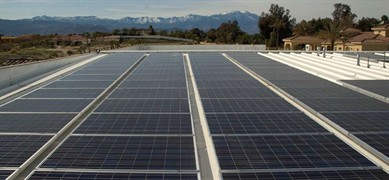
When a PV system is mounted parallel to the roof plane there is virtually no effect on wind effect to the roof. In fact, it may actually be reduced. Additional collateral loads are negligible (2 pounds per square foot to 3.2 pounds per square foot, depending on module weights and the mounting method).
Attaching modules directly to the seam creates the most economical approach as it eliminates the need for an additional rail support. Using this method results in minimal space loss depending on module size and standing seam spacing. While using a rail adds additional cost to the system, it may also help to achieve even better space loss ratios.
Tilting the PV may create greater output per installed watt of power, but it can also result in significant space loss on a SSMR due to shading effects. Also, when tilting a PV array, a new and different airfoil is created, which may introduce loads for which the roof was not engineered. These new wind dynamics result in both positive and negative point loads that will need to be supported by the roof panels and structure. Use of a wind deflector can reduce possible loads caused by wind.
Aside from space loss and wind loading, many tilted PV arrays may also increase snow loads due to drifting.
Although tilted PV arrays were a fairly common practice in the past, you must weigh the cost-benefit ratio to determine the best possible return on investment. Due to the falling cost of PV modules and the increased relative costs associated with tilting an array, the tilting scheme is becoming less and less cost justified. The price of crystalline modules dropped almost 50 percent in the last two quarters of 2011 alone. At such a reduction in cost, many installers are finding they can make up for the loss in module efficiencies by utilizing the available rooftop space to mount more modules in a flush-mount orientation rather than spending premiums on tilting.
Solar technology continues to advance at a rapid rate. In 2012, you will see the advancement of plug-and-play technology, reduction in soft cost and balance of system material and improved codes and standards for PV assemblies being mounted on a rooftop. With constantly advancing technologies and standards, your options for mounting solar on the best rooftop platform will continue to improve.
Rob Haddock is the founder of S-5! and has 35 years in the industry. Starting out as a metal building erector, today Haddock is a well-known metal roof consultant, author, speaker and inventor. For 15 years, Haddock operated one of the nation’s largest metal roofing companies with approximately 10 million square feet of successful installations nationwide. He also serves as director of the Metal Roof Advisory Group Ltd., a consulting firm performing a variety of services for a worldwide clientele.
Dustin Haddock is research and development manager for S-5! and responsible for new product development, product testing and certification.