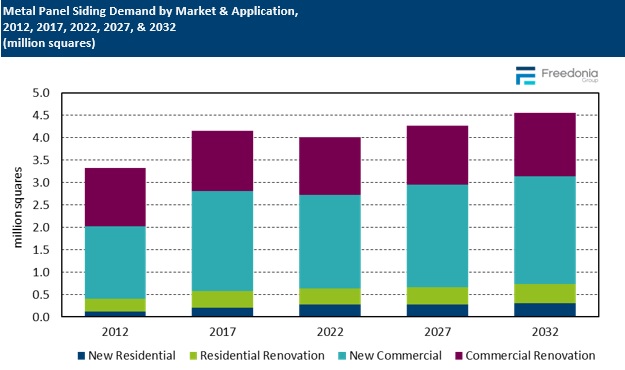
The Freedonia Group’s latest study, “U.S. Siding,” forecasts a steady growth in the demand for commercial siding, with an expected increase of 1.5 percent annually through 2027, reaching a total of 22 million sf (204,386,688 m2).
In the commercial market, performance properties are considerably far more important factors in siding material choice than aesthetics. Materials that are extremely durable and require little maintenance are particularly popular in the market, often carrying a higher-than-average price per square foot.
Metal panels, brick, and concrete will hold the largest shares of commercial siding demand, together accounting for 83 percent of the market in 2027.
- Metal panel siding is commonly used on prefabricated commercial buildings because it reduces construction times and labor costs, offers long-term durability, and requires minimal maintenance.
- In addition to its durability, brick is used for commercial buildings that require pleasing aesthetics to attract customers.
- Concrete is popular because of its extreme durability.
Siding materials expected to remain popular in the commercial siding market include:
- Stucco, as it offers Southwestern- or European-style aesthetics.
- Fiber cement, which is generally popular with consumers for its durability, is used not infrequently on commercial buildings when attractiveness is important.
Small volume materials such as exterior insulation and finish systems (EIFS) and polypropylene are expected to see above average gains:
- Rising public awareness of the insulative properties of EIFS is precipitating greater use on commercial buildings, where it can boost energy efficiency.
- Polypropylene has notable damage resistance, making it attractive for use on commercial buildings that are located in areas with extreme weather.